
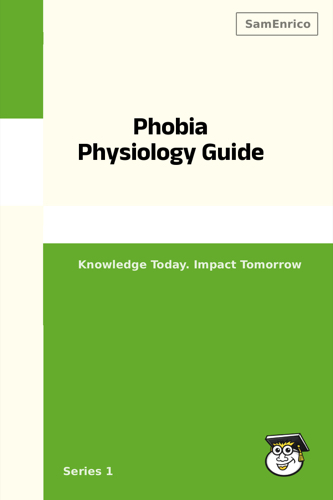
Phobia Physiology Guide eBook
Learn how fight flight response triggers panic and
Learn how fight flight response triggers panic and how to calm it.
Formats
Free sample
Chapter 1: The Body's Betrayal--–- It begins as a whisper. A slight flutter in your chest. A moment of dizziness when you stand up too quickly. A sensation that your breath has gone shallow, that the air is suddenly not quite enough. You notice it.
That is all. Just a noticing.Then the whisper becomes a shout.Your heart slams against your ribs like a trapped animal. Your palms slick with sweat. Your vision tunnels, darkening at the edges until the world becomes a narrow corridor of fear. Your legs feel like they might collapse.
Your stomach drops as if you have just crested the peak of a roller coaster—except you are standing still. You are sitting in a meeting. You are lying in bed. You are driving on a familiar road. There is no roller coaster.
There is no danger. But your body does not know that.Your body is screaming that you are dying.This is the paradox of panic. The most terrifying physical experience a human being can endure often happens in the complete absence of threat. You are safe. Your chair is stable.
The room is quiet. The people around you are going about their ordinary lives. And inside you, a fire alarm is blaring so loudly that you cannot hear anything else.If you are reading this book, you know this experience intimately. You have felt the betrayal of your own body—the machinery that is supposed to keep you alive suddenly turning against you, flooding you with terror for no reason you can name. You may have developed a phobia: a specific, laser-focused fear of a particular situation or object that once seemed ordinary.
You may have started avoiding places, people, or activities, not because you want to, but because the memory of that terror is so vivid that you will do anything to avoid feeling it again.Here is the truth that will change everything: Your body is not betraying you. It is trying to protect you from a threat that does not exist.This chapter will teach you why that happens, how to recognize it, and why the very act of recognition is the first and most powerful step toward freedom. By the time you finish these pages, you will understand the critical difference between real fear and false alarm. You will see panic not as a mysterious breakdown but as a predictable physiological process. And you will begin to reclaim the authority over your own nervous system that panic has stolen from you.Let us begin with a story.The Man Who Stopped Driving James was thirty-seven years old when his life changed on a Tuesday afternoon.
He was a commercial real estate broker, a job that required him to spend hours each day behind the wheel, driving from one property to another across Los Angeles. He had been doing this for twelve years. He knew every freeway, every shortcut, every traffic pattern. Driving was as natural to him as walking.On that Tuesday, he was stopped at a red light on Ventura Boulevard when he felt a sudden wave of heat wash over his body. His heart began to race.
He felt a crushing sensation in his chest. His first thought was heart attack. His second thought was that he was going to die right there, in his leased BMW, with the radio playing a song he could not later remember.He pulled into a parking lot and sat for forty-five minutes, waiting for the terror to subside. It did, eventually. He drove home slowly, stayed in bed for two days, and convinced himself it was a fluke—too much coffee, not enough sleep, a weird virus.But it was not a fluke.
The next week, on the same stretch of road, it happened again. Then again on the freeway. Then again while sitting in his own driveway, not even moving. Within two months, James had stopped driving entirely. He took Ubers to appointments.
He had groceries delivered. He told his colleagues he was having "car trouble" for so long that they stopped believing him. He was too ashamed to tell them the truth: that he was afraid of a stretch of asphalt.James had developed a phobia. The panic attacks on the road had conditioned his brain to associate driving with terror. The association was so strong that the mere thought of getting behind the wheel triggered a physiological response identical to the original attacks.
His amygdala—the brain's alarm system, which we will explore in depth in Chapter 2—had learned a powerful lesson: driving equals danger. The fact that he had driven safely for twelve years, that millions of people drive safely every day, that there was no actual threat on Ventura Boulevard—none of that mattered to his amygdala. It had learned. And what it learned was wrong.James is not unusual. He is not weak.
He is not broken. He is a man whose brain did exactly what brains are designed to do: it learned from experience. The problem was not the learning mechanism. The problem was the experience it learned from.Real Fear Versus False Alarm To understand what happened to James—and to you—we must first understand the difference between real fear and false alarm. This distinction is the foundation of everything that follows.Real fear is triggered by an actual, present, physical threat.
A car swerving into your lane. A dog lunging at you with bared teeth. A shelf collapsing above your head. In these situations, your body's fight-or-flight response is perfectly appropriate. Your heart races to pump blood to your large muscles.
Your breathing quickens to oxygenate that blood. Your pupils dilate to take in more visual information. Your digestion slows because digesting a meal is not a priority when you might need to run for your life. Every change in your body is preparing you to survive.This response is mediated by your sympathetic nervous system and fueled by the hormone norepinephrine (often called adrenaline). It is one of the most elegant survival mechanisms in the animal kingdom.
It has kept humans alive for hundreds of thousands of years. It is not the enemy.Panic is what happens when this same system activates in the absence of a real threat. Your heart races not because you are running from a predator, but because you noticed a harmless palpitation. Your breathing quickens not because you need oxygen for your muscles, but because you had a thought about fainting. Your body is preparing for a battle that does not exist.This is the core distinction: real fear is triggered by something outside you.
Panic is triggered by something inside you—usually a physical sensation or a thought that you misinterpret as dangerous.Let me repeat that, because it is the single most important sentence in this book: Panic is not caused by danger. Panic is caused by the misinterpretation of a harmless sensation as dangerous.James misinterpreted the physical sensations of a normal stress response (heat, racing heart, chest tightness) as signs of a heart attack. That misinterpretation triggered a full fight-or-flight response. The fight-or-flight response produced more physical sensations, which he then misinterpreted…
This is the end of the free sample. Get the eBook to keep going. Buy now
About this book
Details
- Author
- Guenther Natalya
- Publisher
- SamEnrico
- Language
- English
- Genre
- Non-Fiction, Health & Wellness
- Released
- 2026-06-06
- Pages (approx.)
- 158
- Available as
- eBook, Audiobook

Read better in the ZLOADR app
Your eBooks on your phone or tablet. Sign in with your SamEnrico account and start reading.
More by Guenther Natalya
 Benzo Taper Muscle Spasm GuideGuenther Natalya$11.99
 AuraFlow Video Upscale GuideGuenther Natalya$11.99
 Financial Recovery After Alcohol AddictionGuenther Natalya$11.99
 Facebook Memories ComparisonGuenther Natalya$11.99
 The Phantom Fleet of the Black SeaGuenther Natalya$11.99
 Consumer Electronics Spending TrendsGuenther Natalya$12.99
 Royalty Collection For ProducersGuenther Natalya$12.99
 How to Become a Jewel-cupping-machine OperatorGuenther Natalya$11.99
 Bakery AssistantGuenther Natalya$11.99
 Understanding Infantile Multisystem Inflammatory DiseaseGuenther Natalya$17.99
You may also like
 Hong Kong Handover 1997Dunn Johnnie$11.99
 Zumba For Postnatal Recovery CourseNeal Christian$11.99
 Zumba for BeginnersLadner Nikia$11.99
 YouTube Comment Mining GuideHumes Pandora$12.99
 Worry Box MeditationCarlin Rudy$11.99
 Workplace Stress MeditationNguyen Lynn$11.99
 Workplace Stress and Sleep RepairHawley Ivory$11.99
 Workplace Perfectionism CureDelaney Jeffry$11.99
 Workplace Injustice Anger GuideWallen Isabelle$11.99
 Work Addiction and Burnout LinkGreenwood Ester$11.99
 Women in Yoga and WellnessBeattie Galina$11.99
 Women in Stand Up ComedyChun Evangeline$11.99