
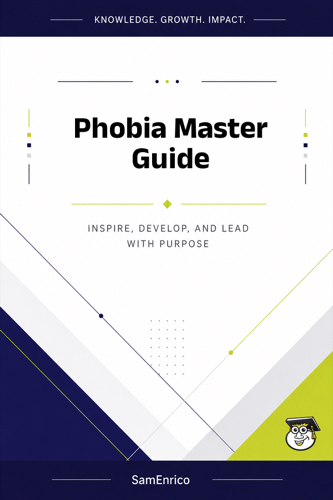
Phobia Master Guide eBook
Complete reference for all specific phobia treatme
Complete reference for all specific phobia treatments.
Formats
Free sample
Chapter 1: The Smoke Alarm That Never Stops...--–- You are not broken. You are not weak. You are not “crazy.” Your brain is doing exactly what it evolved to do—it is just doing it at the wrong time, in the wrong place, and turned up to a volume that no longer serves you.This is the single most important sentence you will read in this entire book. Write it down. Tape it to your bathroom mirror.
Set it as a reminder on your phone. Because somewhere along the way—perhaps from a well-meaning friend who told you to “just relax,” perhaps from a parent who grew frustrated with your avoidance, perhaps from your own exhausted internal monologue—you have likely concluded that your phobia means something is fundamentally wrong with you. That conclusion is false.Let me tell you about a patient I’ll call David. David was a 42-year-old architect who had not ridden an elevator in 11 years. He walked up 26 flights of stairs every morning to his office.
He turned down a promotion because the new position required him to visit clients on the 19th floor of a building whose elevators he could not face. He cancelled a vacation with his wife because the hotel was on the 8th floor. When David first sat in my office, he said something I have heard hundreds of times: “I know it’s ridiculous. I know elevators are safe. I’m an engineer—I literally design buildings with elevators.
But when that door closes, I feel like I’m going to die. What is wrong with me?”Nothing was wrong with David. Not in the way he meant. He did not have a character flaw, a weak will, or a defective personality. David had a smoke alarm that was calibrated to go off when he burned toast.
And once you understand what that means—really understand it—you have already taken the first and most important step toward freedom.The Most Important Distinction You Will Ever Make Before we talk about treatment, before we build hierarchies or learn breathing techniques or recruit a therapeutic coach, we have to establish a foundational distinction that will reframe everything you thought you knew about your phobia. That distinction is between fear and phobia.Fear is a survival mechanism. It is ancient, efficient, and literally life-saving. Fear is what happens when your brain detects a genuine threat to your safety and activates a cascade of physiological and psychological responses designed to keep you alive. Here is what fear looks like in a healthy brain: You are walking across a street.
A car runs a red light and is speeding directly toward you. In less than a second, your amygdala (the brain’s threat-detection center) sends a signal to your hypothalamus, which activates your sympathetic nervous system. Your heart rate spikes from 70 to 140 beats per minute. Blood shunts away from your digestive system and toward your large muscle groups so you can run. Your pupils dilate to take in more visual information.
Your bronchial tubes expand to maximize oxygen intake. You jump out of the way. The car passes. Within a few minutes, your parasympathetic nervous system kicks in, your heart rate returns to baseline, and you continue with your day. That is fear.
It is appropriate. It is proportional. It ends.A phobia is something else entirely. A phobia is a false alarm. It is your smoke detector screaming at the smell of burnt toast as if your house were on fire.
The physiological response—the racing heart, the rapid breathing, the sweating, the trembling—is identical to fear. Your brain cannot tell the difference between a real threat and a perceived threat at the level of autonomic arousal. But the context could not be more different. The person with a spider phobia who sees a tiny, harmless house spider across the room experiences the same physiological cascade as David facing the oncoming car. But the spider is not a car.
The spider is not going to hit him. The spider is, in fact, far more afraid of him than he is of it. And yet his body responds as if his life depends on escape.This is the central paradox of phobia: the response is real, but the threat is not. Your suffering is genuine. Your terror is not imagined.
But the danger is. And that distinction—between the realness of your experience and the unreality of the threat—is the key that unlocks the cage.What a Phobia Actually Is (According to the People Who Study This for a Living)The Diagnostic and Statistical Manual of Mental Disorders, Fifth Edition, Text Revision (DSM-5-TR)—the official guidebook used by psychiatrists, psychologists, and therapists worldwide—defines a Specific Phobia using a set of criteria that are surprisingly straightforward. You do not need a graduate degree to understand them. Here they are, translated from clinical language into plain English:Criterion A: You experience marked fear or anxiety about a specific object or situation. This is not vague unease.
This is not “I’d rather not.” This is a strong, often overwhelming, emotional and physical response. For some people, this is a full-blown panic attack. For others, it is a quieter but still intense feeling of dread. The key word is “marked”—it stands out from your baseline anxiety.Criterion B: The phobic object or situation almost always provokes immediate fear or anxiety. Note the word “almost.” This criterion acknowledges that there might be rare occasions when the response is muted—perhaps you are heavily medicated, perhaps you are exhausted beyond the point of arousal, perhaps you are distracted by an emergency.
But under normal conditions, the trigger produces the response. And importantly, for children, this fear might show up as crying, tantrums, freezing, or clinging.Criterion C: You actively avoid the phobic object or situation, or you endure it with intense fear or anxiety. This is a crucial distinction that we will explore in depth in Chapter 3. There are two types of phobia responders: avoiders and endurers. Avoiders restructure their entire lives to never encounter the trigger.
Endurers encounter it—perhaps because they have no choice—but white-knuckle their way through with every safety behavior at their disposal. Both are suffering. Neither is “handling it better.”Criterion D: The fear or anxiety is out of proportion to the actual danger posed by the object or situation. This is where the smoke alarm analogy comes to life. A spider in your bedroom in a developed country with modern medical care poses essentially zero danger.
An elevator in a code-compliant building has a fatality rate so low that you are more likely to be struck by lightning while winning the lottery. But your brain does not care about statistics. It cares about the signal it received, and that signal says DANGER.Criterion E: The fear, anxiety, or avoidance is persistent, typically lasting for six months or longer. This is what separates a phobia from a transient fear. Many people have a bad experience and develop a temporary wariness.
That is normal. That is adaptive. A phobia is when that wariness hardens into a chronic condition. Six months is…
This is the end of the free sample. Get the eBook to keep going. Buy now
About this book
Details
- Author
- Metzger Xavier
- Publisher
- SamEnrico
- Language
- English
- Genre
- Non-Fiction, Health & Wellness, Complete
- Released
- 2026-06-06
- Pages (approx.)
- 147
- Available as
- eBook, Audiobook

Read better in the ZLOADR app
Your eBooks on your phone or tablet. Sign in with your SamEnrico account and start reading.
More by Metzger Xavier
 Dustin Johnson Power GameMetzger Xavier$11.99
 Blaming Reduction TechniquesMetzger Xavier$11.99
 MDD and Anhedonia GuideMetzger Xavier$11.99
 Working Parent Time BlocksMetzger Xavier$11.99
 Vacation Sobriety GuideMetzger Xavier$11.99
 Resilience FactorsMetzger Xavier$11.99
 Digital Minimalism SRSMetzger Xavier$11.99
 The Shadows of Mount Eden: New Zealand’s Forgotten Witch HuntMetzger Xavier$11.99
 The Battle of Fornovo: The Last Stand of the CondottieriMetzger Xavier$11.99
 A Collector's Handbook to the Ginetta G4Metzger Xavier$11.99
 Factoring Contract Negotiation in EMMetzger Xavier$12.99
 Minimum Viable Product SpendingMetzger Xavier$12.99
You may also like
 Men's Master GuideGass Viviana$11.99
 Injury Master GuideStuckey Berenice$11.99
 Macronutrient Master GuideTillery Carlita$11.99
 Sleep Master GuideDesantis Dominique$11.99
 PCOS Master GuideOtoole Sierra$11.99
 Flexibility Master GuideSamples Lawrence$11.99
 IBS Master ReferenceBolin Meryl$11.99
 Hormonal Master GuideOswald Elda$11.99
 Food Intolerances Complete GuideTitus Earleen$11.99
 Beginner Fitness MasterSharkey Vinita$11.99
 Napping Complete Health GuideEnnis Laronda$11.99
 Group Fitness MasterHolly Lashawnda$11.99