
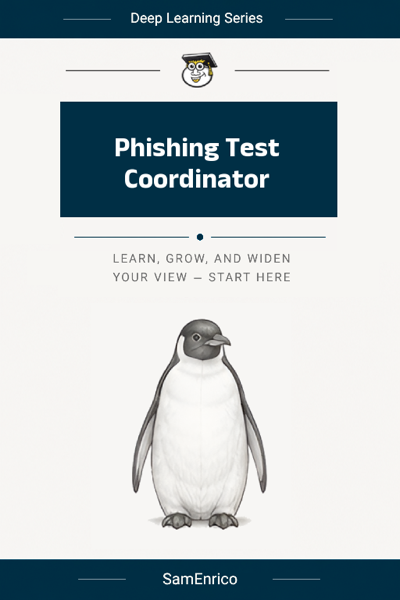
Non-FictionInformativeEducational
Phishing Test Coordinator eBook
A Coursebook on Phishing Test Coordinator
A Coursebook on Phishing Test Coordinator
Formats
Free sample
Chapter 1: The Curiosity Trap...--The email arrived at 2:47 PM on a Tuesday. The subject line read: "HR Alert: Updated Health Benefits Enrollment." The sender appeared to be "HR Benefits Team" from the company domain. The link promised a one-page form requiring only two clicks to confirm coverage.Within eleven minutes, 143 employees had clicked. Seventeen had entered their domain credentials on a fake login page. One had called the help desk in tears, convinced her insurance had been cancelled.The attack was real.
The breach cost $2.3 million.But here is what haunts me most: every single person who clicked that link had completed mandatory phishing awareness training within the last ninety days. Every single one had scored above 90% on the post-test. Every single one knew, intellectually, what phishing was.And every single one clicked anyway.This is not a story about stupid people. It is not a story about lazy employees or uncaring workers. It is a story about the human brain doing exactly what evolution designed it to do: prioritize speed over suspicion, efficiency over security, and habit over vigilance.If you are reading this book, you have likely been assigned the role of Phishing Test Coordinator.
Perhaps you volunteered. Perhaps it was added to your job description without warning. Perhaps you inherited a broken program and are trying to figure out why your carefully crafted simulations seem to annoy everyone while teaching no one.Whatever brought you here, you need to understand something that most security awareness programs get fundamentally wrong: your users are not the problem. The way their brains work is not the problem. The problem is that most phishing simulations are designed to catch mistakes rather than understand cognition.This chapter will dismantle every comfortable assumption you have about why people click.
You will learn why a Harvard-trained CFO clicks on fake UPS delivery notifications. You will understand why the same person who fails a simulation can spot a real phishing email hours later. And you will begin to see your role not as a tester of knowledge but as a designer of cognitive environments.Let us start with a confession from my own career.The Day I Realized I Was Part of the Problem Seven years ago, I ran my first phishing simulation. I was proud of it. I had spent three days crafting the perfect template: an urgent message from "IT Security" warning that the recipient's account would be locked in two hours unless they verified their credentials via the embedded link.The click rate was 31 percent.
I presented these results to the CISO with a sense of accomplishment. Then I sat through a meeting where department heads argued about which teams were "the dumb ones." The marketing team blamed operations. Operations blamed sales. The CFO quietly asked whether we could fire repeat clickers.No one asked why people clicked. No one asked what the simulation taught them.
No one asked whether the test made anyone safer.That night, I received an email from a junior accountant named Maria. She had clicked the link. She had entered her password. She had realized her mistake three seconds later and immediately changed her credentials. Maria wrote:"I know what phishing is.
I have taken the training three times. But this morning, my son was home sick, my manager was demanding a report by noon, and I had not slept more than four hours. When that email popped up saying my account would be locked, I just clicked. I am not stupid. I am exhausted."Maria was right.
And I was wrong to run a test that measured nothing except who was having the worst day.That was the moment I stopped being a "phishing tester" and started studying the psychology of the click. What I learned changed everything about how I design simulations, interpret metrics, and measure success. What I learned is what this chapter will teach you.The Suspicion, Cognition, Automaticity Model (SCAM)The most important framework for understanding phishing failures is the Suspicion, Cognition, Automaticity Model, or SCAM. Developed by security researchers studying human behavior under cognitive load, SCAM explains why knowledgeable people make insecure decisions.Let me break it down into its three components.Suspicion is your brain's threat detection system. It is the feeling that something is wrong—that the email's tone is slightly off, that the sender's address has an extra character, that the request doesn't quite match company policy.
Suspicion is slow, effortful, and energy-intensive. Your brain does not like being suspicious because suspicion requires active analysis.Cognition is your available mental processing power. Every human has a finite cognitive budget. When you are well-rested, focused, and working on one task at a time, your cognitive budget is high. When you are multitasking, tired, stressed, or hungry, your cognitive budget is low.
Phishing attackers know this. They send emails at predictable times—Tuesday afternoons, just before holidays, during known company deadlines—because they understand cognitive depletion.Automaticity is the brain's default mode. When your brain detects a familiar pattern (an email from HR, a shipping notification, a calendar invite), it shifts into automatic processing. You stop analyzing and start acting. Automaticity is efficient.
It is also dangerous because it bypasses suspicion entirely.Here is what SCAM reveals: a phishing email succeeds not because the user lacks knowledge but because the user's cognitive budget is depleted at the exact moment automaticity overrides suspicion.Maria was not ignorant. She was exhausted. Her cognition was depleted. The email triggered automaticity (an HR message, which she receives weekly). Suspicion never had a chance.The Three Primal Triggers of Social Engineering Attackers do not rely on complex hacking techniques to breach most organizations.
They rely on three primal psychological triggers that have worked for thousands of years. These triggers bypass rational analysis and speak directly to the brain's ancient threat-response systems.Trigger One: Authority Humans are hardwired to obey authority figures. This tendency has been studied extensively since the Milgram experiments of the 1960s, in which ordinary people administered what they believed were painful electric shocks to strangers simply because a lab coat told them to.Phishing emails exploit authority by impersonating IT departments, HR directors, CEOs, lawyers, and government regulators. The message is simple: "I am in charge. You must comply.
Act now."Your brain processes authority cues in milliseconds. A familiar job title. A corporate logo. A signature block that looks official. By the time your rational mind asks "Is this real?", your automatic system has already decided to comply.Real-world example: In 2016, a phishing email pretending to be the CEO of Snapchat tricked a payroll manager into emailing employee tax records to an attacker.
The email contained no malicious link or attachment. It simply said, "I need the W-2 forms for all employees. Please send as PDF."The manager complied because the request came from "Evan Spiegel." Authority overrode suspicion.Trigger Two: Urgency Urgency shuts down critical thinking. When your brain perceives a time constraint, it prioritizes speed over accuracy. This is an evolutionary adaptation: in the ancestral environment, a slow decision could mean death.
In the modern office, a fast decision means clicking a phishing link.Phishing emails create urgency with phrases like "Your account…
This is the end of the free sample. Get the eBook to keep going. Buy now
About this book
Details
- Author
- Triplett Desire
- Publisher
- SamEnrico
- Language
- English
- Genre
- Non-Fiction, Informative, Educational
- Released
- 2026-05-09
- Pages (approx.)
- 155
- Available as
- eBook, Audiobook

Read better in the ZLOADR app
Your eBooks on your phone or tablet. Sign in with your SamEnrico account and start reading.
More by Triplett Desire
 Remote Retreats Conflict ResolutionTriplett Desire$11.99
 Retrieval Practice WorkbookTriplett Desire$11.99
 Polish Intelligence Enigma BreakTriplett Desire$11.99
 Innovation Landscape PrimerTriplett Desire$11.99
 Cognitive Load Management for Deep WorkTriplett Desire$11.99
 The Pink Panther Heist: The 1978 Diamond Caper That Shocked the WorldTriplett Desire$11.99
 The Lost Voyagers: Polynesian Navigators and the Dawn of Pacific ExplorationTriplett Desire$11.99
 Understanding Chorioretinopathy Dominant Form MicrocephalyTriplett Desire$17.99
 JEE Organic Chemistry GuideTriplett Desire$12.99
 Department Budgeting Software GuideTriplett Desire$12.99
 10 Ways to Use Cheesecloth (Recipe Book)Triplett Desire$11.99
You may also like
 Hong Kong Handover 1997Dunn Johnnie$11.99
 Zumba For Postnatal Recovery CourseNeal Christian$11.99
 Zumba for BeginnersLadner Nikia$11.99
 YouTube Comment Mining GuideHumes Pandora$12.99
 Worry Box MeditationCarlin Rudy$11.99
 Workplace Stress MeditationNguyen Lynn$11.99
 Workplace Stress and Sleep RepairHawley Ivory$11.99
 Workplace Perfectionism CureDelaney Jeffry$11.99
 Workplace Injustice Anger GuideWallen Isabelle$11.99
 Work Addiction and Burnout LinkGreenwood Ester$11.99
 Women in Yoga and WellnessBeattie Galina$11.99
 Women in Stand Up ComedyChun Evangeline$11.99