
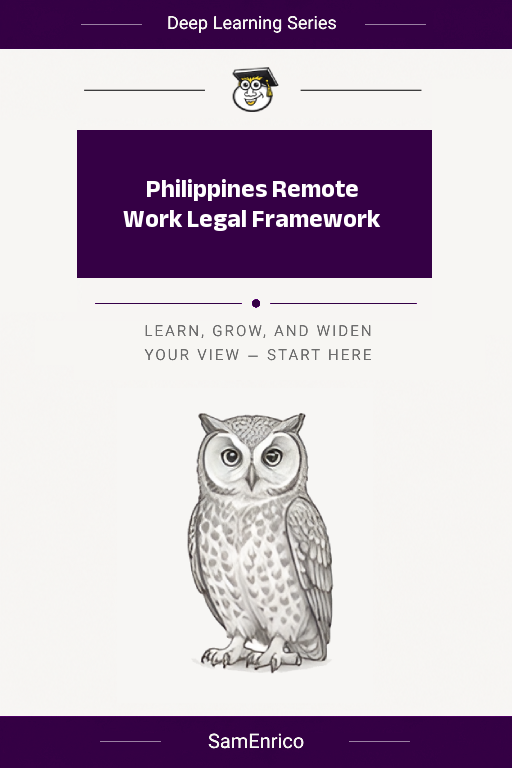
Non-FictionBusiness BriefPhilippine Law
Philippines Remote Work Legal Framework eBook
Navigate Philippine labor code remote work regulat
Navigate Philippine labor code remote work regulations and EOR requirements for international hiring.
Formats
Free sample
Chapter 1: The ₱4.2 Million Mistake--In January 2025, a mid-sized Australian software company learned a lesson that no amount of due diligence could have fully prepared them for. They had hired twelve Filipino remote developers over an eighteen-month period, classifying each one as an independent contractor through an online freelancing platform. The contracts were clear, or so they thought: each developer signed a "Freelance Services Agreement" that explicitly stated, in bold type, "This is not an employment contract. The Contractor is an independent business owner, not an employee of the Company." The Australian company provided no equipment, set no formal working hours, and paid a flat monthly fee that the developers reported as business income on their own tax returns. From the company's perspective, they had done everything right.The Department of Labor and Employment disagreed.
Following a complaint filed by two of the developers who had been terminated without separation pay, DOLE conducted an investigation that lasted four months. The investigators examined Slack message logs, Jira task assignments, performance review documents, and the developers' actual working arrangements. What they found was a textbook case of misclassification under the four-fold test. Despite the contractor labels, the developers were assigned to specific teams, received detailed instructions on how to complete tasks, had their work reviewed and approved by Australian managers, used company accounts for project management software, and were subject to a code of conduct that dictated their working hours and availability. One developer had been asked to change his profile picture on the company Slack to something "more professional." Another had been required to attend a mandatory two-hour weekly meeting every Tuesday at 9 AM Philippine time.The final judgment was devastating.
The company was ordered to pay back wages for the full duration of each developer's engagement, calculated at the applicable minimum wage for their regions (Metro Manila and Cebu), plus overtime pay for hours exceeding eight per day, plus night differential for hours worked between 10 PM and 6 AM, plus 13th month pay for each year of service, plus Service Incentive Leave conversion, plus the employer's share of unpaid SSS, Phil Health, and Pag-IBIG contributions with interest and penalties. The total came to ₱4,200,000—roughly $75,000 USD at the exchange rate at the time. The company's directors faced potential criminal charges for willful misclassification, though those were eventually settled with a fine. The company's reputation in the Philippine remote work community was destroyed, making it impossible to hire replacements through legitimate channels. Six months later, the company exited the Philippine market entirely, abandoning plans to establish a regional hub that had been in development for two years.This chapter is about preventing your company from becoming the next ₱4.2 million mistake.
It establishes the foundational legal framework that governs every remote work arrangement in the Philippines, dispels the most dangerous misconceptions that lead foreign employers into compliance traps, and provides a actionable baseline for ensuring your remote team operates within the law. By the end of this chapter, you will understand exactly which laws apply to your Filipino remote workers, what the Telecommuting Act requires, where the gaps in the law create hidden risks, and why the distinction between "employee" and "contractor" is the single most important legal determination you will make when building a remote team in the Philippines.Section 1.1: The Labor Code – A 1974 Law in a 2026 World The Labor Code of the Philippines, enacted as Presidential Decree No. 442 in 1974, remains the primary source of labor rights and obligations more than fifty years later. It covers everything from minimum wage and hours of work to leave benefits, termination procedures, security of tenure, and the rights of workers to organize and bargain collectively. Its provisions apply to all employees—defined simply as any person who performs services for an employer where the employer controls or reserves the right to control the means and methods of work.
Notably, the Code contains no exception for remote workers, no exemption for digital nomads, and no special category for work-from-home arrangements. The law was written for a world of factory floors and office buildings, but its protections travel with the worker, not the workplace.This absence of remote-specific provisions creates the first layer of what this book calls the Legal Mirage—the dangerous illusion that because remote work feels different, the legal rules must be different too. Foreign employers see a law that mentions "workplaces," "premises," "supervision," and "time clocks" and incorrectly conclude that the law presupposes physical presence. Philippine courts have rejected this interpretation repeatedly. In Mabilog v.
Department of Labor and Employment (G.R. No. 212340, 2018), the Supreme Court held that the Labor Code's protections are territorial in the sense that they apply to work performed within Philippine territory, but not geographical in the sense of requiring a physical workplace. An employee working from their home in Quezon City is as fully protected as an employee working from a high-rise office in Makati's central business district.The practical implications for foreign employers are enormous. Every remote Filipino worker classified as an employee—a determination guided by the four-fold test, which will be covered in depth in Chapter 2—is entitled to the following non-negotiable protections:Minimum Wage: The applicable regional minimum wage based on the employee's residence, not the employer's location.
As of 2026, Metro Manila's daily minimum wage is approximately ₱645 (roughly $11.50 USD). Provincial rates range from ₱350 to ₱500 depending on the region. An employer cannot pay a worker who resides in Manila the lower provincial rate simply because the employer is registered in a province or because the work is remote. The wage follows the worker.Overtime Pay: Work beyond eight hours in a workday requires overtime pay at 125% of the regular hourly rate. This applies regardless of whether the overtime was explicitly requested or simply permitted without objection.
If an employer knows or should know that a remote worker is working more than eight hours—through time tracking software, Slack activity, or simply the timing of work product submissions—the employer is liable for overtime pay.Night Shift Differential: Work performed between 10:00 PM and 6:00 AM requires night shift differential at 110% of the regular hourly rate. This applies to remote workers who choose night schedules as well as those required to work nights. The only exception is for workers who voluntarily and consistently work night shifts without any employer encouragement or requirement, a factual determination that is difficult for employers to prove.Holiday Pay: The Philippines recognizes twelve regular holidays (200% pay if worked, 100% pay if unworked) and eight special non-working holidays (130% pay if worked, no pay if unworked unless company policy provides otherwise). Remote workers are entitled to holiday pay on the same terms as office-based workers. An employer cannot require a remote worker to work on a regular holiday without paying the 200% premium.Service Incentive Leave: Five days of paid leave annually after one year of service.
This leave is cumulative, and unused leave must be converted to cash upon separation—a statutory requirement that no company policy can override. The leave applies to all rank-and-file employees, regardless of how they are labeled in their contracts.13th Month Pay: A non-negotiable, tax-exempt bonus equal to 1/12th of total basic salary earned during the calendar year, due on or before December 24th. This…
This is the end of the free sample. Get the eBook to keep going. Buy now
About this book
Details
- Author
- Lemieux Madge
- Publisher
- SamEnrico
- Language
- English
- Genre
- Non-Fiction, Business Brief, Philippine Law
- Released
- 2026-05-29
- Pages (approx.)
- 160
- Available as
- eBook, Audiobook

Read better in the ZLOADR app
Your eBooks on your phone or tablet. Sign in with your SamEnrico account and start reading.
More by Lemieux Madge
 Teen Self Esteem Video SeriesLemieux Madge$11.99
 Health Insurance After Job LossLemieux Madge$11.99
 The Freelance Goal TrackerLemieux Madge$11.99
 Child Star Rehab Centers GuideLemieux Madge$11.99
 The Socratic Persuasion MethodLemieux Madge$11.99
 UK VAT Registration for Sole Traders GuideLemieux Madge$11.99
 Rocha Family Grief JourneyLemieux Madge$11.99
 Buffett BNSF RailroadLemieux Madge$11.99
 The Celestial Sages of Meroë: Engineering Time ItselfLemieux Madge$11.99
 Seeds of the First Dawn: How a Forgotten Farmer Fed a ContinentLemieux Madge$11.99
 Shadows Over Berlin: The Spy Who Vanished in Cold War GermanyLemieux Madge$11.99
 The Complete Guide to the Oatmeal DietLemieux Madge$11.99
You may also like
 Hong Kong Handover 1997Dunn Johnnie$11.99
 Zumba For Postnatal Recovery CourseNeal Christian$11.99
 Zumba for BeginnersLadner Nikia$11.99
 YouTube Comment Mining GuideHumes Pandora$12.99
 Worry Box MeditationCarlin Rudy$11.99
 Workplace Stress MeditationNguyen Lynn$11.99
 Workplace Stress and Sleep RepairHawley Ivory$11.99
 Workplace Perfectionism CureDelaney Jeffry$11.99
 Workplace Injustice Anger GuideWallen Isabelle$11.99
 Work Addiction and Burnout LinkGreenwood Ester$11.99
 Women in Yoga and WellnessBeattie Galina$11.99
 Women in Stand Up ComedyChun Evangeline$11.99