
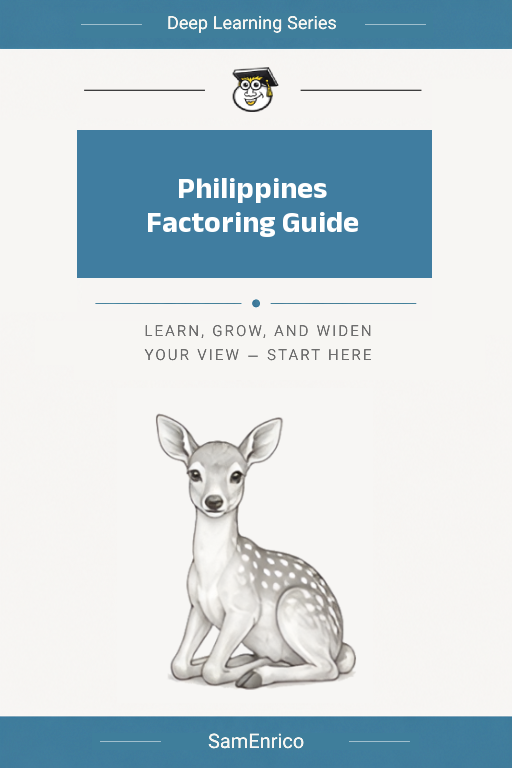
Non-FictionBusiness BriefBSP Circular
Philippines Factoring Guide eBook
Factor receivables in Philippines through SEC regi
Factor receivables in Philippines through SEC registered financing companies. BSP circular 1033 allows factoring of both goods and service invoices.
Formats
Free sample
Chapter 1: The 90-Day Nightmare--–- The sun had not yet risen over Mandaue City, but Nelson Yu was already staring at his phone. His furniture export business had just received a purchase order from a major Manila retailer—₱5.2 million worth of handcrafted tables and chairs. The order would keep his 47 workers employed for two months. It was exactly the kind of break he had been praying for.–- There was only one problem. The retailer's payment terms were 90 days from delivery.
Nelson had payroll in 14 days. His lumber supplier demanded cash on delivery in 21 days. The shipping container deposit was due in 10 days. He had ₱300,000 in his business account. The gap between what he had and what he needed was not a gap; it was a chasm.–- Nelson did what millions of Filipino business owners do.
He went to his bank. He presented his financial statements, his tax returns, his three years of operations, and the shiny new purchase order. The bank manager was polite. He was even sympathetic. But the answer was the same one Nelson had heard three times before: "You don't have hard collateral.
We cannot approve the loan."–- Nelson's story is not unusual. It is not even remarkable. It is, in fact, the daily reality of over 998,000 registered business enterprises in the Philippines—99.5 percent of all businesses in the country, according to the Department of Trade and Industry. These are the SMEs that employ 63 percent of the Filipino workforce. And they are all trapped by the same paradox: they are doing business, but they cannot access the cash that is rightfully theirs.–- This book exists because Nelson's problem has a solution.
That solution is called factoring. And factoring exists because the Philippine financial system, for all its sophistication, has systematically excluded the very businesses that keep the economy running.The Cash Flow Paradox: Why Success Breeds Bankruptcy–- Let us start with a simple truth that most business books dance around. In the Philippines, getting a large order can be the fastest way to go bankrupt. This is the cash flow paradox.–- When a small or medium enterprise wins a major contract, several things happen simultaneously. First, they must purchase raw materials.
Second, they must pay for labor, often weekly. Third, they must cover logistics, warehousing, and delivery. Fourth, they must wait—30 days, 60 days, 90 days, or sometimes longer—for the customer to pay the invoice. During that waiting period, the business must continue to pay rent, utilities, salaries, and suppliers. Many SMEs operate on gross margins of 15 to 25 percent.
A single 90-day delay on a large invoice can wipe out an entire year's profit.–- Consider the numbers. According to a 2024 study by the Philippine Institute for Development Studies, the average B2B payment term in the Philippines is 67 days. For transactions involving government or large conglomerates, terms frequently stretch to 120 days or more. During these 67 days, the SME must finance its operations from somewhere. The traditional source is working capital—cash reserves built up over years.
But most SMEs do not have substantial cash reserves. The majority operate on what accountants call "hand to mouth" cycles, where incoming payments are already allocated to outgoing obligations before they arrive.–- This creates a bizarre situation where a business can be profitable on paper—its invoices adding up to a healthy bottom line—while being functionally insolvent in reality. The accountant looks at accounts receivable and sees assets. The operations manager looks at the same number and sees a countdown to missed payroll.The Collateral Trap: Why Banks Say No–- The natural question is: why do banks not solve this problem? After all, banks exist to lend money.
The answer lies in the nature of collateral.–- Traditional bank lending in the Philippines operates on a simple principle: the borrower must pledge an asset that the bank can seize if the loan is not repaid. The preferred collateral is real estate. Land has value. Buildings have value. They do not disappear.
They can be appraised, auctioned, and converted into cash. For decades, this system worked reasonably well for Filipinos who owned land.–- But here is the problem. Most SMEs do not own the land their business occupies. They lease. Many operate from rented spaces, shared buildings, or even their own homes—which are often still under mortgage to a different bank.
The machinery and equipment they use—saws, sewing machines, delivery trucks, computers—depreciate rapidly and are difficult to sell at auction for anything close to their book value.–- The Bangko Sentral ng Pilipinas reported in its 2025 Financial Inclusion Survey that only 23 percent of SME loan applications were approved by universal and commercial banks. The rejection rate for micro and small enterprises was even higher: 71 percent. The primary reason cited by banks was "insufficient collateral." Not bad credit. Not poor business performance. Not lack of profitability.
Insufficient collateral.–- This is not a conspiracy against small business. It is a structural feature of the banking system. Banks are risk-averse institutions. Their depositors demand safety. Regulators demand capital adequacy.
A loan secured by a piece of land in Makati is a safe loan. A loan secured by a warehouse full of finished furniture is a risky loan. The furniture might not sell. It might be damaged. It might be stolen.
The bank does not want to become a furniture dealer. So the bank says no.–- The SME owner hears "no" and internalizes it as "your business is not good enough." But that is not what the bank said. The bank said "your assets are not the right shape." And that distinction is the entire premise of this book.The Factoring Alternative: Selling What You Are Owed–- Factoring is not a loan. This point is so important that it bears repeating. Factoring is not a loan.
A loan involves a lender giving money to a borrower under an agreement to repay that money with interest, typically secured by some form of collateral. Factoring involves the sale of an asset—specifically, an invoice or accounts receivable—to a buyer, who pays a discounted price for that asset and then collects the full amount from the debtor when it becomes due.–- The distinction is not merely technical. It has profound legal and practical implications. Because factoring is a sale, the factoring company owns the invoice. It has the right to collect payment directly from the debtor.
It bears the risk of the debtor's non-payment (depending on whether the factoring is recourse or non-recourse, a topic we will explore in depth in Chapter 6). And critically, because it is a sale, it does not appear as debt on the seller's balance sheet. It appears as a reduction in accounts receivable and an increase in cash.–- Here is how factoring worked for Nelson, had he known about it. After delivering the ₱5.2 million worth of furniture to the Manila retailer, Nelson would have taken the invoice—the evidence of indebtedness—to an SEC-registered financing company that specializes in factoring. The factoring company would have verified the invoice, checked the creditworthiness of the retailer (not Nelson), and within 24 to 48 hours, advanced Nelson approximately 85…
This is the end of the free sample. Get the eBook to keep going. Buy now
About this book
Details
- Author
- Conway Lanita
- Publisher
- SamEnrico
- Language
- English
- Genre
- Non-Fiction, Business Brief, BSP Circular
- Released
- 2026-06-01
- Pages (approx.)
- 138
- Available as
- eBook, Audiobook

Read better in the ZLOADR app
Your eBooks on your phone or tablet. Sign in with your SamEnrico account and start reading.
More by Conway Lanita
 Spanish Inquisition Torquemada Terror ManualConway Lanita$11.99
 PowerPoint Copilot MasteryConway Lanita$11.99
 Puberty Body Image GuideConway Lanita$11.99
 Infant Formula Recall HistoryConway Lanita$11.99
 The Monk Who Never Sat DownConway Lanita$11.99
 The Beginner's Mind Zen GuideConway Lanita$11.99
 Band of Brothers VeteranConway Lanita$11.99
 Bulgarian Renewable Energy PipelineConway Lanita$11.99
 Bedtime Rituals For Peaceful DreamsConway Lanita$11.99
 Versailles: The Sun King's Architectural RevolutionConway Lanita$11.99
 The Iron Tower of the Oni KingConway Lanita$11.99
 The 1972 Olympics: A Cold War Showdown in IceConway Lanita$11.99
You may also like
 Hong Kong Handover 1997Dunn Johnnie$11.99
 Zumba For Postnatal Recovery CourseNeal Christian$11.99
 Zumba for BeginnersLadner Nikia$11.99
 YouTube Comment Mining GuideHumes Pandora$12.99
 Worry Box MeditationCarlin Rudy$11.99
 Workplace Stress MeditationNguyen Lynn$11.99
 Workplace Stress and Sleep RepairHawley Ivory$11.99
 Workplace Perfectionism CureDelaney Jeffry$11.99
 Workplace Injustice Anger GuideWallen Isabelle$11.99
 Work Addiction and Burnout LinkGreenwood Ester$11.99
 Women in Yoga and WellnessBeattie Galina$11.99
 Women in Stand Up ComedyChun Evangeline$11.99