
Non-FictionInformativeEducational
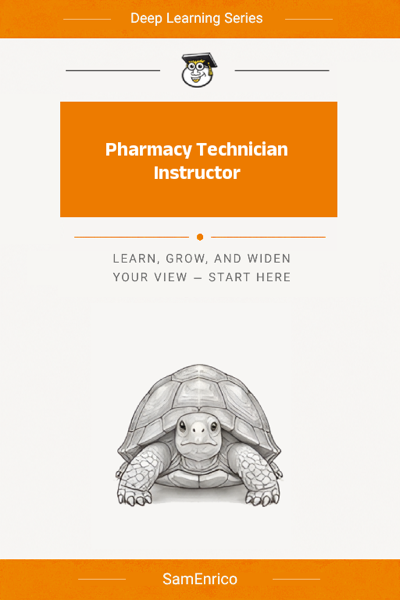
Pharmacy Technician Instructor eBook
A Coursebook on Pharmacy Technician Instructor
by Garber Buck
A Coursebook on Pharmacy Technician Instructor
Formats
Free sample
Chapter 1: The Mirror Test--You have been a pharmacy technician for years. You know the Top 200 drugs by generic name. You can spot a look-alike error from across the counter. You have drawn up a thousand syringes, checked a thousand prescriptions, and caught a thousand mistakes before they reached the patient. You are good at this.And now someone has decided that you should teach.Maybe you volunteered because you were tired of night shifts.
Maybe your manager said, "You're the most experienced tech here, so you're running the training program." Maybe you applied for a position at a community college, and they hired you because your resume said "CPh T" and they needed a warm body in front of the classroom by Monday. Or maybe you actually wanted to teach. You believed you had something to give back. You remembered the terrible instructor who made you hate calculations and the wonderful one who made pharmacology click, and you thought, I can be the wonderful one.Then you stood in front of a room full of strangers, and you realized something terrifying.You have no idea how to teach.Not because you are stupid. Not because you lack knowledge.
But because being a good pharmacy technician and being a good pharmacy technician instructor are two completely different skills. They share a subject matter the way that driving a car and teaching someone to drive share a vehicle. The driver looks at the road. The instructor looks at the driver. The driver reacts instinctively.
The instructor must see the instinct before it happens and decide whether to encourage it or correct it. The driver's job is to get there safely. The instructor's job is to make the student capable of getting there safely without you.This chapter is about that gap. It is about the shift from the technician mindset to the educator mindset. It is about the unspoken lessons you never realized you were teaching.
And it is about the first and most important question you must ask yourself before you write a single lesson plan: Am I teaching pharmacy, or am I teaching people to be pharmacy technicians?Because those are not the same thing.The Two Mindsets: Technician vs. Educator Let us begin with a thought experiment. You are working the bench at a busy retail pharmacy. A prescription comes in for amoxicillin 500mg, one capsule three times daily for ten days. You fill it.
You check it against the patient profile. Everything matches. You hand it to the pharmacist for final verification. The pharmacist glances at the bottle, then at the prescription, then back at the bottle. "This patient is allergic to penicillin," the pharmacist says.
"It's flagged in the profile."Your heart drops. You missed the flag. You knew the patient had an allergy. You even remembered thinking about it earlier. But in the rush of filling, you saw the drug name, matched it to the prescription, and moved on.
The pharmacist catches it. No harm done. But you feel sick for the rest of the shift.What do you do?If you are in the technician mindset, you beat yourself up. You think, I am so stupid. I almost killed someone.
I need to go slower. I need to double-check every allergy flag. I will never make this mistake again. And then you go back to work, faster than before, because the queue is building up and the pharmacist is giving you that look.If you are in the educator mindset, you do something different. You stop.
You ask yourself why you missed the flag. Not to assign blame but to understand the mechanism of the error. You realize: the allergy flag was in the top right corner of the screen. You always check the top right corner first. But today, the label printer jammed, you looked away for two seconds, and when you looked back, your eyes started at the top left instead.
You never saw the flag because your visual scanning pattern broke.Now you have something. Not a resolution to "go slower" (vague and useless) but a specific cognitive insight: My scanning pattern is habitual, not deliberate. When the routine is interrupted, I skip steps without realizing it. That is something you can teach. That is something your future students will do, and you will see it before they do, and you will say, "Stop.
What did you just skip? Walk me back to the moment the printer jammed."The technician mindset asks, "How do I fix this?" The educator mindset asks, "What does this tell me about how humans learn, attend, and err?" The technician wants a procedure. The educator wants a principle.This book exists to drag you from the first mindset to the second.The Hidden Curriculum: What You Teach When You Aren't Teaching Here is a hard truth. Your students will learn more from watching you than from listening to you. They will learn how to talk to patients by overhearing you on the phone.
They will learn how to handle stress by watching you when the queue hits thirty and the pharmacist is on break. They will learn what professionalism looks like by seeing whether you complain about the tech who called in sick or simply pick up the slack.This is called the hidden curriculum. It is not written in any syllabus. It is not assessed on any rubric. But it is the most powerful teaching tool you have, and it works whether you want it to or not.Consider two instructors.
Both are teaching the same lesson on HIPAA privacy rules. Both use the same Power Point slides, the same case studies, the same quiz. On paper, they are identical.Instructor A arrives to class five minutes late. She apologizes, but she has done this every week, so the students no longer believe her. She lectures from the slides without looking up because she did not prepare.
During a role-play about patient privacy, a student loudly says, "Well, if the patient has HIV, that's their own fault for—" Instructor A cuts the student off and says, "Let's stay on topic." She does not address the comment. She does not explain why it was inappropriate. She just moves on.Instructor B arrives five minutes early. She has rearranged the desks into a circle because today's role-play works better that way. During the same role-play, when a student makes a flippant comment about a patient's HIV status, Instructor B stops the scene immediately.
She says, "I am pausing the simulation. What just happened?" The student looks confused. Instructor B says, "You made a comment about the patient's personal health history in a voice that carried across the room. In a real pharmacy, that is a HIPAA violation. It is also disrespectful to patients who trust us with their most vulnerable information.
Let's reset. This time, every word you say about a patient should be something you would say if the patient's family member was standing next to you."What did the students learn in each classroom?Instructor A taught that HIPAA is a set of rules to memorize for the exam. Instructor B taught that HIPAA is a value to…
This is the end of the free sample. Get the eBook to keep going. Buy now
About this book
Details
- Author
- Garber Buck
- Publisher
- SamEnrico
- Language
- English
- Genre
- Non-Fiction, Informative, Educational
- Released
- 2026-06-03
- Pages (approx.)
- 144
- Available as
- eBook, Audiobook

Read better in the ZLOADR app
Your eBooks on your phone or tablet. Sign in with your SamEnrico account and start reading.
More by Garber Buck
 Titanic's Gymnasium EquipmentGarber Buck$11.99
 MBSR Daily Home Practice CourseGarber Buck$11.99
 Cooperative Avocado Export GuideGarber Buck$11.99
 Meeting Fatigue Fix WorkbookGarber Buck$11.99
 The MDD Stigma Reduction GuideGarber Buck$11.99
 The Serpent's Lament: The Forgotten Ballad of the Rainbow SnakeGarber Buck$11.99
 Understanding Oral-facial-digital SyndromeGarber Buck$17.99
 Bootcamp Dropout Recovery GuideGarber Buck$12.99
 BlackRock SWOT GuideGarber Buck$12.99
 How to Start a Chronic Sick Hospital (private Sector) Business (Beginners Guide)Garber Buck$11.99
You may also like
 Hong Kong Handover 1997Dunn Johnnie$11.99
 Zumba For Postnatal Recovery CourseNeal Christian$11.99
 Zumba for BeginnersLadner Nikia$11.99
 YouTube Comment Mining GuideHumes Pandora$12.99
 Worry Box MeditationCarlin Rudy$11.99
 Workplace Stress MeditationNguyen Lynn$11.99
 Workplace Stress and Sleep RepairHawley Ivory$11.99
 Workplace Perfectionism CureDelaney Jeffry$11.99
 Workplace Injustice Anger GuideWallen Isabelle$11.99
 Work Addiction and Burnout LinkGreenwood Ester$11.99
 Women in Yoga and WellnessBeattie Galina$11.99
 Women in Stand Up ComedyChun Evangeline$11.99