
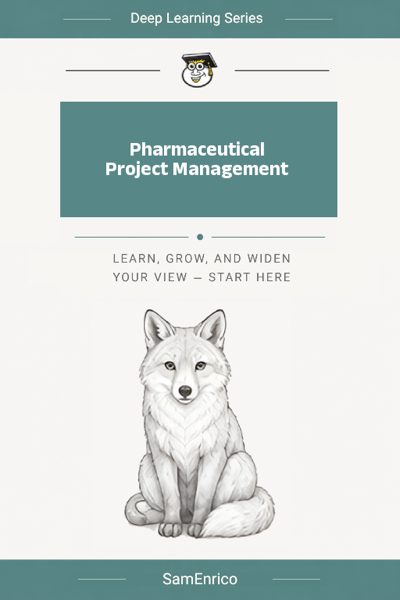
Non-FictionInformativeEducational
Pharmaceutical Project Management eBook
A Coursebook on Pharmaceutical Project Management
by Bock Tory
A Coursebook on Pharmaceutical Project Management
Formats
Free sample
Chapter 1: The Boomerang Budget--–- The email arrived at 11:47 PM on a Tuesday. Sarah, a seasoned project manager who had spent fifteen years in automotive manufacturing, had just joined Geno Vax Biotherapeutics three weeks earlier. She was proud of her PMP certification, her black belt in Six Sigma, and her reputation for delivering complex programs on time. The email was from the VP of R&D: “Sarah, please review the enclosed clinical trial budget and provide your recommendations by 9 AM tomorrow. Welcome to pharma.”The budget was a spreadsheet with forty-seven tabs.
Forty-seven. In automotive, she had never needed more than seven. Scrolling through rows labeled “Patient screening failure contingency,” “Site monitoring visit accruals,” “IRB submission fees per amendment,” and “Drug substance stability study overage,” she felt the first twinge of dread. Then she saw the number at the bottom of the summary tab: $47 million for a single Phase II trial.She called her old colleague Mike, who had made the same transition from aerospace to pharma two years earlier. “It’s just a budget, right?
Work breakdown structure, cost accounts, earned value. Same as building a car door, just with molecules.”Mike laughed. It was not a happy laugh. “Sarah, put away your Gantt chart for a second. You’re not managing a supply chain.
You’re managing a living thing. And the FDA doesn’t care about your cost variance. They care about patient safety. If you miss a preclinical toxicity signal, your entire program gets a clinical hold. That $47 million?
It becomes zero. Overnight.”She stayed up until 3 AM reading about the FDA’s clinical hold authority, about adverse event reporting, about something called a Target Product Profile. By dawn, she understood one thing clearly: she had been a project manager in title, but she had never managed a pharmaceutical project. Everything she knew about risk, about quality, about stakeholders—it was all about to be tested.This chapter is for Sarah, and for every project manager who assumes that Gantt charts and budget tracking are enough. They are not.
Pharmaceutical project management is a different discipline entirely. This chapter defines why, and gives you the foundational framework to survive your first year without making the mistakes that cost millions—or worse, harm patients.The DNA of Pharma Project Management What makes pharmaceutical project management fundamentally different from construction, IT, or automotive? The answer lies in four distinctive features that shape every decision, every risk, and every success metric in this industry.Feature One: The Patient Is the Ultimate Stakeholder. In construction, the building does not die if you miss a deadline. In IT, the software does not experience an adverse event.
In pharma, every delay means a patient goes without treatment. Every safety signal ignored could mean a life lost. This ethical weight changes how you make decisions. You cannot trade quality for speed when quality means patient safety. The Iron Triangle of project management—Cost, Quality, Speed—collapses into a different shape.
Quality is non-negotiable. Speed matters because patients are waiting. Cost matters because resources are finite. But when these three conflict, quality wins every time. This is not a platitude.
It is a regulatory reality. The FDA will shut down a trial for a single data integrity issue, regardless of how much money has been spent.Feature Two: Regulatory Bodies Are Primary Stakeholders, Not External Nuisances. In most industries, government regulators are an afterthought—a permit to obtain, an inspection to pass. In pharma, the FDA (in the United States), EMA (in Europe), PMDA (in Japan), and other health authorities are active, engaged, and powerful stakeholders in every project. They have the legal authority to:Halt any clinical trial at any time (clinical hold authority)Reject a submission for formatting errors alone Require additional studies after approval (Phase IV commitments)Inspect your facilities, your data, and your processes without notice The project manager who treats regulatory bodies as external nuisances will fail.
The successful PM treats them as a key stakeholder—engaging early, communicating transparently, and anticipating their requirements before they are requested.Feature Three: The Drug Development Lifecycle Is Long, Expensive, and Uncertain. The average drug takes ten to fifteen years from discovery to market. The average cost to develop a single new medicine exceeds $2.6 billion when you factor in the cost of failed programs. And the probability of success? For a drug entering Phase I clinical trials, the chance of ever reaching a patient is less than 12%.
This means pharmaceutical project managers spend most of their careers managing projects that will fail. Not because of incompetence—because the science is hard. Your job is not to guarantee success. Your job is to maximize the probability of success, minimize the cost of failure, and ensure that when a project fails, it fails fast, cheaply, and safely.Feature Four: The Matrix Organization Is the Only Way to Work. In a traditional functional organization, you have authority over your team.
In pharma, the typical project manager has no direct authority over the scientists, clinicians, regulatory specialists, and manufacturing engineers who do the work. Those individuals report to functional managers—the Head of Clinical Operations, the Director of CMC, the VP of Regulatory Affairs. You must lead through influence, not authority. You must build consensus across functions that have different incentives, different languages, and different definitions of success. This is the central leadership challenge of pharmaceutical project management, and we will dedicate all of Chapter 10 to the specific strategies, tools, and scripts you need.
For now, understand this: your PMP certification taught you to manage resources. Pharma will teach you to manage relationships.The Drug Development Lifecycle: A Reference Map Before we go any further, you need a clear map of the territory. The drug development lifecycle consists of eight major stages, from the earliest discovery of a molecule to the long-term monitoring of a marketed drug. A full-color diagram of this lifecycle is provided in Appendix A. You will reference it throughout this book.
We will not re-describe the lifecycle in every chapter—that would be repetitive and inefficient. Instead, we will refer back to this map.Stage 1: Discovery. Scientists identify a biological target (e.g., a protein involved in cancer growth) and screen thousands of molecules to find one that interacts with that target in a beneficial way. This stage takes two to five years. Most molecules never leave this stage.Stage 2: Preclinical Development.
The promising molecule is tested in laboratory experiments and in animals to assess safety, toxicity, and preliminary efficacy. The goal is to generate enough data to justify testing in humans. This stage takes one to two years. Approximately 30% of molecules survive preclinical testing.Stage 3: Phase I Clinical Trial (Safety). The drug is tested in 20 to 100 healthy volunteers (or patients with advanced disease) to assess safety, tolerability, and pharmacokinetics (how the body processes the drug).
This stage takes six to twelve months. Approximately 70% of drugs survive Phase I.Stage 4: Phase II Clinical Trial (Efficacy). The drug is tested in 100 to 500 patients with the target disease to assess efficacy (does it work?) and further characterize safety. This stage takes one to two years. Approximately 33% of drugs survive Phase…
This is the end of the free sample. Get the eBook to keep going. Buy now
About this book
Details
- Author
- Bock Tory
- Publisher
- SamEnrico
- Language
- English
- Genre
- Non-Fiction, Informative, Educational
- Released
- 2026-06-02
- Pages (approx.)
- 146
- Available as
- eBook, Audiobook

Read better in the ZLOADR app
Your eBooks on your phone or tablet. Sign in with your SamEnrico account and start reading.
More by Bock Tory
 Research Proposal Significance Section GuideBock Tory$12.99
 Senior Move Management GuideBock Tory$11.99
 Trigger Rehearsal VisualizationBock Tory$11.99
 Hair Salon Chemical ExposureBock Tory$11.99
 Self Hypnosis Script WritingBock Tory$11.99
 Wearable Tech InvestmentBock Tory$11.99
 Pet Loss For Vet TechsBock Tory$11.99
 Topical Estrogen Skin Aging WorkbookBock Tory$11.99
 DeSantis FloridaBock Tory$11.99
 Anger In PolyamoryBock Tory$11.99
 The Calculators of the Nile: Alexandria's Forgotten GeniusesBock Tory$11.99
 The Lost River Pioneers: Taming the Congo’s Prehistoric WatersBock Tory$11.99
You may also like
 Hong Kong Handover 1997Dunn Johnnie$11.99
 Zumba For Postnatal Recovery CourseNeal Christian$11.99
 Zumba for BeginnersLadner Nikia$11.99
 YouTube Comment Mining GuideHumes Pandora$12.99
 Worry Box MeditationCarlin Rudy$11.99
 Workplace Stress MeditationNguyen Lynn$11.99
 Workplace Stress and Sleep RepairHawley Ivory$11.99
 Workplace Perfectionism CureDelaney Jeffry$11.99
 Workplace Injustice Anger GuideWallen Isabelle$11.99
 Work Addiction and Burnout LinkGreenwood Ester$11.99
 Women in Yoga and WellnessBeattie Galina$11.99
 Women in Stand Up ComedyChun Evangeline$11.99