
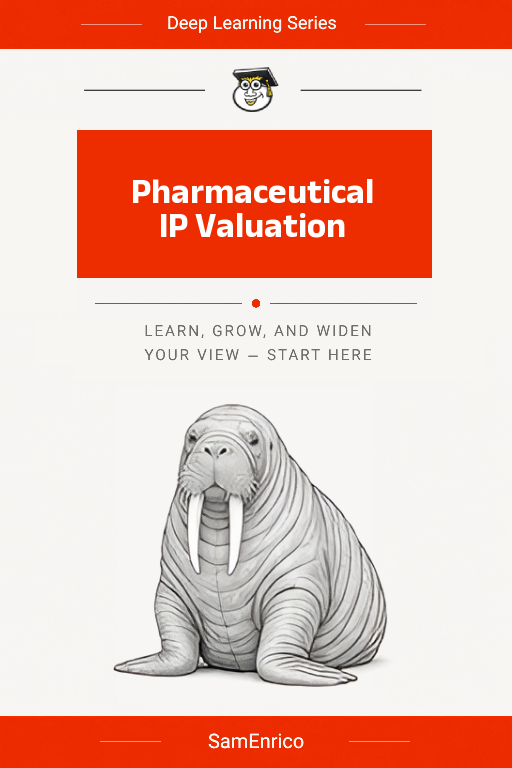
Non-FictionCapital & Valuation RegisterPharma
Pharmaceutical IP Valuation eBook
Values drug patents using risk-adjusted net presen
Values drug patents using risk-adjusted net present value and option pricing methods for clinical-stage assets.
Formats
Free sample
Chapter 1: The Two-Billion-Dollar Coin Flip...--–- The phone rang at 6:47 AM on a Tuesday in March. On the other end was a hedge fund manager I'll call David, though that is not his real name. His voice had the particular strain of someone who had watched three years of work evaporate in ninety minutes. "They missed," he said. "Primary endpoint.
p-value 0.21. The stock is down 70 percent pre-market." He paused. "I just lost two hundred million dollars."The drug was a Phase II asset for a rare form of kidney cancer. Forty-three patients. Twelve months of dosing.
A single binary outcome: did the drug shrink tumors more than placebo? The answer was no. Not because the drug was unsafe. Not because the manufacturing failed. Not because the patent was weak.
The drug simply did not work well enough in that specific group of patients, with that specific dosing regimen, at that specific point in time. Forty-three patients. Two hundred million dollars.This is the central paradox of pharmaceutical intellectual property valuation: a pre-revenue, pre-profit company with nothing more than a patent, a lab notebook, and a hypothesis can be worth multiple billions of dollars one day, and essentially zero the next. No factory burns down. No inventory is stolen.
No key employee quits. A statistical outcome changes, and billions of dollars transfer from shareholders to... nowhere. The money does not go to another company. It does not go to creditors.
It vaporizes.If you have picked up this book, you already sense that something is different about valuing drug patents compared to valuing other assets. You may have tried to use discounted cash flow, the workhorse method of corporate finance, and found that it produced numbers that felt either absurdly high or absurdly low with no middle ground. You may have sat through licensing negotiations where the two sides were an order of magnitude apart on value, not because one was greedy and the other was cheap, but because they fundamentally disagreed about how to think about risk. You may have looked at a biotech stock trading at a $500 million market cap and wondered: is this a bargain based on the Phase III data that just read out, or a trap?This chapter answers the first and most important question: why traditional valuation methods fail for pharmaceutical IP, and what that failure teaches us about the unique economics of drug development. By the end, you will understand why a drug patent is not like a factory, why DCF is worse than useless in this context, and why the valuation methods taught in the rest of this book exist at all.
More importantly, you will internalize the single most important fact in pharmaceutical valuation: nine out of ten drugs that enter clinical trials will never generate a dollar of revenue.The Binary Nature of Drug Development Most industries operate on a continuum. A factory can operate at 60 percent capacity or 90 percent capacity. A restaurant can be half full or full. A software company can sell 10,000 licenses or 100,000 licenses. Value changes gradually, predictably, and in proportion to inputs.
Pharmaceutical development operates on a binary: success or failure, approval or rejection, blockbuster or zero.This is not an exaggeration. Of the drugs that enter Phase I clinical trials, approximately 90 percent will never reach patients. The overall likelihood of approval (Lo A) from first-in-human dosing to market approval ranges from 7.9 percent to 9.6 percent depending on therapeutic area and the time period analyzed. For every ten drugs that enter clinical testing, nine fail. And when they fail, they fail completely.
There is no partial credit. A drug that is safe but not quite effective enough is not worth 30 percent of a successful drug. It is worth zero.Consider the numbers behind that 90 percent failure rate. A typical Phase I trial enrolls twenty to one hundred healthy volunteers or patients. The goal is safety and dosing, not efficacy.
Approximately 60 to 70 percent of drugs survive Phase I. Phase II is where most drugs die. This transition from safety testing to efficacy testing—from healthy volunteers to sick patients—is so brutal that it has earned its own name: the Valley of Death. In Phase II, a drug must demonstrate that it actually does something meaningful for patients. Approximately 30 to 40 percent of drugs survive Phase II.
Phase III, the large pivotal trial that serves as the primary basis for approval, kills another 40 to 50 percent of the drugs that enter it. Finally, of the drugs that submit a New Drug Application (NDA) or Biologics License Application (BLA) to the FDA, approximately 80 to 90 percent receive approval.Multiply those survival probabilities together: 0.65 × 0.35 × 0.55 × 0.85 equals approximately 0.106. Ten percent. Nine out of ten fail. This is not a bug in the system.
This is the system. Drug development is designed to be a filter that only the most effective and safest molecules survive. The FDA does not want to approve drugs that do not work. Patients do not want to take drugs that harm them. The high failure rate is a feature, not a flaw.The implication for valuation is immediate and devastating.
If you value a drug as if it will be approved—that is, if you forecast its peak sales, discount them back to the present, and call that the value—you will be wrong approximately 90 percent of the time. More importantly, you will be spectacularly wrong. A drug that fails is not worth 10 percent less than your forecast. It is worth 100 percent less. Your forecast error is not a small miss around the mean.
It is a binary error that flips your valuation from billions to zero.This is why pharmaceutical IP valuation cannot use the same tools as industrial or consumer goods valuation. The underlying economics are fundamentally different. A patent on a new chemical entity is not a claim on a stream of cash flows. It is a lottery ticket. A very expensive, highly educated, rigorously tested lottery ticket.
But a lottery ticket nonetheless. And like any lottery ticket, its value is not the payout if you win multiplied by an arbitrary discount rate. Its value is the payout if you win multiplied by the probability that you win.Why Tangible Assets Are Not Like Drug Patents To understand why drug patents break traditional valuation, we must first understand what traditional valuation assumes. Discounted cash flow, the gold standard of corporate finance, rests on three pillars. First, cash flows are predictable within a range.
Second, the business will continue operating for the foreseeable future. Third, the assets being valued are tangible or at least have a track record of producing cash.A factory is a tangible asset. It depreciates predictably. It can be sold for scrap value. Its output—automobiles, chemicals, packaged food—has a known market price.
If you own a factory, you can forecast next year's production within a narrow band. You can hedge input costs. You can negotiate long-term sales contracts. The factory will not suddenly become worthless because a regulator decides that automobiles are no longer useful.A drug patent is the opposite of a factory. It has no scrap value.
It depreciates not gradually but catastrophically on the date of patent expiry or, more commonly, on the date of a…
This is the end of the free sample. Get the eBook to keep going. Buy now
About this book
Details
- Author
- Logue Ramonita
- Publisher
- SamEnrico
- Language
- English
- Genre
- Non-Fiction, Capital & Valuation Register, Pharma
- Released
- 2026-05-30
- Pages (approx.)
- 142
- Available as
- eBook, Audiobook

Read better in the ZLOADR app
Your eBooks on your phone or tablet. Sign in with your SamEnrico account and start reading.
More by Logue Ramonita
 Emotion Regulation Diary CardLogue Ramonita$11.99
 Congress Of Vienna Redrawing Europe HandbookLogue Ramonita$11.99
 The Assertive Medical AdvocacyLogue Ramonita$11.99
 Pet Loss For Multiple LossLogue Ramonita$11.99
 The ADHD Sleep GuideLogue Ramonita$11.99
 Operation Black Buck: The Falklands' Secret Air WarLogue Ramonita$11.99
 Understanding Symphalangism Cushing TypeLogue Ramonita$17.99
 How to Start a Abrasive Grain of Aluminium Oxide Business (Beginners Guide)Logue Ramonita$11.99
 Family Engagement SpecialistLogue Ramonita$11.99
 Payment Terms Chinese GuideLogue Ramonita$12.99
You may also like
 Hong Kong Handover 1997Dunn Johnnie$11.99
 Zumba For Postnatal Recovery CourseNeal Christian$11.99
 Zumba for BeginnersLadner Nikia$11.99
 YouTube Comment Mining GuideHumes Pandora$12.99
 Worry Box MeditationCarlin Rudy$11.99
 Workplace Stress MeditationNguyen Lynn$11.99
 Workplace Stress and Sleep RepairHawley Ivory$11.99
 Workplace Perfectionism CureDelaney Jeffry$11.99
 Workplace Injustice Anger GuideWallen Isabelle$11.99
 Work Addiction and Burnout LinkGreenwood Ester$11.99
 Women in Yoga and WellnessBeattie Galina$11.99
 Women in Stand Up ComedyChun Evangeline$11.99