
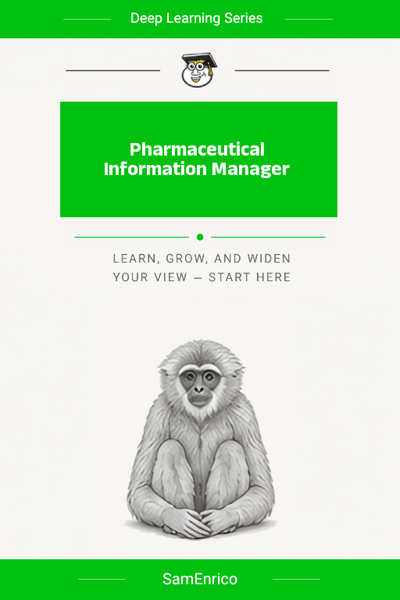
Non-FictionInformativeEducational
Pharmaceutical Information Manager eBook
A Coursebook on Pharmaceutical Information Manager
A Coursebook on Pharmaceutical Information Manager
Formats
Free sample
Chapter 1: The Hidden Role...--The voicemail arrived at 4:47 PM on a Friday, just as the medical information team was wrapping up for the week. A critical care physician in Ohio had a patient, a sixty-two-year-old woman recently started on a novel immunotherapy for advanced melanoma. She had developed a fever, new-onset confusion, and elevated liver enzymes. The physician needed to know, within the hour, whether these symptoms matched the drug's known safety profile or pointed to something else entirely. He also needed to know what to do next.
The pharmaceutical information manager who received that message would spend the next two hours not simply looking up facts but interpreting clinical data, weighing evidence quality, considering regulatory boundaries, and ultimately providing guidance that would directly affect a patient's survival.This is the hidden role that the pharmaceutical industry cannot fill fast enough. It is not pharmacy, though pharmacists excel at it. It is not regulatory affairs, though regulators scrutinize every output. It is not medical writing, though written communication is its daily currency. It is pharmaceutical information management, and it sits at the exact intersection of clinical pharmacology, data science, regulatory compliance, and patient safety.
The professionals who master this role command salaries ranging from ninety-five thousand dollars for entry-level positions to nearly two hundred thousand dollars for directors, yet most pharmacy students, life sciences graduates, and even experienced clinicians have never heard of it.The purpose of this chapter is to introduce you to this hidden profession, to help you understand whether you belong in it, and to give you a clear picture of what your first year in the role would actually look like. By the end of this chapter, you will know what pharmaceutical information management is, how it differs from related fields, where it came from, who succeeds in it, and whether you should pursue this path.Defining the Unseen Profession Pharmaceutical information management is the systematic process of collecting, evaluating, synthesizing, storing, and disseminating drug-related information to support safe and effective medication use, regulatory compliance, and clinical decision-making. That definition sounds academic, so let us break it into what you would actually do every day.You would receive questions from doctors, nurses, pharmacists, patients, and even your own company's sales representatives. The questions would range from simple dosing inquiries to complex safety assessments. You would search for evidence, evaluate its quality, and formulate responses that are accurate, balanced, and legally compliant.
You would document everything because regulators will eventually audit your work. You would work closely with pharmacovigilance to report adverse events. You would maintain knowledge bases of standard responses. You would train sales representatives on where to find information and what they cannot say. And you would do all of this under the constant pressure of regulatory scrutiny, because every word you write could become evidence in a lawsuit or an inspection finding.The pharmaceutical information manager is not merely a repository of drug facts.
That role is increasingly automated. Instead, the information manager is a strategic professional who bridges clinical knowledge, data stewardship, and regulatory compliance. You interpret conflicting evidence. You recognize when a question signals a potential safety issue. You know when to escalate and when to answer directly.
You understand the difference between what is legal to say and what is clinically accurate. You protect your company from regulatory action while ensuring that patients receive the information they need.The Three Faces of Drug Information Before we go deeper into the pharmaceutical industry role, we need to distinguish it from two related but distinct fields: drug information services and poisons information. Many people confuse these, and understanding the differences will help you see where you might fit.Drug information services typically operate within hospital pharmacies and academic medical centers. Their core function is providing evidence-based drug therapy advice to clinicians, pharmacists, and formulary committees. They answer questions like, "What is the best antibiotic for community-acquired pneumonia in a penicillin-allergic patient?" They have broad latitude to discuss off-label uses, unapproved indications, and comparative effectiveness across all available drugs.
They are not employed by drug manufacturers and therefore face no restrictions on promoting or not promoting specific products. Their funding usually comes from hospital operating budgets or academic institutions.Poisons information centres operate from specialized toxicology units, often affiliated with emergency departments. Their core function is providing poisoning management guidance to emergency physicians and the public. They answer questions like, "A two-year-old just swallowed three of grandma's blood pressure pills. What do we do?" They maintain detailed toxicology databases and provide real-time management advice for overdoses, envenomations, and chemical exposures.
Their staff typically includes clinical toxicologists and specially trained pharmacists.Medical information departments within pharmaceutical companies operate fundamentally differently. Their core function is providing product-specific inquiry responses to healthcare professionals, patients, sales forces, and regulators. They answer questions only about their company's own products. Unlike hospital drug information services, they cannot discuss off-label uses freely. Instead, they operate under strict regulatory prohibitions against promotion of unapproved indications.
Unlike poisons information centers, they do not provide medical advice. They cannot tell a patient to stop taking a medication or to change a dose. Their funding comes from the pharmaceutical company, which introduces both resources and constraints.While these three service models share core skills in literature evaluation and communication, they differ fundamentally in mission, legal constraints, and information sources. The hospital drug information pharmacist can say, "For this off-label use, evidence suggests effectiveness but safety data are limited." The pharmaceutical information manager must say, "This use has not been approved by regulatory authorities. Published evidence suggests X, Y, and Z, but we cannot recommend its use for this indication." The difference is not semantic; it is the difference between regulatory compliance and regulatory violation.The History You Need to Know You do not need a complete historical survey of drug information, but you do need to understand three periods that shaped the profession.The first period, the 1960s and 1970s, marked the emergence of organized drug information services.
The thalidomide tragedy of the early 1960s, in which a seemingly safe morning sickness medication caused severe birth defects in thousands of children, exposed the catastrophic consequences of inadequate drug safety information. In response, governments strengthened drug approval requirements and healthcare institutions sought ways to provide objective medication information to clinicians. The first United States drug information center opened at the University of Kentucky in 1962. These early centers focused on collecting and disseminating safety data, systematically evaluating adverse event reports, and answering clinician questions about newly approved drugs. The model spread gradually across academic medical centers and large hospital systems.The second period, the 1980s and 1990s, brought professionalization.
The Drug Information Association was founded in 1965 but gained significant influence in this period. Specialized journals including the Drug Information Journal began publishing research on information management practices. Professional organizations established standards for drug information services, created training programs, and advocated for recognition of drug information as a distinct pharmacy specialty. Pharmaceutical companies, recognizing both the regulatory necessity and the strategic value of medical information, began building dedicated medical information departments separate from sales and marketing.The third period, from 2000 to the present, has seen strategic integration.…
This is the end of the free sample. Get the eBook to keep going. Buy now
About this book
Details
- Author
- Vetter Vasiliki
- Publisher
- SamEnrico
- Language
- English
- Genre
- Non-Fiction, Informative, Educational
- Released
- 2026-05-07
- Pages (approx.)
- 150
- Available as
- eBook, Audiobook

Read better in the ZLOADR app
Your eBooks on your phone or tablet. Sign in with your SamEnrico account and start reading.
More by Vetter Vasiliki
 Bullet Maturity StructuresVetter Vasiliki$11.99
 Heist Reenactment GuideVetter Vasiliki$11.99
 The Leveraged Buyout Modeling GuideVetter Vasiliki$11.99
 Bariatric Surgery Gallstone PreventionVetter Vasiliki$11.99
 Gluten Free Grain Alternatives HandbookVetter Vasiliki$11.99
 The Frozen Scrolls: Deciphering the Arctic's Lost Viking RunesVetter Vasiliki$11.99
 The Visionary Behind the Lens: How James Cameron Reinvented FilmmakingVetter Vasiliki$11.99
 Understanding Cataract Dental SyndromeVetter Vasiliki$17.99
 European Research Council FormatVetter Vasiliki$12.99
 Business Credit Monitoring ToolsVetter Vasiliki$12.99
 How to Become a Desulfurizer OperatorVetter Vasiliki$11.99
You may also like
 Hong Kong Handover 1997Dunn Johnnie$11.99
 Zumba For Postnatal Recovery CourseNeal Christian$11.99
 Zumba for BeginnersLadner Nikia$11.99
 YouTube Comment Mining GuideHumes Pandora$12.99
 Worry Box MeditationCarlin Rudy$11.99
 Workplace Stress MeditationNguyen Lynn$11.99
 Workplace Stress and Sleep RepairHawley Ivory$11.99
 Workplace Perfectionism CureDelaney Jeffry$11.99
 Workplace Injustice Anger GuideWallen Isabelle$11.99
 Work Addiction and Burnout LinkGreenwood Ester$11.99
 Women in Yoga and WellnessBeattie Galina$11.99
 Women in Stand Up ComedyChun Evangeline$11.99