
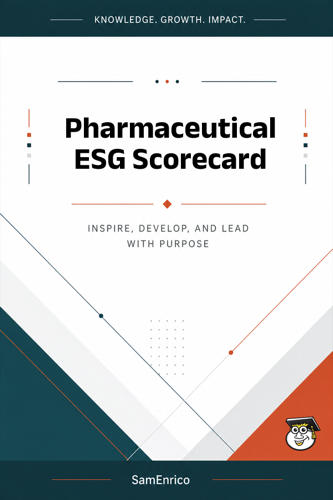
Pharmaceutical ESG Scorecard
Evaluate drug pricing ethics and environmental imp
Evaluate drug pricing ethics and environmental impact across major healthcare firms.
Formats
About this book
Free sample
Chapter 1: The Materiality Maze--–- It was a Tuesday morning in March 2021 when the portfolio manager at a $50 billion pension fund learned that his largest pharmaceutical holding—a seemingly stable, dividend-paying giant—had just lost 12% of its market value. There was no earnings miss, no clinical trial failure, and no product recall. The trigger was a single paragraph in a congressional staff report about drug pricing practices that had been public for three weeks but had gone unnoticed by his team. The report mentioned the company’s name alongside the phrase “excessive pricing relative to therapeutic benefit.” That was enough. Within five trading days, the stock had shed $8 billion in value.
The manager had done everything right by traditional metrics: the company had a strong pipeline, a P/E ratio below industry average, and a dividend yield that beat Treasury bonds. What he had not done was understand the materiality of pharmaceutical-specific ESG risks—specifically, how pricing ethics and environmental liabilities could move markets faster than any clinical readout.This book exists because that Tuesday morning happens dozens of times every year. And it happens because the financial industry continues to apply generic analytical frameworks to an industry that is anything but generic. Pharmaceutical companies operate at the intersection of life-saving science, government regulation, public desperation, and planetary boundaries. A pricing decision made in a conference room in New Jersey can cause protests in Berlin, congressional hearings in Washington, and a shareholder resolution filed in London—all within the same quarter.
A wastewater discharge from a factory in Hyderabad can contaminate a river that supplies drinking water to three million people, generate a documentary by an investigative journalist, and result in a supply chain shutdown by European regulators. Traditional financial analysis, with its focus on revenue growth, operating margins, and earnings per share, does not merely miss these risks. It actively blinds investors to them.The failure is not one of diligence but of framework. Equity analysts are trained to ask: What is the addressable market for this new drug? What is the patent expiration schedule?
What is the gross margin on this product line? These are essential questions, but they are no longer sufficient. The…
This is the end of the free sample. Get the eBook to keep going. Buy now
Contents
- Chapter 1
- Chapter 2
- Chapter 3
- Chapter 4
- Chapter 5
- Chapter 6
- Chapter 7
- Chapter 8
- Chapter 9
- Chapter 10
- Chapter 11
- Chapter 12
Details
- Author
- Buckner Teisha
- Publisher
- SamEnrico
- Language
- English
- Genre
- Non-Fiction, Strategic Atlas, Healthcare ESG
- Released
- 2026-06-12
- Pages (approx.)
- 138
- Available as
- eBook, Audiobook

Read better in the ZLOADR app
Your eBooks on your phone or tablet. Sign in with your SamEnrico account and start reading.
More by Buckner Teisha
 Metta for a Loved OneBuckner Teisha$11.99
 The Stress Blood HealthBuckner Teisha$11.99
 Twin Or Multiples Loss Support GuideBuckner Teisha$11.99
 The Bullying Forgiveness GuideBuckner Teisha$11.99
 The Calculus of the Cosmos: Benin's Astronomical MathematiciansBuckner Teisha$11.99
 Side Hustle to LLC GuideBuckner Teisha$12.99
 Paydex Score US GuideBuckner Teisha$12.99
 Understanding SarcoidosisBuckner Teisha$17.99
 Personal Assistant to CEOBuckner Teisha$11.99
 How to Become a Dry-pan OperatorBuckner Teisha$11.99