

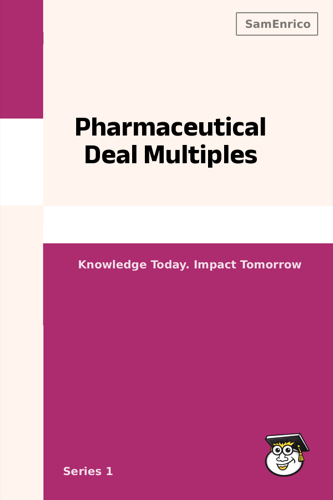
Non-FictionCapital & Valuation RegisterPharma Finance
Pharmaceutical Deal Multiples eBook
Benchmark drug company and biotech acquisitions us
Benchmark drug company and biotech acquisitions using this precedent transaction guide.
Formats
Free sample
Chapter 1: The Classification Mandate--–- Every failed pharmaceutical acquisition leaves behind a trail of expensive lessons, but the most expensive lesson of all is also the simplest: valuing a company before you know what kind of company it is. In 2021, a mid-sized biotech with a promising gene therapy asset accepted a $1.2 billion buyout offer. The buyer, a large pharmaceutical company, had benchmarked the deal against twelve precedent transactions. The multiples looked reasonable. The bankers signed off.
The deal closed.Eighteen months later, the drug failed Phase III trials. The buyer wrote off the entire acquisition. The sell-side advisors, however, had done just fine.The post-mortem revealed a fundamental error. The precedent transactions the buyer had used as comparables were almost entirely single-asset, clinical-stage companies. The target, by contrast, had a diversified platform with three independent assets and a proprietary delivery technology.
The buyer had paid a single-asset price for a platform company. The difference between what they paid and what they should have paid was approximately $800 million.This chapter solves that problem before it starts.The Classification Mandate is the single most important framework in this book because every other valuation tool—every multiple, every r NPV calculation, every precedent transaction comparison—depends entirely on correctly categorizing your target. Misclassify a platform company as a pipeline company and you will underpay, losing the deal to a sharper competitor. Misclassify a single-asset company as a platform and you will overpay, destroying shareholder value. Get the classification right and everything else follows.This chapter teaches you how to classify any pharmaceutical or biotech acquisition target into one of three distinct valuation archetypes, each with its own appropriate valuation methodology, multiple ranges, and strategic considerations.
By the end of this chapter, you will never again confuse a platform for a pipeline or a pipeline for a commercial company. You will have a classification system that works for preclinical startups and multinational pharma giants alike. And you will understand why optionality—the most valuable and most misunderstood concept in biotech valuation—separates billion-dollar platforms from million-dollar one-hit wonders.The Three Valuation Archetypes Every pharmaceutical and biotech acquisition target falls into one of three maturity categories. These categories are not arbitrary stages of development; they reflect fundamentally different sources of value, different risk profiles, and different valuation methodologies. Confusing them is the fastest path to valuation error.Platform Companies: Value in Optionality A platform company is defined not by what it has produced but by what it can produce.
These are pre-revenue, technology-focused entities where the primary asset is a proprietary technology platform—m RNA delivery, gene editing, antibody-drug conjugates, T-cell engagers, or any other enabling technology that can generate multiple drug candidates across multiple indications.The defining characteristic of a platform company is optionality. A single-asset company has one shot on goal. If that asset fails, the company is worth zero. A platform company with three independent assets in the pipeline has three shots on goal, and the failure of any one asset does not destroy the enterprise. More importantly, a platform can generate new assets that do not yet exist.
The value of the platform is not the sum of its current pipeline; it is the net present value of all future pipelines that the platform can generate.Consider two hypothetical companies. Company A has one Phase II asset for a rare disease with $500 million in peak sales potential. Company B has a proprietary lipid nanoparticle delivery platform that has generated one Phase II asset, one preclinical asset, and the capability to generate three more preclinical assets over the next two years. Company A is a pipeline company. Company B is a platform company.
Their valuations will diverge dramatically, even though their current clinical-stage assets look similar.Platform companies trade at a premium to single-asset companies because optionality has value. A diversified platform has a higher probability of at least one successful asset. It has greater strategic flexibility to pursue multiple indications. It provides a hedge against binary clinical risk. And for a strategic acquirer, a platform can fill multiple pipeline gaps simultaneously, not just one.However—and this is a critical distinction that Chapter 9 will quantify in detail—not all platforms are created equal.
An early-stage, unproven platform with no human data is valued very differently from a proven platform with multiple clinical-stage assets. The optionality premium exists on a spectrum. A preclinical m RNA platform with only in vitro data might trade at a modest premium over its R&D costs. A platform with three Phase II assets and validated human data might trade at a massive premium captured through sum-of-the-parts r NPV.For classification purposes, a company is a platform if two conditions are met. First, the company possesses a proprietary technology that can generate multiple distinct drug candidates.
Second, the company either has already generated multiple candidates or has a credible plan to do so. If both conditions are true, classify as a platform company.Pipeline Companies: Value in Probability-Adjusted Peak Sales A pipeline company has clinical-stage assets but no commercial revenue. Unlike platform companies, pipeline companies do not possess a technology that can generate endless new candidates. Instead, they have a finite set of drug candidates in development, typically one to three assets, often in related indications or from a common mechanism rather than a true platform.The defining characteristic of a pipeline company is binary risk. Each asset either succeeds or fails in clinical trials.
There is no "platform" to fall back on. If the lead asset fails, the company may be worthless. If it succeeds, the company may be worth billions. This binary nature creates the wide valuation swings that characterize biotech investing.For valuation purposes, pipeline companies are best analyzed using r NPV (risk-adjusted net present value), which Chapter 3 covers in exhaustive detail. The core logic is straightforward: project peak sales for each asset, discount for the probability of success at each clinical phase, and sum the results.
Multiples like EV/Revenue are generally not applicable because pipeline companies have no revenue. EV/EBITDA is also not applicable because pipeline companies have negative EBITDA due to R&D spending that exceeds any licensing or collaboration revenue.A pipeline company becomes a commercial company only when it receives regulatory approval and begins generating meaningful revenue from product sales. Until that point, it remains a pipeline company for valuation purposes, even if it has filed a New Drug Application or is awaiting an FDA decision.For classification purposes, a company is a pipeline company if three conditions are met. First, the company has no commercial revenue from product sales. Second, the company's assets are finite and not generated by a repeatable platform.
Third, the company's primary value driver is the probability-adjusted net present value of its clinical-stage assets.Commercial Companies: Value in Revenue and EBITDAA commercial company has marketed products with established revenue streams. These companies may be profitable or pre-profit, but they have moved beyond binary clinical risk for at least one asset. The revenue is real, the customers are paying, and the commercial infrastructure is in place.The defining characteristic of a commercial company is cash flow visibility. Unlike pipeline companies, where value depends on uncertain future…
This is the end of the free sample. Get the eBook to keep going. Buy now
About this book
Details
- Author
- Wester Demetrius
- Publisher
- SamEnrico
- Language
- English
- Genre
- Non-Fiction, Capital & Valuation Register, Pharma Finance
- Released
- 2026-06-06
- Pages (approx.)
- 157
- Available as
- eBook, Audiobook

Read better in the ZLOADR app
Your eBooks on your phone or tablet. Sign in with your SamEnrico account and start reading.
More by Wester Demetrius
 LBO Secondaries Market GuideWester Demetrius$11.99
 Customer Service EQ GuideWester Demetrius$11.99
 The Dubai Library GuideWester Demetrius$11.99
 Flossing Habit FormationWester Demetrius$11.99
 Diabetic NeuropathyWester Demetrius$11.99
 Dental Charting GuideWester Demetrius$11.99
 Thai Massage StretchingWester Demetrius$11.99
 The Golden Vow: A Royal Love That Built an EmpireWester Demetrius$11.99
 How to Produce PET Waste BagsWester Demetrius$11.99
 How to Produce Deck Shuffleboard PucksWester Demetrius$11.99
 One Page Referral Program PrimerWester Demetrius$12.99
 Philippines Remote Hiring HandbookWester Demetrius$12.99
You may also like
 Hong Kong Handover 1997Dunn Johnnie$11.99
 Zumba For Postnatal Recovery CourseNeal Christian$11.99
 Zumba for BeginnersLadner Nikia$11.99
 YouTube Comment Mining GuideHumes Pandora$12.99
 Worry Box MeditationCarlin Rudy$11.99
 Workplace Stress MeditationNguyen Lynn$11.99
 Workplace Stress and Sleep RepairHawley Ivory$11.99
 Workplace Perfectionism CureDelaney Jeffry$11.99
 Workplace Injustice Anger GuideWallen Isabelle$11.99
 Work Addiction and Burnout LinkGreenwood Ester$11.99
 Women in Yoga and WellnessBeattie Galina$11.99
 Women in Stand Up ComedyChun Evangeline$11.99