
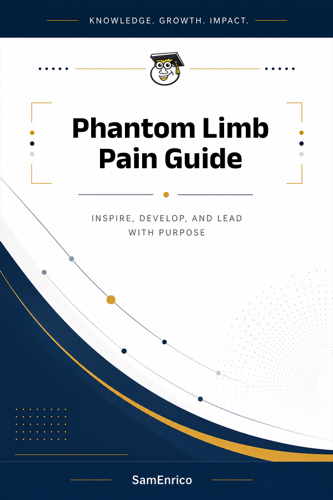
Non-FictionSelf-HelpAmputation
Phantom Limb Pain Guide eBook
Addresses sensation in missing limbs through body
by Lam Chloe
Addresses sensation in missing limbs through body awareness.
Formats
Free sample
Chapter 1: The Living Map...--–- The first time Sarah felt her missing fingers itch, she was standing in line at a grocery store, three months after the accident. She looked down at her right forearm—which ended just below the elbow—and watched empty space where her hand used to be. The itching was unbearable. She tried to scratch her phantom thumb against her phantom index finger, a gesture she had made ten thousand times in her life, and felt the familiar friction of nail on skin. Except there was no skin.
There was no thumb. There was no hand. She stood frozen in the checkout aisle, convinced she was losing her mind. It took her another six weeks to tell anyone about it. When she finally described the sensation to her surgeon, he nodded without looking up from his clipboard and said, "That's just phantom pain.
Take these pills." He did not explain why she could feel a hand that was no longer there. He did not tell her that 90 to 98 percent of amputees experience the same phenomenon. He did not say that her experience was not madness but neurology—perfectly normal, predictable, and potentially treatable. This book is the explanation he should have given her.The Territory That Never Leaves You have a body map. You have always had one, though you have never seen it directly.
It lives in your brain, specifically in a strip of tissue called the sensorimotor cortex, which runs like a headband from one ear to the other over the top of your head. This map is not a metaphor. It is a physical structure made of billions of neurons organized into precise, recognizable patterns. Every square inch of your body corresponds to a specific patch of cortical real estate. Your lips, for example, occupy a vast territory because they are exquisitely sensitive.
Your back, by contrast, occupies a tiny sliver because it is relatively numb. Your hands—especially your fingertips—take up an enormous amount of space, nearly as much as your entire torso combined. This is the homunculus, the "little man" drawn inside your skull. He looks nothing like you. His lips are enormous.
His hands are gigantic. His thighs are the size of raisins.Now consider what happens when a limb is removed. The body map does not vanish. It cannot vanish. The brain does not know that the limb is gone because the brain does not receive mail from the post office of the body.
The brain receives electrical signals—or the absence of signals—and it must interpret those signals using the only tool it has: the map it built over a lifetime. When a limb is amputated, the brain area that once controlled that limb goes silent. But silence is not deletion. It is more like a stage after the actors have left. The curtain is still there.
The lights are still rigged. The audience expects a performance. And because the brain abhors idle real estate, neighboring areas begin to send their signals into the empty territory. The face map creeps into the hand map. The thigh map colonizes the foot map.
This is called cortical remapping, and it explains why a touch on your cheek might feel like a touch on your missing thumb, or why moving your shoulder might trigger a cramp in your missing hand. Your brain is not broken. It is doing exactly what brains evolved to do: use every scrap of tissue for something. The problem is that the "something" is now a ghost.The Neuromatrix: Your Brain's Hidden Blueprint In the 1990s, a neuroscientist named V.S. Ramachandran proposed a radical idea.
He suggested that the body map is not a passive receiver of signals but an active generator of experience. He called this the neuromatrix. The neuromatrix is your brain's internal model of your body, constructed from sensory input, memory, expectation, and genetic programming. It is not a photograph. It is a live simulation, constantly updated, constantly predicting what your body should feel like at any given moment.
When the simulation matches reality, you feel nothing unusual. When the simulation diverges from reality, you feel something strange—a phantom limb, a missing hand that still itches, a foot that feels permanently curled inside a shoe that no longer exists.Think of it this way. Imagine you have lived in the same house for forty years. You know every creak in the floorboards, every draft from the windows, every angle of the afternoon light. One day, you demolish the back porch.
You tear down the wood, remove the steps, and pave over the foundation. But for months afterward, you still find yourself stepping over a threshold that is no longer there. You still reach for a railing that vanished with the demolition. Your body remembers the porch. Your neuromatrix still includes it.
The porch is gone in physical reality but present in your neural blueprint. That is the phantom limb phenomenon. It is not hallucination. It is not psychiatric illness. It is the normal, predictable consequence of having a brain that builds predictive models of the body.Why Sensation Does Not Equal Pain One of the most important distinctions in this entire book—perhaps the most important—is the difference between phantom sensation and phantom pain.
They are not the same thing, though they are often confused by patients and clinicians alike. Phantom sensation is any feeling in the missing limb that is not painful. This includes warmth, cold, tingling, pressure, position sense (the feeling that your missing hand is resting on a table or that your missing foot is pointing downward), itching, crawling, the sensation of wearing a ring or a watch, and even the feeling of movement. Phantom sensation is extraordinarily common. Nearly every amputee experiences it.
Most describe it as strange but not distressing. Some find it mildly annoying. A few find it comforting, as if the missing limb is still keeping them company.Phantom pain, by contrast, is a distinct phenomenon. It is not simply "stronger" phantom sensation. It is qualitatively different.
Patients describe it as cramping, burning, crushing, shooting, stabbing, or electric. It can be intermittent or constant. It can be triggered by stress, weather changes, fatigue, or nothing at all. It can last seconds or days. And critically, phantom pain and phantom sensation do not always correlate.
Some people have severe phantom pain with no non-painful sensation. Others have rich, detailed phantom sensation without a trace of pain. Still others have both. The clinical literature suggests that about 80 percent of amputees experience phantom pain at some point, but nearly all experience phantom sensation. This means that phantom sensation is the baseline phenomenon.
Pain is an overlay, a complication, an additional layer that can often be treated separately from the underlying map.The Third Category: Residual Limb Pain There is a third phenomenon that must be distinguished from both phantom sensation and phantom pain: residual limb pain. This is pain coming from the stump itself—the remaining portion of the amputated limb. It arises from nerve endings that were cut during surgery (neuromas), from bone spurs, from scar tissue, from poor prosthetic fit, or from skin breakdown.…
This is the end of the free sample. Get the eBook to keep going. Buy now
About this book
Details
- Author
- Lam Chloe
- Publisher
- SamEnrico
- Language
- English
- Genre
- Non-Fiction, Self-Help, Amputation
- Released
- 2026-06-09
- Pages (approx.)
- 126
- Available as
- eBook, Audiobook

Read better in the ZLOADR app
Your eBooks on your phone or tablet. Sign in with your SamEnrico account and start reading.
More by Lam Chloe
 Product Development Creativity GuideLam Chloe$11.99
 Emotional Eating in MenopauseLam Chloe$11.99
 The Global NetworkerLam Chloe$11.99
 Air Traffic Controller Burnout GuideLam Chloe$11.99
 The Storm Chasers of the Age of Discovery: Navigating the Atlantic's WrathLam Chloe$11.99
 The Phantom Tide: The Lost Fleet of the Black SeaLam Chloe$11.99
 Understanding Facio Skeletal Genital Syndrome Rippberger TypeLam Chloe$17.99
 Partner Success ManagerLam Chloe$11.99
 How to Become a Mold PresserLam Chloe$11.99
 Procurement in MergersLam Chloe$12.99
 Writing Executive Summaries for Merger DocumentsLam Chloe$12.99
You may also like
 Hong Kong Handover 1997Dunn Johnnie$11.99
 Zumba For Postnatal Recovery CourseNeal Christian$11.99
 Zumba for BeginnersLadner Nikia$11.99
 YouTube Comment Mining GuideHumes Pandora$12.99
 Worry Box MeditationCarlin Rudy$11.99
 Workplace Stress MeditationNguyen Lynn$11.99
 Workplace Stress and Sleep RepairHawley Ivory$11.99
 Workplace Perfectionism CureDelaney Jeffry$11.99
 Workplace Injustice Anger GuideWallen Isabelle$11.99
 Work Addiction and Burnout LinkGreenwood Ester$11.99
 Women in Yoga and WellnessBeattie Galina$11.99
 Women in Stand Up ComedyChun Evangeline$11.99