
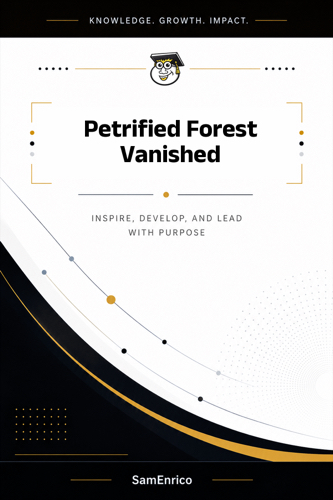
Free sample
Chapter 1: The Forest Before Time...--The first thing you need to understand about the Petrified Forest is that it was never a forest. Not really. Not in the way you imagine when you hear that word—no shady canopy of leaves, no birdsong echoing between mossy trunks, no soft carpet of ferns and fallen nuts underfoot. The thing you are looking at when you stand on the rim of the Painted Desert and gaze across the badlands—those lavender and crimson hills, those scattered logs that look like dragon bones—is the ghost of a world so alien that you would not survive ten minutes in it. The air would choke you.
The heat would cook you. The silence would drive you mad. And yet, against all odds, that world produced something that would outlast continents, ice ages, and the rise and fall of every empire ever built. It produced stone. But not just any stone.
It produced a forest made of crystal.This is not a metaphor. When you run your fingers over a petrified log in the Giant Logs section of the park, what you are touching is not rock that looks like wood. It is wood that became rock. Every cell wall, every growth ring, every microscopic tube that once carried water from root to leaf—all of it is still there, but transmuted. The lignin and cellulose are gone, replaced atom by atom by quartz, opal, and chalcedony.
The tree did not rot. It did not burn. It did not get crushed into coal. Instead, it underwent a transformation so precise that a geologist can count the tree's years by the bands of iron and manganese that now color what was once living tissue. The tree is dead, yes.
But it is also more permanent than anything that has ever lived. The forest vanished 225 million years ago. And then it came back as gemstone.To understand how this happened—to truly grasp the scale of time and violence required to turn a tree into a jewel—you have to go back to the beginning. Not the beginning of the park. Not the beginning of Arizona.
The beginning of the world as we know it. The Late Triassic period. A time when all the continents were smashed together into one giant landmass called Pangaea. A time before flowers, before grass, before bees. A time when the first dinosaurs were the size of chickens and the top predators were not reptiles but enormous amphibians left over from an even earlier age.
And at the heart of this alien world, along the equator where Arizona would eventually drift, there stood a forest of trees unlike any that exist today.The World That Vanished Let us perform an act of radical imagination. Close your eyes. Forget everything you know about North America. The continent does not exist yet. The Rocky Mountains are still 150 million years from being born.
The Atlantic Ocean is a crack in the earth's crust that has not yet begun to bleed. Instead, you are standing on a floodplain near the equator of Pangaea. The sun is merciless. The air is thick with humidity and carbon dioxide—five times the level of today's atmosphere. There are no seasons as you know them.
There is only wet and dry. When the monsoons come, they come for months at a time, turning rivers into lakes and lakes into inland seas. When the dry season arrives, the mud cracks into polygons and the ferns turn brown and wait.And rising from this floodplain, reaching two hundred feet into the sky, are the Araucarioxylon arizonicum trees. They are conifers, relatives of the modern Norfolk Island pine, but they are not pines. They have no needles, exactly, but rather scale-like leaves pressed tight against their branches.
Their trunks are massive—ten, twelve, fifteen feet in diameter—and completely bare of branches until the very top. They look like telephone poles topped with green pom-poms. And they are everywhere. Not in dense groves like a redwood forest, but scattered across the floodplain like solitary giants, each one claiming its own territory.There is no grass beneath your feet. Grass will not evolve for another 150 million years.
Instead, the ground is covered in ferns, some of them low and lacy, some of them as tall as your waist, and horsetails that grow in dense thickets along the riverbanks. There are no flowers. Angiosperms—flowering plants—are still tens of millions of years in the future. There are no fruits, no nuts, no seeds in the modern sense. The trees reproduce with cones, and the ferns reproduce with spores, and that is the entire botanical menu.Listen.
What do you hear? Not birds. Birds will not evolve from dinosaurs for another 75 million years. The first crickets evolved 300 million years ago, in the Carboniferous, so you would hear their distant chirping—but not the constant drone you associate with a summer night. That sound, the modern cricket chorus, is a Jurassic innovation.
In the Triassic, crickets were still new, still sparse, still figuring out how to make noise. Frogs you would hear. Frogs have existed since the Early Triassic, 250 million years ago, and their ancestors were already calling along the riverbanks. But the loudest sound, the one that would fill your ears if you stood there for an hour, would be the wind. The wind across the ferns.
The wind through the scale-leaves of the Araucarioxylon two hundred feet above your head. And occasionally, the hiss and chatter of pterosaurs gliding overhead—their calls lost to time, but their bones preserved in the same rocks that hold the trees.Now look up. The sky is not blue. Not exactly. With five times the CO2 in the atmosphere, the sky would have a yellowish haze, especially near the horizon.
The sun is larger in this sky because the earth is closer to it? No, that is a myth. The sun is the same size. But the air is so thick with humidity and volcanic dust that the sun often appears as a hazy disk behind a veil. And at night, the stars are the same as they have always been, but the moon is closer—the moon is slowly drifting away from Earth, and 225 million years ago it was noticeably larger in the sky.
A Triassic night would have been brighter than ours, lit by a giant moon and unspoiled by any human light.This is the world that vanished. And in this world, the Araucarioxylon trees lived their long, slow lives. They grew for centuries, adding ring after ring of wood. They withstood floods and droughts. They dropped their cones and their scale-leaves into the mud.
And then, one day, they died. Not all at once. Not in a single catastrophe. But over thousands of years, as the climate shifted and the rivers changed course, the forest began to thin. Fallen logs lay in the mud.
Young trees struggled to take root. And then the volcanoes erupted.The Ash Fall There is a moment in deep time that geologists call the "end-Triassic extinction." It happened 201 million years ago, give or take a few hundred thousand years.…
This is the end of the free sample. Get the eBook to keep going. Buy now
About this book
Details
- Author
- Conyers Mitzi
- Publisher
- SamEnrico
- Language
- English
- Genre
- Non-Fiction, True Crime / National Parks
- Released
- 2026-06-09
- Pages (approx.)
- 149
- Available as
- eBook, Audiobook

Read better in the ZLOADR app
Your eBooks on your phone or tablet. Sign in with your SamEnrico account and start reading.
More by Conyers Mitzi
 Body Image Resilience Against Media MythsConyers Mitzi$11.99
 Ben Silbermann PinterestConyers Mitzi$11.99
 Nobel Prize Poverty Research GuideConyers Mitzi$11.99
 Elder Financial Abuse SignsConyers Mitzi$11.99
 Vehicle Through Sahara SandsConyers Mitzi$11.99
 Glasses Push as DisagreementConyers Mitzi$11.99
 Beginner Mindfulness Of UrgesConyers Mitzi$11.99
 The Quantum Leap That Split RealityConyers Mitzi$11.99
 Anansi's Golden Web: Lessons from the Spider TricksterConyers Mitzi$11.99
 The Mineral Guide to AlarsiteConyers Mitzi$11.99
 How to Become a Brine Maker IConyers Mitzi$11.99
 Cracking JEE Through Self StudyConyers Mitzi$12.99
You may also like
 Hong Kong Handover 1997Dunn Johnnie$11.99
 Zumba For Postnatal Recovery CourseNeal Christian$11.99
 Zumba for BeginnersLadner Nikia$11.99
 YouTube Comment Mining GuideHumes Pandora$12.99
 Worry Box MeditationCarlin Rudy$11.99
 Workplace Stress MeditationNguyen Lynn$11.99
 Workplace Stress and Sleep RepairHawley Ivory$11.99
 Workplace Perfectionism CureDelaney Jeffry$11.99
 Workplace Injustice Anger GuideWallen Isabelle$11.99
 Work Addiction and Burnout LinkGreenwood Ester$11.99
 Women in Yoga and WellnessBeattie Galina$11.99
 Women in Stand Up ComedyChun Evangeline$11.99