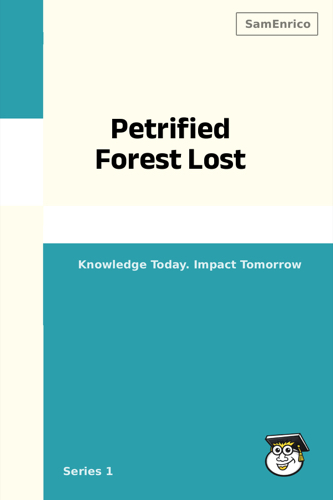
Petrified Forest Lost eBook
Investigates vanishings in Arizona badlands.
by Guess Tonda
Investigates vanishings in Arizona badlands.
Formats
Free sample
Chapter 1: The Stone Forest...--–- The first thing you notice is the silence. Not the peaceful quiet of a forest after snow, nor the soft stillness of a desert dawn. This is a heavier silence, the kind that presses against your eardrums like deep water. You stand at the edge of the Painted Desert, looking out over a landscape that seems to have been designed by a mind that had never encountered the concept of mercy. The ground beneath your feet is not dirt.
It is shattered gemstones—amethyst, citrine, jasper, quartz—all of them once trees. Two hundred and twenty-five million years ago, giant conifers fell in ancient floodplains. Volcanic ash buried them. Groundwater carrying silica seeped through their cells. And over eons, the organic matter was replaced, molecule by molecule, by stone.
The trees did not rot. They did not return to the earth. They became something harder, sharper, and infinitely stranger. They became a forest of rock.The Petrified Forest National Park sits in northeastern Arizona, a five-hour drive from Phoenix and a world away from everything else. The park covers roughly 146 square miles of badlands—a geological term that sounds like an opinion but is actually a technical classification.
Badlands form when soft sedimentary rock erodes into a maze of steep slopes, sharp ridges, and deep gullies. They are called badlands because they are nearly impossible to traverse, because they grow nothing edible, because they hide their secrets well. The Painted Desert, which overlaps with the park, adds another layer of strangeness: its hills are striped in bands of lavender, vermilion, ochre, and pale gray, the colors shifting with the angle of the sun. At noon, the landscape looks exhausted, bleached white by the heat. At sunset, it burns.
At twilight, it seems to hold its breath.The people who vanish here do not simply get lost. They are absorbed.The Geography of Disappearance To understand why this particular patch of Arizona consumes so many travelers, you must first understand what the ground is made of. The petrified logs that give the park its name are not scattered randomly across the surface. They lie in dense concentrations, like the bones of a mass extinction event, which in a sense they are. The Chinle Formation—the geological layer that contains the petrified wood—was deposited during the Late Triassic period, when this part of North America was a vast tropical floodplain crisscrossed by rivers.
The trees grew tall along these waterways, fell into the mud, and were buried by successive layers of silt, ash, and sand. When the Colorado Plateau began to rise millions of years later, the softer rock around them eroded away, leaving the harder petrified logs behind. The result is a landscape that looks like the wreckage of a world that never quite finished forming.But the geology is only the beginning. The petrified wood itself is dangerous in ways that have nothing to do with curses or folklore. Freshly fractured surfaces of the logs are razor-sharp, capable of slicing through hiking boots and flesh with equal ease.
The park service has documented cases of visitors who fell while climbing on the logs and required dozens of stitches. Others have cut themselves reaching down to pick up a "pretty rock" and found themselves bleeding into the sand with no first aid kit for miles. The logs are also deceptively unstable. They look solid, rooted in the earth like the trees they once were. But they are not rooted.
They rest on crumbling pedestals of softer stone, balanced precariously after centuries of wind and flash floods. A single wrong step can send a log weighing several tons rolling downhill, crushing anything in its path.The terrain between the logs is no safer. The badlands are cut by arroyos—steep-sided gullies that are bone-dry most of the year but can become raging torrents in minutes during the summer monsoon season. These flash floods move with shocking speed, carrying boulders, trees, and anything else in their path. They are the leading cause of weather-related deaths in the Arizona backcountry, and they are particularly dangerous in the Petrified Forest because the hard, compacted clay of the badlands absorbs almost no water.
Every drop that falls runs off immediately, gathering speed and force as it funnels into the arroyos. A hiker standing at the bottom of a dry wash on a sunny afternoon can be swept away by a wall of water from a storm ten miles away, invisible over the horizon.This is the physical reality of the Petrified Forest: a maze of sharp stone, collapsing ledges, flash-flood channels, and a total lack of shade for most of the year. Summer temperatures regularly exceed 100 degrees Fahrenheit, and the dry air wicks moisture from the body so efficiently that dehydration can set in within hours. A person who becomes lost here has, on average, less than twenty-four hours before heat exhaustion progresses to heat stroke, and then to organ failure. The park receives fewer than ten inches of rain per year, so finding water is a matter of luck, not planning.
The few natural springs are hidden in remote canyons, their locations known only to the deer and the coyotes.But physical danger does not explain everything. It does not explain why experienced hikers with maps, water, and satellite phones still vanish. It does not explain the cases where the bodies are never found, even when search teams comb every inch of the terrain within a twenty-mile radius. It does not explain the letters.The Curse as Data Park rangers at the Petrified Forest have an unusual ritual. Once a month, someone from the visitor center drives to the exit gates and empties the amnesty boxes—wire mesh containers where visitors can anonymously return petrified wood they have stolen.
The boxes fill up quickly. In 1999, park staff weighed the contents of the amnesty boxes over a twelve-month period and found that visitors had returned more than 100 pounds of stolen wood per month, despite signs at every exit warning that theft is a federal crime punishable by fines of up to $10,000. That is only the wood that comes back. The 1991 UV paint study, in which researchers secretly marked 1,000 logs and tracked them through exit checkpoints, found that visitors were removing an estimated 12 tons of petrified wood from the park every week.The amnesty boxes are not just filled with rocks. They are also filled with letters.
Hundreds of them, written by people from all over the world, addressed to the park rangers and stuffed into boxes along with the stolen wood. The letters share a common theme: guilt. But not the ordinary guilt of a tourist who broke a rule. Something deeper, stranger. A man from Ohio wrote in 1984 that he had taken a single piece of petrified wood as a souvenir and that since then, his car had been totaled in a wreck, his wife had left him, his business had failed, and his health had collapsed.
He was returning the rock, he said, in the hope that the curse would lift. A woman from Texas wrote that her teenage son had taken a chunk of petrified wood…
This is the end of the free sample. Get the eBook to keep going. Buy now
About this book
Details
- Author
- Guess Tonda
- Publisher
- SamEnrico
- Language
- English
- Genre
- Non-Fiction, True Crime, Desert Mystery
- Released
- 2026-06-10
- Pages (approx.)
- 117
- Available as
- eBook, Audiobook

Read better in the ZLOADR app
Your eBooks on your phone or tablet. Sign in with your SamEnrico account and start reading.
More by Guess Tonda
 DEAR MAN Assertiveness MethodGuess Tonda$11.99
 Opioid Dependency RecoveryGuess Tonda$11.99
 Seated Meditation for Anxious EnergyGuess Tonda$11.99
 Relationship Anxiety WorkbookGuess Tonda$11.99
 Loci for Medical StudiesGuess Tonda$11.99
 Method of Loci HandbookGuess Tonda$11.99
 Coastal vs Inland TalentGuess Tonda$11.99
 Loving Kindness For DivorceGuess Tonda$11.99
 The Pre-Raphaelite Plot: How a Secret Society Defied Victorian Morality and Revolutionized ArtGuess Tonda$11.99
 The Philosopher-King: The Radiant Wisdom of King Ptolemy of KushGuess Tonda$11.99
 The Mineral Guide to ClinohumiteGuess Tonda$11.99
 Growing DuboisiaGuess Tonda$11.99