
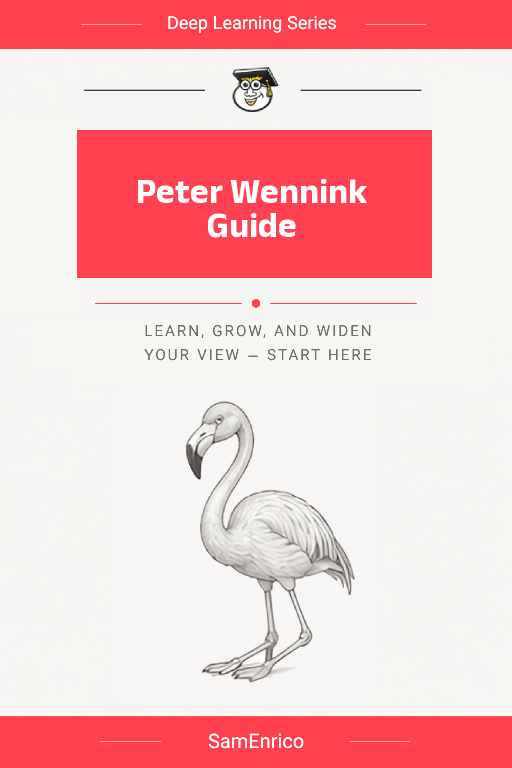
Non-FictionStrategic AtlasSemiconductor Leadership
Peter Wennink Guide eBook
Analyze ASML CEO priorities: EUV demand, High-NA a
Analyze ASML CEO priorities: EUV demand, High-NA adoption, China export controls, and customer concentration risk.
Formats
Free sample
Chapter 1: The Reluctant Monarch...--The call came at 11:47 PM on a Tuesday. Peter Wennink was in his study in Veldhoven, reviewing a quarterly forecast that would be obsolete by morning, when his secure phone buzzed with a ringtone reserved for exactly twelve people on earth. He glanced at the screen. The Dutch Minister of Economic Affairs. At this hour, there was only one possible subject."Peter, I need you to listen carefully," the Minister said.
"The Americans have just submitted a formal request. They want us to revoke all export licenses for the 2050i and 2100i models to China. Effective midnight tonight."Wennink said nothing for a long moment. He had been expecting this for months—had war-gamed it with his team, had prepared legal briefs, had even rehearsed the conversation he would have with his board when it happened. But expectation and reality are different countries, and the border between them is always guarded by panic."Midnight tonight," he repeated.
"That is forty-seven minutes from now.""I know.""Minister, we have a ship three days from Shanghai. Two hundred million euros in machines. Are you telling me to turn it around?"The Minister hesitated. "I am telling you that the licenses are revoked. What you do with the ship is your decision, but if it arrives in Shanghai without a valid license, your company is in violation of Dutch law and US extraterritorial regulations."Wennink closed his eyes.
He could feel the weight of every decision he had made in the past twenty-five years pressing down on his shoulders—the bet on EUV when everyone said it was impossible, the embrace of the Chinese market when Western customers were stalling, the careful cultivation of a supply chain that spanned three continents and a dozen time zones. It had all led to this moment, a single phone call in the dark, a bureaucrat in The Hague telling him that the most valuable company in Europe could no longer sell to its biggest customer."I need a better offer," he said."Excuse me?""You are asking me to destroy my own company to protect American national security. I need something in return. A transition period. A grandfather clause for existing orders.
Something."There was a long pause. Wennink could hear the Minister breathing, could imagine him weighing political survival against economic reality. The Netherlands was a small country. ASML was its largest company by market capitalization, its most valuable export, its only real claim to a seat at the table of global technology. The Americans were asking the Dutch to cut off their own arm."I will see what I can do," the Minister said finally.
"But I cannot promise anything.""Then neither can I," Wennink replied, and ended the call.He sat in the dark for a long time. His wife, knowing better than to ask, had long ago learned to read the geometry of his silences. This one was different. This one was the sound of a man realizing that the world he had spent his entire career building no longer existed.The Paradox of the Monopoly To understand why that phone call mattered—why it still matters, as you read these words—you have to understand something strange about ASML. It is a monopoly.
The only monopoly. The only company on earth that can make the machines that make the world's most advanced computer chips. Without ASML, there are no i Phones, no AI data centers, no military systems that rely on sub-7-nanometer logic. Without ASML, the digital economy stops.You would think that would make Peter Wennink the most powerful technology executive on the planet. You would be wrong.In fact, ASML's monopoly is not a position of strength but a position of extreme, almost absurd, vulnerability.
Consider the geometry of it. ASML has exactly three customers for its most advanced products: TSMC, Intel, and Samsung. If any one of them stumbles—a financial crisis, a technology miss, a geopolitical disaster—ASML's backlog collapses. ASML has exactly one region that supplies its most critical components: Germany, where Zeiss makes the mirrors and Trumpf makes the lasers. If a factory in Oberkochen burns down, ASML cannot ship machines for eighteen months.
ASML has exactly two superpowers deciding whether it can sell to its largest market: the United States and China, neither of which has any particular loyalty to Dutch prosperity.This is the hidden architecture of deep-tech monopolies. They look invincible from the outside. They are, in fact, held together by a thousand threads, each one of which could snap at any moment. The CEO of such a company is not a king. He is a hostage negotiator, and the hostages are everyone.Peter Wennink understood this better than anyone.
He had not come to ASML as a technologist. He had come as a numbers man—trained as an accountant, promoted through finance, appointed as CFO in 1999 when the company was bleeding cash and the EUV project was a joke whispered in the hallways of semiconductor conferences. His genius, such as it was, lay not in understanding how light bends through a vacuum at thirteen and a half nanometers. It lay in understanding risk.And in the winter of 2023, sitting in his study in Veldhoven, he understood that the risk had metastasized. The phone call from the Minister was not an isolated event.
It was the logical conclusion of a decade of decisions—some his, some made by people long gone—that had woven ASML into the fabric of global competition. The company could not escape geopolitics. It could only navigate it.This chapter is about how Peter Wennink learned to navigate. It is about the twenty-year bet on EUV that nearly bankrupted ASML, about the strange dance of co-opetition that turned rivals into investors, about the supply chain that spans a continent and the pandemic that nearly broke it. It is about the difference between operational decisions and physics decisions—a distinction that would prove essential when the world started coming apart.Most of all, it is about the paradox that defines every deep-tech monopoly: the only thing worse than having no competitors is having no customers.The Bet That Should Have Failed The story of EUV begins in failure.
No, that is not quite right. It begins in a series of failures so spectacular that they would have bankrupted any normal company. But ASML was not a normal company, and its leaders were not normal leaders, and the bet they made was not a normal bet. It was a kamikaze run into the heart of physics, and by all rights, it should have killed them.In the 1990s, the semiconductor industry faced a problem. The tools they used to print circuits onto silicon—using deep ultraviolet light at 193 nanometers—were reaching their fundamental limits.
You cannot print features smaller than the wavelength of light you are using, at least not without heroic efforts, and the industry had already exhausted the heroic efforts. They needed a new light source. They needed extreme ultraviolet, with a wavelength of just thirteen and a half nanometers.The problem was that extreme ultraviolet light does not want to exist. It is…
This is the end of the free sample. Get the eBook to keep going. Buy now
About this book
Details
- Author
- Harrington Stella
- Publisher
- SamEnrico
- Language
- English
- Genre
- Non-Fiction, Strategic Atlas, Semiconductor Leadership
- Released
- 2026-05-30
- Pages (approx.)
- 144
- Available as
- eBook, Audiobook

Read better in the ZLOADR app
Your eBooks on your phone or tablet. Sign in with your SamEnrico account and start reading.
More by Harrington Stella
 Emotion Loci EnhancementHarrington Stella$11.99
 Trypophobia Hole FearHarrington Stella$11.99
 Estate Planning for ExpatsHarrington Stella$11.99
 Time Zone Rotation Schedule GuideHarrington Stella$11.99
 DBT for Postpartum DepressionHarrington Stella$11.99
 Black Sunday: The Storm That Swallowed the PlainsHarrington Stella$11.99
 How to Start a Video Tape and Disc Rental BusinessHarrington Stella$11.99
 Database SpecialistHarrington Stella$11.99
 Mentor Outreach Message GuideHarrington Stella$12.99
 Understanding Panic DisorderHarrington Stella$17.99
You may also like
 Hong Kong Handover 1997Dunn Johnnie$11.99
 Zumba For Postnatal Recovery CourseNeal Christian$11.99
 Zumba for BeginnersLadner Nikia$11.99
 YouTube Comment Mining GuideHumes Pandora$12.99
 Worry Box MeditationCarlin Rudy$11.99
 Workplace Stress MeditationNguyen Lynn$11.99
 Workplace Stress and Sleep RepairHawley Ivory$11.99
 Workplace Perfectionism CureDelaney Jeffry$11.99
 Workplace Injustice Anger GuideWallen Isabelle$11.99
 Work Addiction and Burnout LinkGreenwood Ester$11.99
 Women in Yoga and WellnessBeattie Galina$11.99
 Women in Stand Up ComedyChun Evangeline$11.99