
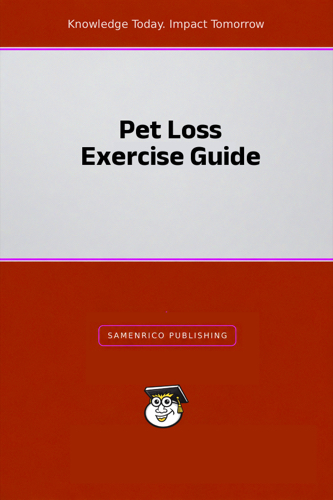
Pet Loss Exercise Guide eBook
Use physical activity to manage grief.
by Worthy Jay
Use physical activity to manage grief.
Formats
Free sample
Chapter 1: The Smallest Movement...--When grief first arrives, it does not knock. It moves in without warning, unpacks its heavy suitcases in your chest, and hangs its clothes over every source of light. You wake up the morning after losing your pet—or the morning after making the decision, or the morning after finding them gone—and your body feels like it has been filled with wet sand. Your arms weigh more than they did yesterday. Your legs do not want to cooperate with the command to stand.
Your breath, which has always been automatic and invisible, now feels like something you have to remember to do, manually, like pumping air into a leaky tire.This is not weakness. This is not laziness. This is not a failure of willpower or a sign that you are "handling it badly." This is the physiology of acute grief, and it has a name: the shock wave.The shock wave is what happens when your nervous system receives a blow it was not designed to absorb. Unlike physical injuries, which announce themselves with blood or bruising, grief injures the invisible architecture of your body—your autonomic nervous system, your hypothalamic-pituitary-adrenal axis, your vagal tone, and your interoceptive networks (the pathways that allow you to feel what is happening inside your own body). In plain language: your brain and body have just experienced a seismic event, and they are still figuring out which way is up.Every best-selling pet loss book will tell you that grief is normal.
Every therapist will tell you that you need to feel your feelings. Every well-meaning friend will tell you to "take all the time you need." But almost no one will tell you what to do with the physical sensation of grief—the heaviness, the tightness, the nausea, the sensation that you are wearing a lead apron over your entire body. That is what this chapter is for.This chapter is not about exercise. If the word "exercise" makes you want to throw this book across the room, good. That means you are paying attention.
This chapter is about the smallest possible movement you can make, right now, exactly where you are, without changing your clothes, without putting on shoes, without leaving your bed if you cannot leave your bed. This chapter is about the two-minute rule, which will save your life more times than you can count in the months ahead. And this chapter is about giving you permission—explicit, written, ironclad permission—to do almost nothing while still calling it healing.Let us begin with the science, because the science is what will protect you from the voice in your head that says you should be doing more.The Neurochemistry of Numbness: Why Your Body Feels Like Concrete Within the first twenty-four hours after a significant loss, your brain floods with stress hormones at concentrations typically reserved for life-threatening emergencies. Cortisol, the primary stress hormone, rises by an average of 48 percent in acutely grieving individuals, according to research published in the journal Biological Psychiatry. Adrenaline surges unpredictably.
And simultaneously, your brain's reward circuitry—the same system that lit up when your pet curled up next to you or greeted you at the door—goes dark, starved of the oxytocin and dopamine it had come to expect.The result is a body caught in an impossible contradiction: hyper-aroused and exhausted at the same time. Your muscles may be tense enough to cause pain (that is the cortisol and adrenaline), but you have no energy to move (that is the dopamine crash). Your heart might race when you think about the loss, but your limbs feel like they are moving through molasses. This is not a paradox. This is the shock wave.The "grief fog"—that inability to remember where you put your keys, what day it is, or why you walked into the kitchen—has a physical basis as well.
Elevated cortisol suppresses activity in the prefrontal cortex, the part of your brain responsible for executive function, decision-making, and short-term memory. You are not losing your mind. You are losing temporary access to a brain region that requires normal cortisol levels to operate. As the cortisol settles, the fog lifts. But in the early days, it is dense and disorienting.Understanding this physiology is not academic.
It is the foundation of self-compassion. When you know that your body is literally flooded with chemicals designed to make you feel heavy, frozen, and confused, you can stop asking yourself why you are not "handling this better." You are handling it exactly as your biology dictates. The question is not whether you are handling it well. The question is: what can you do, right now, that will not make it worse?The Two-Minute Rule: Why 120 Seconds Is Not a Consolation Prize The fitness industry has done enormous damage to grieving people. For decades, we have been told that exercise only "counts" if it is at least thirty minutes, if it elevates the heart rate to a specific zone, if it produces sweat, if it is done three to five times per week.
This messaging has created what psychologists call the "all-or-nothing trap": the belief that if you cannot do the full thing, you might as well do nothing.Grief destroys the all-or-nothing trap by revealing it as a lie. On a day when getting out of bed requires more courage than running a marathon, the suggestion that you need thirty minutes of cardio is not motivating. It is cruel. It is like telling someone with two broken legs that they should really be running a 5K.The two-minute rule is the antidote. It works like this: on any day when movement feels impossible, you commit to just two minutes of the smallest possible movement.
Not a workout. Not a routine. Not even a "light exercise session." Two minutes of moving your body in any way that does not hurt, does not exhaust you further, and does not require you to pretend you feel better than you do.Why two minutes? Because research on behavior activation—a core component of cognitive behavioral therapy—shows that the hardest part of any movement is the first ninety seconds. Once you have passed that threshold, momentum carries you forward, not because you are motivated, but because your brain's motor cortex has already been activated.
The two-minute rule is not about getting you to exercise. It is about getting you past the activation barrier. If you stop at two minutes, you have succeeded. If you continue past two minutes, you have succeeded more. There is no failure condition.Here is what two minutes can look like in the shock wave:Lying on your back, bending your knees so your feet are flat on the bed, and letting your knees fall gently side to side Sitting up against your headboard and rolling your shoulders in slow circles, first forward, then backward Standing next to your bed for the duration of one slow song Walking from your bedroom to your kitchen and back, even if you do not get anything from the kitchen Lifting your arms above your head while lying down and letting them fall heavily back…
This is the end of the free sample. Get the eBook to keep going. Buy now
About this book
Details
- Author
- Worthy Jay
- Publisher
- SamEnrico
- Language
- English
- Genre
- Non-Fiction, Self-Help, Exercise
- Released
- 2026-06-12
- Pages (approx.)
- 147
- Available as
- eBook, Audiobook

Read better in the ZLOADR app
Your eBooks on your phone or tablet. Sign in with your SamEnrico account and start reading.
More by Worthy Jay
 High Protein Meal PrepWorthy Jay$11.99
 SEC Cyber Rules ImpactWorthy Jay$11.99
 Interoceptive Exposure PhobiaWorthy Jay$11.99
 Only Child Death GuideWorthy Jay$11.99
 The ADHD Distraction GuideWorthy Jay$11.99
 TM Technique Beginner CourseWorthy Jay$11.99
 Chakra BalancingWorthy Jay$11.99
 The Last Pound: How a Single Coin Doomed an EmpireWorthy Jay$11.99
 The Damascus Code: The 1860 Conspiracy That Shocked the Ottoman EmpireWorthy Jay$11.99
 How to Start a Machine Shop BusinessWorthy Jay$11.99
 How to Produce a Root StimulantWorthy Jay$11.99
 A Collector's Handbook to the American Motors (USA) American Motors Jeep WagoneerWorthy Jay$11.99
You may also like
 The Exercise and Emotion GuideWorkman Bette$11.99
 Teen Exercise Confidence GuideTeel Sidney$11.99Teen Exercise Confidence GuideTeel Sidney$11.99
 Exercise for Student Stress ReliefWinter Marivel$11.99
 Exercise for Emotional HealthBruner Elma$11.99
 Spouse Loss Exercise GuideRockwell Jay$11.99
 Mindfulness for ExerciseHart Santiago$11.99
 Joyful Movement Gratitude FlowBerrios Yukiko$11.99
 Exercise Prescription BurnoutDodson Joni$11.99
 Imposter Exercise AntidoteDraper Chasidy$11.99
 Anger And Exercise PrescriptionLipscomb Art$11.99
 Workaholism Recovery And ExerciseBueno Meghann$11.99