
Non-FictionHealth & WellnessPets
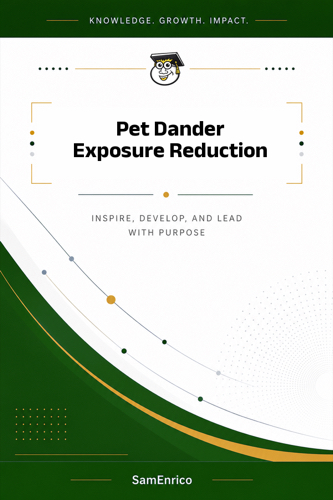
Pet Dander Exposure Reduction eBook
Teaches HEPA filters, bathing, and no-bedroom rule
Teaches HEPA filters, bathing, and no-bedroom rules for allergy management.
Formats
Free sample
Chapter 1: Beyond Fur Deep...--–- The first thing you need to understand about pet dander is that you have probably been looking at the problem backward your entire life. You see fur on your black pants, so you assume fur is the enemy. You vacuum up fluffy clumps from under the couch, so you assume those clumps are what make you sneeze. You hear the word "hypoallergenic" attached to a poodle or a sphynx cat, and you believe—truly believe—that if you just bought that breed instead of the one you have, your itchy eyes and stuffy nose would vanish. All of these assumptions are wrong, and they are keeping you sick.The war against pet allergies is not a war against fur.
Fur is a vehicle, not a weapon. The actual enemy is invisible, microscopic, and far more persistent than any stray hair you can see on your sofa. It is a complex biological aerosol made of dried skin flakes, crystallized saliva proteins, and desiccated urine particles. It floats through your air for hours, settles into your carpets for months, and clings to your clothing like a betrayed lover. It is called dander, and until you understand what it truly is and how it behaves, every filter you buy, every bath you give, and every rule you enforce will be like trying to empty the ocean with a teaspoon.This chapter is your scientific foundation.
We are going to dismantle the myths that have wasted your time and money. We are going to build a precise, practical understanding of what dander is, where it comes from, how it moves through your home, and why it refuses to leave. By the time you finish reading, you will see your living space differently—not as a collection of rooms and furniture, but as an ecosystem of invisible particles. And once you see that ecosystem clearly, you will finally understand how to control it.Let us begin with the myth that causes more suffering than any other.The Hypoallergenic Lie In 2011, a team of researchers at the Henry Ford Hospital in Detroit did something that should have ended the hypoallergenic pet industry overnight. They recruited 60 families with dogs, half of whom owned supposedly hypoallergenic breeds (poodles, Portuguese water dogs, and a few other "low-shedding" types) and half of whom owned standard breeds.
The researchers collected dust samples from every home and measured the concentration of Can f 1—the primary dog allergen—in each one. Their findings, published in the American Journal of Rhinology and Allergy, were devastating to the hypoallergenic claim: there was no statistically significant difference in allergen levels between the two groups. Homes with poodles had just as much dog allergen as homes with Labrador retrievers.A follow-up study in 2013 examined cats, comparing sphynx cats (the hairless breed often promoted as allergy-friendly) to normal coated cats. The researchers collected fur wipes, dust samples, and air samples from homes with each type of cat. Once again, the results were clear: sphynx cats produced just as much Fel d 1—the primary cat allergen—as their fluffy counterparts.
The only difference was that the allergen was distributed differently. In homes with coated cats, more allergen stuck to the fur; in homes with sphynx cats, more allergen was deposited directly onto surfaces from the cat's skin oils. But the total load was the same. A hairless cat is not a hypoallergenic cat. It is just a cat that spreads its allergens in a slightly different way.Why does this myth persist?
Because it is profitable. Breeders can charge two to three times more for a "hypoallergenic" puppy. Pet stores market "allergy-friendly" products with zero scientific backing. And consumers, desperate to keep a pet without suffering, want to believe. A 2016 investigation published in the Journal of Allergy and Clinical Immunology surveyed 100 breeders advertising hypoallergenic dogs online.
The researchers asked each breeder to provide scientific evidence supporting their claim. Only 25 percent responded at all, and none could cite a peer-reviewed study. The remaining 75 percent either ignored the request or offered anecdotal evidence ("my customers say they don't sneeze").Here is the truth that those breeders will never tell you: every mammal produces allergens. Every cat, dog, rabbit, hamster, guinea pig, ferret, horse, and cow produces proteins in its skin, saliva, and urine that can trigger an allergic reaction in a sensitized human. Some individual animals produce less of a specific protein than others—there is natural variation within breeds—but no breed consistently produces zero.
When you buy a "hypoallergenic" pet, you are gambling that you will get one of the low producers. And if you lose that gamble, you are left with an animal you love and a body that rebels against it.The word "hypoallergenic" itself is unregulated. The Food and Drug Administration (FDA) does not certify it for pets. The Federal Trade Commission (FTC) has never defined it. Any breeder, any pet store, any product manufacturer can slap the word on their offering without providing a single shred of evidence.
It is a marketing term, not a medical one. And it has caused incalculable harm, as allergic families purchase these animals, suffer through symptoms, and then face the heartbreaking decision to rehome them. A 2017 study in the journal Animals found that among dogs surrendered to shelters, 28 percent were initially acquired because a family member had allergies—and nearly half of those families believed they were buying a hypoallergenic breed.We are done with that word in this book. From this point forward, we will use accurate language: some pets produce less dander than others, but all pets produce dander. Your goal is not to find a magic breed that solves your problems.
Your goal is to manage the dander that your beloved, imperfect, completely normal pet produces every single day. And you cannot manage what you do not understand.The Biology of Dander: Skin, Saliva, and Urine Let us zoom in. Way in. Past the fur, past the surface of the skin, down to the microscopic scale where the real action happens. Your pet's body is constantly shedding a complex mixture of biological materials, and three components in particular matter for your allergies.Dead skin cells are the most abundant component by mass.
Mammals regenerate their outer layer of skin, the stratum corneum, every two to four weeks. Old cells are pushed to the surface, flatten, dry out, and eventually flake off. Humans lose about 500 million skin cells per day. A medium-sized dog loses roughly the same number. A cat, despite its smaller size, loses nearly as many because cats have a faster skin cell turnover rate.
Each of these flakes is typically 5 to 30 microns in diameter. (For context, a human hair is about 70 microns thick, and the smallest particle visible to the naked eye is about 40 microns.) These flakes are lightweight, irregularly shaped, and covered in a matrix of proteins that help them stick to surfaces.But here is the critical detail: the skin cells themselves are not the primary allergen. They are the delivery system. The allergenic proteins are embedded in the cell walls and coating the surfaces of these flakes. When you inhale a skin…
This is the end of the free sample. Get the eBook to keep going. Buy now
About this book
Details
- Author
- Medina Reginald
- Publisher
- SamEnrico
- Language
- English
- Genre
- Non-Fiction, Health & Wellness, Pets
- Released
- 2026-06-06
- Pages (approx.)
- 150
- Available as
- eBook, Audiobook

Read better in the ZLOADR app
Your eBooks on your phone or tablet. Sign in with your SamEnrico account and start reading.
More by Medina Reginald
 Reading Challenge Social PressureMedina Reginald$11.99
 Transcendental Meditation for CouplesMedina Reginald$11.99
 Lunch Break BreathMedina Reginald$11.99
 Heavy Metal Detox Lifestyle GuideMedina Reginald$11.99
 Bipolar Disorder CourseMedina Reginald$11.99
 Laser Resurfacing Age Spot ManualMedina Reginald$11.99
 Osteoarthritis Weight Loss GuideMedina Reginald$11.99
 Hope and Meaning RebuildingMedina Reginald$11.99
 The Whistling Tunnels: Echoes of the Centralia Mine FireMedina Reginald$11.99
 The Laughing Man: The Untold Horror of John Wayne Gacy’s Carnival of DeathMedina Reginald$11.99
 The Hippocratic Oath: Ancient Greece's Medical RevolutionMedina Reginald$11.99
 How to Start a Hobby in Collecting CoinsMedina Reginald$11.99
You may also like
 Hong Kong Handover 1997Dunn Johnnie$11.99
 Zumba For Postnatal Recovery CourseNeal Christian$11.99
 Zumba for BeginnersLadner Nikia$11.99
 YouTube Comment Mining GuideHumes Pandora$12.99
 Worry Box MeditationCarlin Rudy$11.99
 Workplace Stress MeditationNguyen Lynn$11.99
 Workplace Stress and Sleep RepairHawley Ivory$11.99
 Workplace Perfectionism CureDelaney Jeffry$11.99
 Workplace Injustice Anger GuideWallen Isabelle$11.99
 Work Addiction and Burnout LinkGreenwood Ester$11.99
 Women in Yoga and WellnessBeattie Galina$11.99
 Women in Stand Up ComedyChun Evangeline$11.99