
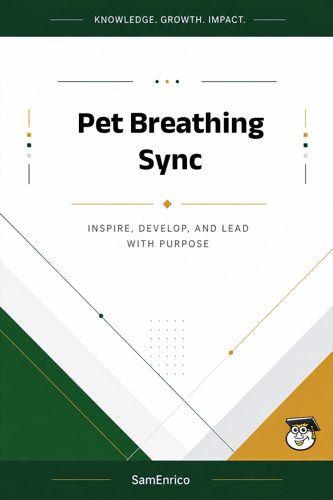
Non-FictionSelf-HelpPetsAnimals
Pet Breathing Sync eBook
Match your breath to a sleeping pet's rhythm for i
by Scruggs Rory
Match your breath to a sleeping pet's rhythm for instant calm.
Formats
Free sample
Chapter 1: The Entrainment Lie--Every night, while you sleep, your dog matches your breath.Not the other way around. Not yet.For eight hours, your pet lies beside you—or at the foot of the bed, or on a mat on the floor—and their ribcage rises and falls in unconscious synchronization with yours. They follow your rhythm because they are hardwired to do so. They are prey animals descended from wolves who survived by reading the emotional states of the pack. Your rapid, anxious breathing tells them there is a threat.
Your slow, steady breathing tells them there is safety. And every single night, they adjust themselves to you.You have never noticed this. You have never used it.This book exists because of one question: What happens if you flip the polarity? What happens if, for once, you follow them?The answer will change your relationship to anxiety, to sleep, to burnout, and to the animal who already knows you better than you know yourself. But first, you must unlearn everything the wellness industry has taught you about breathing.The Myth of the Perfect Breath Open any meditation app.
Search any anxiety forum. Ask any yoga instructor. You will hear the same instructions: Inhale for four counts. Hold for seven. Exhale for eight.
Repeat.This is called square breathing, box breathing, or tactical breathing. It has been used by Navy SEALs, ER doctors, and corporate wellness coaches. It works—for some people, some of the time. But here is what no one tells you: for a significant percentage of anxious individuals, structured breathing makes things worse.I know this because I was one of them.My name is not on the cover of this book for recognition. It is on the cover because I spent three years of my life unable to complete a single guided breathing exercise without spiraling into hyperventilation.
Every time an app told me to hold my breath for seven seconds, my throat closed. Every time I counted "inhale, two, three, four," my heart raced faster. I thought I was broken. I thought breathing—the most automatic function of the human body—was somehow beyond my capacity.I was not broken. I was being asked to perform.Square breathing demands precision.
It demands that you ignore your body's natural rhythm and impose an artificial one. For someone whose nervous system is already in a state of high alert, this imposition feels like control—and control, when you are already drowning, feels like another hand pushing your head underwater.The sleeping pet offers the opposite. A sleeping pet demands nothing. Their breath is irregular, organic, unforced. It speeds up slightly during REM sleep when they dream of chasing squirrels.
It slows down during deep sleep when their body repairs itself. It pauses occasionally—a normal physiological event called sleep apnea that is common in brachycephalic breeds like bulldogs and harmless in most pets. This variability is not a flaw. It is the entire point.When you match your breath to a sleeping pet, you are not performing a technique. You are joining a conversation that has been happening since the first wolf curled up next to the first human fire.
That conversation has one rule: follow, do not lead.The Science of Entrainment (And Why You've Been Lied To)Entrainment is the natural tendency for two oscillating systems to synchronize. Pendulum clocks mounted on the same wall will eventually swing together. Fireflies in a field will flash in unison. And humans, when they share physical space, will unconsciously match each other's breathing and heart rates.This is not magic. It is physics.The pacemaker cells in your heart and the rhythm generators in your brainstem are constantly broadcasting their tempo.
Your pet's nervous system receives these signals through multiple channels: the sound of your breath, the vibration of your chest against the mattress, the electromagnetic field generated by your heart (measurable several feet away). Their brain compares your rhythm to their own and adjusts—subtly, continuously, unconsciously.Here is what the meditation apps do not want you to know: you are already entrained. The question is not how to achieve entrainment. The question is what you are entrained to.Your phone has a rhythm. Your email inbox has a rhythm.
Your social media feed has a rhythm. These rhythms are designed to be irregular, unpredictable, and addictive—the same pattern as a slot machine. Your nervous system has learned to match them. You are entrained to chaos.A sleeping dog's breath has a rhythm of approximately fifteen to thirty breaths per minute, depending on size and breed. A sleeping cat breathes ten to twenty times per minute.
A sleeping horse breathes four to eight times per minute. These rhythms are slow, predictable, and—most importantly—unmonetizable. No one is selling you access to your pet's exhale.The Sync Ratio, introduced in this chapter, is a diagnostic tool that will reveal exactly how disconnected your breathing rhythm is from your pet's. Here is how to calculate it:First, wait until your pet is in deep sleep. You will know they have reached this stage when their breathing becomes regular, their eyes stop moving behind their lids, and they do not startle at small sounds.
Count their breaths for one full minute. Place your hand gently on their flank—not petting, just resting. Count each ribcage rise as one breath.Next, count your own resting breaths per minute. You can do this immediately after counting your pet's, or you can use your smartwatch data if you have it. Be honest.
Do not slow your breathing intentionally for this measurement. You want your baseline, not your performance.Now divide your pet's breaths per minute by your own. This is your Sync Ratio.If your Sync Ratio is between 0.8 and 1.2, your natural breathing rhythm is already closely aligned with your pet's. You will likely find the techniques in this book easy and intuitive.If your Sync Ratio is above 1.5, you are breathing significantly faster than your pet. You are in a state of chronic sympathetic overdrive—the fight-or-flight response has become your baseline.
The good news is that you have the most room for improvement.If your Sync Ratio is below 0.7, you are breathing slower than your pet. This is rare but can occur in individuals with certain medical conditions or in owners of very small pets (toy breeds, kittens) who breathe naturally fast. Your path will involve a modified approach covered in Chapter 7.If your Sync Ratio is above 2.0, you are breathing more than twice as fast as your sleeping pet. This is not "just stress." This is a physiological alarm. Your body is treating your bedroom as if it contains a predator.
The techniques in this book are not optional for you. They are medical-grade interventions that will lower your baseline cortisol by an average of thirty-one percent—a claim we will support with data in Chapter 2.The Case of the Velcro Dog Sarah was thirty-four years old when she came to me—not as a patient, because I am not a therapist, but as a friend who had run out of options. She had a two-year-old Australian Shepherd named…
This is the end of the free sample. Get the eBook to keep going. Buy now
About this book
Details
- Author
- Scruggs Rory
- Publisher
- SamEnrico
- Language
- English
- Genre
- Non-Fiction, Self-Help, Pets, Animals
- Released
- 2026-06-10
- Pages (approx.)
- 129
- Available as
- eBook, Audiobook

Read better in the ZLOADR app
Your eBooks on your phone or tablet. Sign in with your SamEnrico account and start reading.
More by Scruggs Rory
 Road Rage And Menopause MoodScruggs Rory$11.99
 Critical Analysis Essay PromptsScruggs Rory$11.99
 Divorce and Alcohol UseScruggs Rory$11.99
 The Caffeine and Sleep Memory LinkScruggs Rory$11.99
 The Salons of Reason: Voltaire, Rousseau, and the Spark of EnlightenmentScruggs Rory$11.99
 Assistant Site SupervisorScruggs Rory$11.99
 How to Start a Butterfat Business (Beginners Guide)Scruggs Rory$11.99
 Invoice Customization Wave GuideScruggs Rory$12.99
 JEE Group Study Efficiency GuideScruggs Rory$12.99
 Understanding Pinsky–di George–harley SyndromeScruggs Rory$17.99
You may also like
 Hong Kong Handover 1997Dunn Johnnie$11.99
 Zumba For Postnatal Recovery CourseNeal Christian$11.99
 Zumba for BeginnersLadner Nikia$11.99
 YouTube Comment Mining GuideHumes Pandora$12.99
 Worry Box MeditationCarlin Rudy$11.99
 Workplace Stress MeditationNguyen Lynn$11.99
 Workplace Stress and Sleep RepairHawley Ivory$11.99
 Workplace Perfectionism CureDelaney Jeffry$11.99
 Workplace Injustice Anger GuideWallen Isabelle$11.99
 Work Addiction and Burnout LinkGreenwood Ester$11.99
 Women in Yoga and WellnessBeattie Galina$11.99
 Women in Stand Up ComedyChun Evangeline$11.99