
Non-FictionAI OperatorEnvironmental Scan
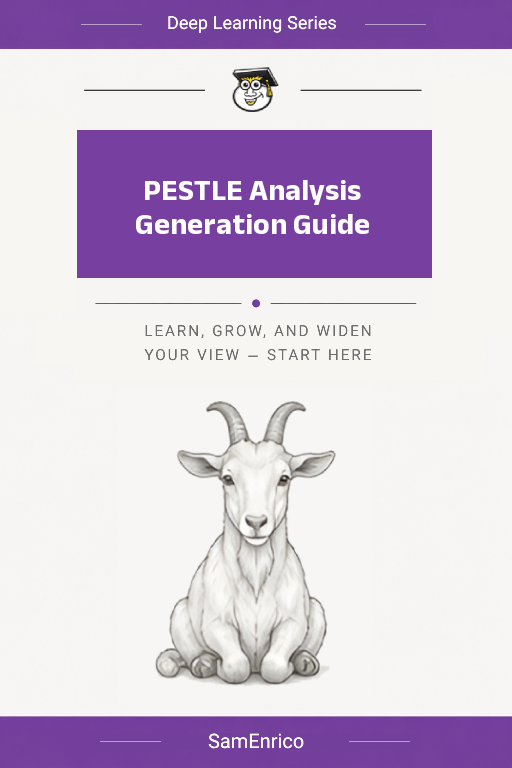
PESTLE Analysis Generation Guide eBook
Generate PESTLE analyses from external environment
Generate PESTLE analyses from external environment research using structured prompt frameworks.
Formats
Free sample
Chapter 1: The Twenty-Hour Lie...--The first time a junior strategist is handed a PESTLE template, they are told it should take about twenty hours. Six factors. A few tables. Some light research. What could possibly take twenty hours?
Everything, as it turns out. The twenty hours are not spent thinking. They are not spent on insight. They are spent on drudgery—the slow, grinding work of opening thirty browser tabs, scanning PDFs that were never designed to be searched, copying numbers from one government report and dates from another, and then arranging all of it into a Word document that will be obsolete by the time the final period is typed.This chapter reveals the inconvenient truth that the traditional PESTLE analysis is not conceptually broken but executionally disastrous. The six factors—Political, Economic, Social, Technological, Legal, and Environmental—remain the gold standard for external environment scanning.
They have survived decades of strategic fads because they work. But the way most organizations generate PESTLE analyses today was designed for a world that no longer exists: a world of static reports, annual planning cycles, and human researchers who had no alternative but to read slowly.That world is gone. Yet most professionals are still using methods from 1995 to solve problems from 2025.The gap between what PESTLE should do and what it actually does in most organizations is not a skill gap. It is a process gap. And the single biggest driver of that process gap is the assumption that manual research is virtuous—that the hours spent digging through reports somehow sanctify the output.
They do not. They merely delay it.The Invention That Forgot to Evolve The PESTLE framework emerged from the broader family of environmental scanning tools developed in the 1960s and 1970s, most notably the STEP (Sociological, Technological, Economic, Political) framework popularized by scholars like Francis Aguilar. Over time, Legal and Environmental factors were added, reflecting growing regulatory complexity and ecological awareness. The framework was simple, elegant, and desperately needed. For the first time, strategists had a checklist that forced them to look outside the four walls of their organization.But here is the problem that no textbook mentions: the framework was designed for an era when external information was scarce.
In 1985, finding relevant data on a foreign market required subscriptions to physical journals, phone calls to trade associations, and weeks of waiting for documents to arrive by mail. A twenty-hour PESTLE was genuinely efficient compared to the alternatives.Today, information is not scarce. It is superabundant. The problem has inverted completely. We are not drowning in a lack of data; we are drowning in a fire hose of it.
The average strategist today has access to more economic indicators, legislative updates, and social trend reports in one hour on the internet than a 1985 strategist could access in a month. And yet, the method of analysis has barely changed. We still open browser tabs. We still copy and paste. We still fill tables manually.This is the twenty-hour lie: the belief that the time required for PESTLE is fixed by the complexity of the task, not by the inefficiency of the tools.What Twenty Hours Actually Buys You Let us be specific about what happens in those twenty hours, because naming the waste is the first step to eliminating it.In hour one through three, the strategist identifies sources.
This is the phase where they search for relevant government websites, industry reports, and news archives. They bookmark thirty links. They download fifteen PDFs. They feel productive because they are gathering.In hour four through ten, they read. This is the brutal middle.
They scan annual reports for political risk disclosures. They read central bank minutes looking for interest rate signals. They skim social trend forecasts that are mostly fluff. They highlight passages. They take handwritten or digital notes.
By hour seven, their eyes glaze over. They are no longer analyzing; they are surviving.In hour eleven through fifteen, they translate. The notes become bullet points. The bullet points become PESTLE factors. They write sentences like “increasing regulatory scrutiny” and “shifting consumer preferences” without realizing these phrases could describe almost any industry in any year.In hour sixteen through eighteen, they format.
They align tables. They check that the font is consistent. They add page numbers. They send the document to a colleague who will ask, “Can we add a section on ESG?”In hour nineteen, they add the ESG section.In hour twenty, they email the final version to their manager. The manager reads it the next morning and asks, “Does this account for the regulatory change that was announced yesterday?”It does not.
Because the twenty-hour PESTLE is a snapshot of a dying animal. By the time it is complete, the environment has already moved.The False Virtue of Manual Labor There is a deeply embedded cultural assumption in many strategy departments that manual research is somehow more rigorous. This assumption is never stated aloud, but it operates beneath the surface like a silent operating system. It sounds like this: “If we use AI to generate the analysis, we won’t understand it as deeply.” Or: “The manual process forces us to engage with the material.”These objections sound reasonable until you examine what actually happens during hour seven of manual research. The strategist is not engaging deeply.
They are skimming. They are fatigued. They are missing connections because the human brain was not designed to hold thirty sources in working memory simultaneously. The supposed rigor of manual research is an illusion maintained by tradition.Let us name the truth directly: manual research does not guarantee depth; it merely guarantees slowness. Depth comes from asking better questions, not from spending more hours copying numbers.
The most rigorous PESTLE analyses in the world are not produced by the people who spend the most time typing; they are produced by the people who spend the most time thinking. And you cannot think when you are drowning in data entry.This book makes a sharp distinction that will appear throughout every subsequent chapter: drudgery versus judgment. Drudgery is the work of sourcing, extracting, formatting, and summarizing. Judgment is the work of prioritizing, weighting, interpreting, and deciding. The traditional twenty-hour PESTLE conflates the two.
The result is that strategists spend 80 percent of their time on drudgery and 20 percent on judgment. This book inverts that ratio.The Two-Stage Workflow That Changes Everything The central methodological innovation of this book is the two-stage workflow. It is simple enough to state in one sentence but profound enough to reshape how you think about environmental scanning.Stage One: Rapid AI-Generated First Draft (target: 15 minutes). In this stage, you use the techniques from Chapters 2 through 6 to generate a complete, structured, cited PESTLE analysis. The AI does the drudgery.
It sources data from your curated documents. It extracts relevant factors. It formats them into tables. It weights them by probability and impact. It produces a first draft that would have taken twenty hours manually.Stage Two: Human-Led Validation and Refinement (target: 15 minutes).
In this stage, you do not start over. You do not second-guess everything. Instead, you audit the AI’s output using the hallucination detection methods from…
This is the end of the free sample. Get the eBook to keep going. Buy now
About this book
Details
- Author
- Wilder Merissa
- Publisher
- SamEnrico
- Language
- English
- Genre
- Non-Fiction, AI Operator, Environmental Scan
- Released
- 2026-06-01
- Pages (approx.)
- 156
- Available as
- eBook, Audiobook

Read better in the ZLOADR app
Your eBooks on your phone or tablet. Sign in with your SamEnrico account and start reading.
More by Wilder Merissa
 Cynicism And Depersonalization Recovery HandbookWilder Merissa$11.99
 Vidor Crowd ProcessWilder Merissa$11.99
 Missing Finger Self Esteem PlanWilder Merissa$11.99
 Second Baby Sleep GuideWilder Merissa$11.99
 Navigating Breakup and Separation TalksWilder Merissa$11.99
 Tariq ibn Ziyad: The Sword and the Strait – Conquest of IberiaWilder Merissa$11.99
 System Engineer InfrastructureWilder Merissa$11.99
 Australia Critical Tech PlanWilder Merissa$12.99
 Understanding Mesenteric PanniculitisWilder Merissa$17.99
 How to Become a NeedlemakerWilder Merissa$11.99
You may also like
 Hong Kong Handover 1997Dunn Johnnie$11.99
 Zumba For Postnatal Recovery CourseNeal Christian$11.99
 Zumba for BeginnersLadner Nikia$11.99
 YouTube Comment Mining GuideHumes Pandora$12.99
 Worry Box MeditationCarlin Rudy$11.99
 Workplace Stress MeditationNguyen Lynn$11.99
 Workplace Stress and Sleep RepairHawley Ivory$11.99
 Workplace Perfectionism CureDelaney Jeffry$11.99
 Workplace Injustice Anger GuideWallen Isabelle$11.99
 Work Addiction and Burnout LinkGreenwood Ester$11.99
 Women in Yoga and WellnessBeattie Galina$11.99
 Women in Stand Up ComedyChun Evangeline$11.99