
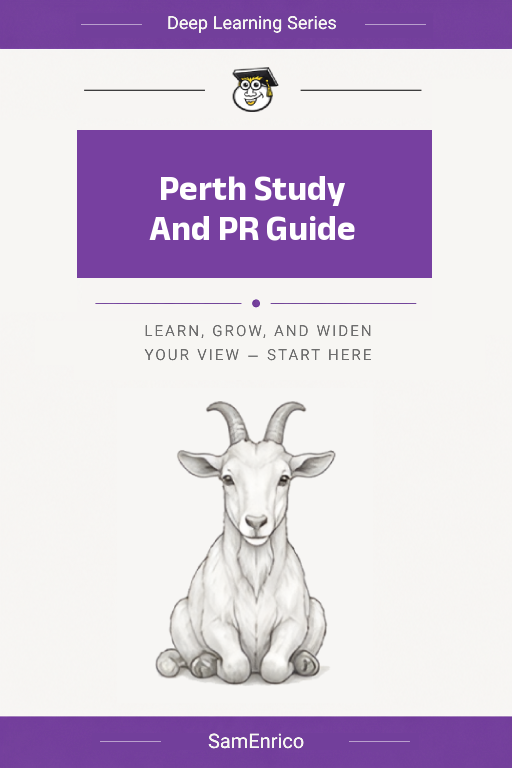
Non-FictionStudent's ShortcutPerth GuideWestern Australia
Perth Study And PR Guide eBook
Study in Perth with Western Australia nomination a
Study in Perth with Western Australia nomination and mining tech job market including regional points.
Formats
Free sample
Chapter 1: The Western Edge--–- When Maria, a civil engineer from Brazil, first landed in Perth in 2019, she had never heard of FIFO. She had come to study a Master of Project Management because a migration agent in São Paulo told her it was a “safe bet.” Two years and 65,000later,shehadnojoboffer,nostatenomination,and45daysleftonhergraduatevisa.Acrosstown,Raj,amechanicalengineerfrom Indiawhohadenrolledin Curtin’s Masterof Professional Engineering(Mining)onahunch,wassigningacontractwitha Tier1minerfor65,000 later, she had no job offer, no state nomination, and 45 days left on her graduate visa. Across town, Raj, a mechanical engineer from India who had enrolled in Curtin’s Master of Professional Engineering (Mining) on a hunch, was signing a contract with a Tier 1 miner for 65,000later,shehadnojoboffer,nostatenomination,and45daysleftonhergraduatevisa.Acrosstown,Raj,amechanicalengineerfrom Indiawhohadenrolledin Curtin’s Masterof Professional Engineering(Mining)onahunch,wassigningacontractwitha Tier1minerfor125,000 plus a 25% FIFO allowance. He had applied for WA state nomination three weeks before graduation. This book is the difference between Maria’s story and Raj’s.The Great Australian Misalignment Every year, more than 600,000 international students arrive in Australia.
The vast majority follow the same well-worn path: they choose a course based on university rankings, social media aesthetics, or the advice of an agent who has never set foot in a mining site. They land in Sydney or Melbourne because those cities appear on postcards. They study generic business, accounting, or IT degrees that 47,000 other international students are studying in the same postcode. Then they graduate, enter the points race for the Subclass 189 visa, and discover that 95 points is the new normal. Most of them leave within three years.Western Australia, and specifically Perth, operates under a completely different set of rules.
While the Eastern Seaboard fights for every point, WA is quietly running a parallel migration system designed to fill one specific need: the resources sector. The state government has signed more Designated Area Migration Agreements than any other jurisdiction. It holds the largest allocation of Subclass 491 visas in the country. It has its own occupation list, its own nomination criteria, and its own processing priorities. And the single most important fact about this parallel system is also the least understood: Perth, a capital city of 2.2 million people, is classified as “regional” for migration purposes.That one word – regional – changes everything.
It unlocks an extra five to fifteen points on your visa application. It gives you access to a separate pool of nomination places that Eastern Seaboard capitals cannot touch. It allows you to apply for visas that do not even exist for Sydney or Melbourne graduates. But there is a catch, and it is a catch that most agents either do not understand or deliberately obscure: Perth is only regional for the Subclass 491 visa. For the Subclass 190 visa, Perth is treated as a non‑regional capital city.
Only areas outside the Perth metropolitan area – the South West, the Pilbara, the Goldfields – qualify as regional for 190 purposes. If you are targeting the 190 visa, living in Perth does not give you any regional benefit. Your competition is the entire state. Your settlement plan must be credible, and your job offer must be real.This chapter is not an introduction. It is a reorientation.
By the time you finish reading it, you will understand why the Eastern Seaboard study‑and‑migrate model is broken, why Perth is not a fallback option but a strategic advantage, and why the current mining technology boom in Western Australia is fundamentally different from every resources boom that has come before. You will also understand why the majority of international students in Perth are still getting it wrong – and how you can be among the minority who get it right.Why the Eastern Seaboard Model Is Mathematically Broken Let us begin with numbers because migration is, above all else, a numbers game. The Subclass 189 visa (General Skilled Migration) is the default aspiration for most international students. In theory, it is a points‑tested visa that does not require state nomination or employer sponsorship. In practice, for mining‑related occupations, the invitation rounds have become a lottery for all but the highest‑scoring candidates.Consider the data from the most recent invitation rounds before the 2025‑26 recalibration.
For a Mining Engineer (ANZSCO 233611), the lowest score invited was 95 points. For a Mechanical Engineer, 95 points. For an Electrical Engineer, 100 points in some rounds. To reach 95 points, a typical international student would need to be under 25 years old (25 points), have Superior English (20 points), have a Ph D or a master’s degree plus a bachelor’s (15 points), have studied in a regional area (5 points), have completed a professional year (5 points), have a NAATI accreditation (5 points), and have at least three years of skilled work experience (10 points). Most international graduates have none of these except the degree.
The numbers simply do not work.The Subclass 189 visa also has no state‑specific quota. You are competing against every other engineer, from every other country, who studied anywhere in Australia or overseas. In the 2024‑25 program year, the total number of invitations for Mining Engineers across all rounds was 312. The number of international students enrolled in mining‑related engineering degrees in Australia in that same year was more than 4,000. Those are not odds.
Those are a warning.WA’s state‑nominated visas operate on a completely different set of ratios. The Subclass 190 (State Nominated) visa for WA has its own quota, separate from the 189 pool. The Subclass 491 (Regional) visa has an even larger quota. And unlike the 189, where every occupation competes against every other occupation, WA’s nomination system prioritises occupations on the Western Australian Skilled Migration Occupation List (WASMOL). If your occupation is on that list – and mining engineering, mechanical engineering, electrical engineering, civil engineering, mechanical engineering technician, diesel fitter, and metal fabricator all are – you are not competing against accountants, software engineers, or marketing specialists.
You are competing only against other candidates in your occupation group, and the quota for WA’s 491 visa alone is 2,200 places annually.But here is where most migration advice goes wrong. Agents who have never worked in the resources sector will tell you to “maximise your points” for the 189 visa. They will push you toward a Professional Year, NAATI, and other expensive add‑ons that may or may not yield a single point. They will not tell you that WA’s state‑nominated visas have a lower points threshold precisely because the state government is desperate for workers. In the most recent invitation rounds for WA’s 491 visa, the minimum points score for a Mining Engineer was 65.
Not 95. Sixty‑five. That is the difference between a strategy that chases points and a strategy that chases occupational demand.The Three Numbers That Define WA’s Labour Market Before you choose a course, before you book an English test, before you even decide which university to apply to, you need to understand three numbers. These numbers will determine your employability, your sponsorship prospects, and your visa pathway.Number one: 135,693. That is the number of full‑time equivalent workers employed in Western Australia’s mining sector.
It represents 47 percent of Australia’s entire mining workforce. To put that in perspective, New South Wales and Queensland combined employ less than 40 percent. WA is not…
This is the end of the free sample. Get the eBook to keep going. Buy now
About this book
Details
- Author
- Mccorkle Jannette
- Publisher
- SamEnrico
- Language
- English
- Genre
- Non-Fiction, Student's Shortcut, Perth Guide, Western Australia
- Released
- 2026-05-29
- Pages (approx.)
- 154
- Available as
- eBook, Audiobook

Read better in the ZLOADR app
Your eBooks on your phone or tablet. Sign in with your SamEnrico account and start reading.
More by Mccorkle Jannette
 The Therapist Body ScanMccorkle Jannette$11.99
 Pomodoro Study Sessions GuideMccorkle Jannette$11.99
 Kigali CleanTech Startup ManualMccorkle Jannette$11.99
 Secondhand Stress Immunity BuildingMccorkle Jannette$11.99
 The Sea Surgeon: Dr. Victor Chang and the Heart Transplant Revolution in the Indian OceanMccorkle Jannette$11.99
 Testosterone and Kidney DiseaseMccorkle Jannette$11.99
 The Last Call: The Untold Story of the 2008 Financial Crisis' Secret BailoutMccorkle Jannette$11.99
 Understanding Charcot–Marie–tooth Disease, X-linked Type 2, RecessiveMccorkle Jannette$17.99
 How to Become a BurnerMccorkle Jannette$11.99
 Front Counter Crew MemberMccorkle Jannette$11.99
 Tourism Cooperative GuideMccorkle Jannette$12.99
You may also like
 Hong Kong Handover 1997Dunn Johnnie$11.99
 Zumba For Postnatal Recovery CourseNeal Christian$11.99
 Zumba for BeginnersLadner Nikia$11.99
 YouTube Comment Mining GuideHumes Pandora$12.99
 Worry Box MeditationCarlin Rudy$11.99
 Workplace Stress MeditationNguyen Lynn$11.99
 Workplace Stress and Sleep RepairHawley Ivory$11.99
 Workplace Perfectionism CureDelaney Jeffry$11.99
 Workplace Injustice Anger GuideWallen Isabelle$11.99
 Work Addiction and Burnout LinkGreenwood Ester$11.99
 Women in Yoga and WellnessBeattie Galina$11.99
 Women in Stand Up ComedyChun Evangeline$11.99