
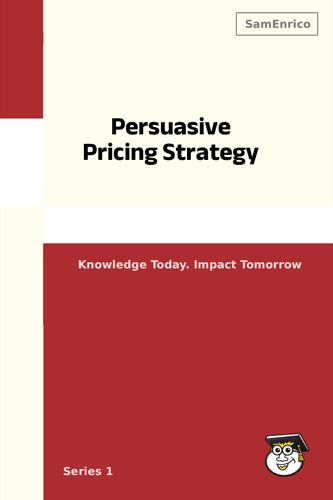
Persuasive Pricing Strategy eBook
Use anchoring, decoy effects, and charm pricing et
Use anchoring, decoy effects, and charm pricing ethically to increase sales.
Formats
Free sample
Chapter 1: The Coffee Lie--–- You walk into a diner. Formica table. Coffee in a thick white mug: $2.50. You hesitate. “That seems a little high,” you think.
Twenty minutes later, you walk into a Starbucks. Exposed brick. Ambient noise. A woman with a sharpie writes something indecipherable on a cardboard cup. The same coffee—actually, arguably worse coffee—costs $5.25.
You pay without blinking. On the walk out, you do not think about the $2.75 price difference. You do not feel ripped off. You feel, if anything, vaguely sophisticated.What just happened?Did the Starbucks coffee have twice the caffeine? No.
Did it come from a better bean? Almost certainly not. Did the barista whisper a secret code that hypnotized your wallet? Also no. What changed was not the product.
What changed was the context. The price of the coffee did not exist in a vacuum. It existed next to a $6.00 muffin, a $7.00 sandwich, a $4.00 bottle of water, and a $250 stainless steel thermos sitting on a shelf behind the register. In the diner, the $2.50 coffee sat next to a $1.75 soda and a $3.00 slice of pie. The same number—$2.50—meant two entirely different things depending on what surrounded it.This is the myth of rational price.
And it is the single most expensive mistake that business owners make.Most entrepreneurs believe that price is a feature of the product. They believe that a “fair price” exists somewhere in the universe, waiting to be discovered, like a fossil. They believe that if they just do enough market research, run enough spreadsheets, and ask enough customers, they will find the one true number that represents what their product is “worth.” This belief is wrong. It is not just wrong; it is dangerously wrong. It costs businesses millions of dollars every single day.Price is not a feature of the product.
Price is a feature of the comparison.The Invention of Value Let us go deeper. The idea that value is inherent—that a thing has a price the way it has a weight—is intuitive but false. A diamond has no inherent price. Water has no inherent price. A cup of coffee has no inherent price.
What we call “price” is actually a judgment of relative desirability made in a specific moment, surrounded by specific alternatives, primed by specific memories.The psychologists Itamar Simonson and Amos Tversky demonstrated this with a now-famous experiment involving microwave ovens. They gave participants two choices: Microwave A, which was cheap and had low power, and Microwave B, which was expensive and had high power. Faced with just these two options, customers split roughly fifty-fifty. Half chose cheap and low power. Half chose expensive and high power.
Reasonable people disagreed. Then the researchers added a third microwave. Microwave C was even more expensive than Microwave B but had lower power than Microwave B. It was, in every measurable way, worse than Microwave B. Nobody wanted Microwave C.
But here is the magic: when Microwave C was added, eighty-five percent of customers chose Microwave B. The same Microwave B that had previously attracted only fifty percent of buyers.What changed? Not the microwave. Not the price. Not the customer.
What changed was the comparison. Microwave C made Microwave B look, by contrast, like a genius decision. “At least I’m not buying that ridiculous one,” thought the customer. The product stayed the same. The price stayed the same.
But the perceived value skyrocketed because of what sat next to it.This is not a laboratory curiosity. This is the hidden engine of every successful pricing strategy you have ever admired. Starbucks does not sell coffee. Starbucks sells a comparison between a $5.25 latte and a $7.00 breakfast sandwich. Apple does not sell laptops.
Apple sells a comparison between a $2,000 Mac Book Pro and a $6,000 Mac Pro that sits next to it on the Apple Store table. Hermès does not sell scarves. Hermès sells a comparison between a $500 scarf and a $10,000 handbag that sits in a locked glass case.You are not selling a product. You are selling a comparison. And if you are not deliberately designing that comparison, your competitors are designing it for you.The Three Comparisons You Cannot Avoid Every customer who considers your price makes three comparisons, whether you want them to or not.
You cannot stop these comparisons. You can only design them or leave them to chance. The three comparisons are:First, your customer compares your price to your other products. If you sell only one thing, they have nothing internal to compare it to, which is a dangerous position. A single product floats in a void, and humans are terrible at valuing voids.
Give them a second option—even a bad one—and suddenly they know exactly what to think.Second, your customer compares your price to your competitor’s closest product. This is the comparison most business owners obsess over, and it matters. But it matters less than you think. If your only comparison is a competitor, you are playing their game on their terms. You are letting them set the anchor.
You are reacting instead of architecting.Third, and most overlooked, your customer compares your price to their own past purchases. This is the ghost in the room. If you sold them a product for $50 last month and you are now asking $75 for a similar product, you are not competing with a competitor. You are competing with a memory. Memories are sticky.
Memories are hard to overwrite. This is why subscription businesses struggle to raise prices. This is why software companies grandfather old customers. The past price is the most powerful anchor of all because the customer owns it.The actionable insight is simple and urgent: before you launch any price, write down these three comparisons. Map them explicitly.
If you cannot articulate what your customer is comparing your price to, you are flying blind.The Context That Cannot Be Turned Off Here is a truth that makes many business owners uncomfortable: you cannot choose to have no context. Context is not a marketing option. Context is the air that pricing breathes. Even a blank white page with a single price on it is a context. The blankness itself is a signal.
“We are minimalist.” “We have nothing to hide.” “We are confident.” These are context signals.Every pricing decision you make—every number you type into a website, every label you stick on a shelf, every email you send to a customer—creates a comparison. The question is not whether you will influence your customer’s perception of value. The question is whether you will influence it deliberately or accidentally.Consider the difference between two identical bottles of wine on a restaurant wine list. One restaurant lists the wine as “House Red – $32.” Another restaurant lists the same wine as “Château de la Tour – $32.” Same wine. Same price.
Different words. In the first restaurant, the wine feels like a commodity. In the second, it feels like a discovery. The context is not the product. The context is the name, the font, the placement on the page, the waiter’s description, the price of the bottle next to it.
All of these are design choices. All of them change what $32 means.Or consider the infamous Williams-Sonoma breadmaker story, which…
This is the end of the free sample. Get the eBook to keep going. Buy now
About this book
Details
- Author
- Scully Selene
- Publisher
- SamEnrico
- Language
- English
- Genre
- Non-Fiction, Business Brief, Pricing
- Released
- 2026-06-12
- Pages (approx.)
- 124
- Available as
- eBook, Audiobook

Read better in the ZLOADR app
Your eBooks on your phone or tablet. Sign in with your SamEnrico account and start reading.
More by Scully Selene
 Gacy Law Enforcement MissesScully Selene$11.99
 IBS After AntibioticsScully Selene$11.99
 Vitamin C Immunity HandbookScully Selene$11.99
 Moldovan TransnistriaScully Selene$11.99
 Bupropion Quit Smoking GuideScully Selene$11.99
 Boomer vs Gen Z Influencer ImpactScully Selene$11.99
 Night Stalker Sexual Assault PatternsScully Selene$11.99
 Hannibal's Gambit: The Alps and the Art of War (218 BC)Scully Selene$11.99
 Operation Midnight Serpent: The Untold CIA-Mossad Gambit in TehranScully Selene$11.99
 Understanding PolymyositisScully Selene$11.99
 How to Produce Solar Energy ProductsScully Selene$11.99
 Ransomware Legal Obligations GuideScully Selene$12.99
You may also like
 The Decoy Effect ExplainedBeall Lessie$11.99
 The Compromise EffectPresley Sheryll$11.99
 Fiverr Package Pricing StrategyDavidson Fred$11.99
 Value Proposition Validation TestBuckley Lorette$11.99
 Uber Marketplace SurchargesStrange Detra$11.99
 The Asymmetric Dominance EffectSena Broderick$11.99
 Behavioral Product PricingSpradlin Eleonore$11.99
 Jumia Pricing Strategy BriefSpringer Douglass$11.99
 Rent Increase StrategyBankston Francesca$11.99
 Anchoring for Price StrategyPrater Lauryn$11.99
 The Contrast EffectFranco Georgine$11.99
 Pricing for Payment CostsHayward Malissa$12.99