
Non-FictionBusiness BriefPolicy Writing
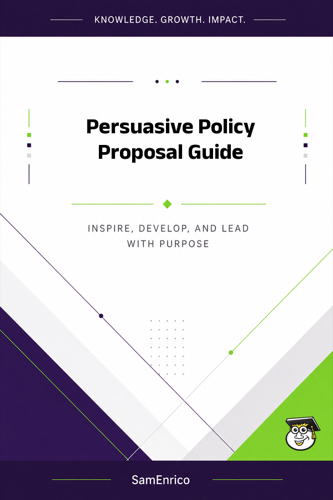
Persuasive Policy Proposal Guide eBook
Write internal policy changes that employees actua
Write internal policy changes that employees actually follow instead of resist.
Formats
Free sample
Chapter 1: The Resistance Illusion--–- Sarah Chen, a regional operations director at a mid-sized logistics company, had spent three weeks crafting the perfect policy. She had consulted legal, benchmarked against industry standards, and built in a generous grace period. The policy required drivers to log their vehicle inspections using a new mobile app instead of paper forms – a change that would reduce accidents, lower insurance premiums, and save the company an estimated $240,000 annually. She announced it on a Tuesday with a detailed email, attached the four-page document, and waited for compliance.Seventy-two hours later, exactly 8 percent of her drivers had downloaded the app. By the end of the first week, resistance had organized.
The warehouse break room became a war room of creative non-compliance. Drivers invented thirteen different reasons why the app “wouldn’t work” on their phones – most of which were demonstrably false. One driver, a twenty-year veteran named Marcus, had printed the email, taped it to the coffee machine, and drawn a cartoon tombstone next to it labeled “Another Great Idea That Forgot We Work Here.”Sarah’s first instinct was to blame the drivers. Lazy. Stubborn.
Afraid of change. She considered adding consequences – write-ups for non-compliance, then suspensions, then termination. But something stopped her. She had read enough management books to know that enforcement alone rarely produced lasting change. So instead of doubling down, she walked into the break room, poured herself a cup of coffee, and asked Marcus one question: “What did I get wrong?”His answer took forty-five minutes.
But in that time, Sarah learned something that no policy manual had ever taught her. The drivers weren’t resisting the inspection app because they were lazy. They were resisting because the policy had arrived like a meteor from another planet – no warning, no consultation, no acknowledgment that they had been doing inspections successfully (on paper) for decades. The app was objectively better, but it had arrived as a command, not a conversation. And for the drivers, that wasn’t laziness.
That was self-preservation.This chapter dismantles the most expensive mistake in organizational management: the assumption that employee resistance to policies stems from laziness, ignorance, or malice. Drawing on behavioral economics, cognitive psychology, and three decades of organizational research, we will reframe resistance as a rational response to perceived threat – and then show you how to design policies that work with human nature instead of against it.The Three False Assumptions That Kill Policies Before They Start Before we can build persuasive policies, we must first demolish the three assumptions that lead most managers to blame employees instead of examining their own policy design. These assumptions are so deeply embedded in corporate culture that they often go unquestioned. But every one of them is demonstrably false – and every one of them guarantees resistance.False Assumption #1: “They’re Just Lazy”The laziness assumption is the most common and the most dangerous. When a policy fails, the instinct is to attribute non-compliance to a character flaw in the employee.
They don’t care. They’re coasting. They want to do the minimum. This assumption is comforting to managers because it requires no self-reflection. If resistance is caused by lazy employees, the solution is simple: threaten, monitor, punish.
The problem, of course, is that this “solution” almost never works – and when it does, it produces compliance without commitment, which evaporates the moment the threat is removed.Research from organizational psychology tells a different story. Studies of workplace behavior consistently find that fewer than 5 percent of employees actively seek to avoid reasonable work requirements. The vast majority want to do their jobs well and take pride in their performance. When they resist a policy, it is almost never because they are “lazy.” It is because the policy has triggered one or more of the psychological mechanisms we will explore later in this chapter.Consider the case of a hospital that introduced a new handwashing policy to reduce infection rates. The policy was scientifically sound, ethically unquestionable, and backed by data showing that proper handwashing saved lives.
Yet compliance hovered around 40 percent. Administrators initially blamed “lazy nurses.” But when researchers interviewed the nurses, a different story emerged. The new policy required handwashing at specific moments during patient care – but the hospital had not installed soap dispensers in convenient locations. Nurses were walking thirty extra feet each time, which added nearly ninety minutes of walking to each shift. The nurses weren’t lazy.
They were exhausted. And the policy had failed to account for the physical reality of their work.The laziness assumption is a trap because it replaces investigation with accusation. Before you assume laziness, ask yourself: What obstacle has my policy created that I cannot see?False Assumption #2: “They Don’t Understand”The ignorance assumption is the refuge of the expert. When a policy fails, the manager concludes that employees simply don’t grasp the rationale. The solution, therefore, is more communication – another email, another training, another Power Point explaining the “why” behind the change.
This assumption feels generous because it blames the message rather than the messenger. But it is still an assumption of deficiency, and it is still wrong more often than it is right.Employees are not ignorant of their own work. They know the shortcuts, the exceptions, the edge cases that never make it into the policy document. When they resist, it is often because they perceive something that the policy writer does not – a hidden cost, an unintended consequence, a mismatch between the rule and the reality of the work. The ignorance assumption dismisses this knowledge as irrelevant.
But that dismissal is the very thing that triggers resistance.A software company once introduced a policy requiring developers to document every code change in a central tracking system. The rationale was clear: better documentation would reduce bugs and make onboarding faster. Developers resisted immediately. Managers assumed the developers were being intellectually lazy – they didn’t understand the long-term benefits of documentation. But when a brave manager finally asked, the developers explained that the tracking system was so slow that documenting a single change took twenty minutes.
The policy wasn’t asking them to document. It was asking them to waste time. The developers understood the rationale perfectly. They also understood that the rationale didn’t matter because the implementation was broken.The ignorance assumption is a trap because it confuses lack of agreement with lack of understanding. Before you assume ignorance, ask yourself: What do my employees know about this work that I do not?False Assumption #3: “They’re Actively Sabotaging”The malice assumption is the most toxic and the rarest.
It attributes resistance to deliberate opposition – employees who want the policy to fail because they enjoy chaos or resent authority. This assumption is almost always projection. When a manager has invested weeks in crafting a policy, any resistance feels personal. It must be. How else could someone reject something so carefully designed?The truth is that active sabotage is extraordinarily rare.
Most employees have no interest in undermining their own workplace. They want the company to succeed because their livelihood depends on it. When they resist, it is not because they want the policy to…
This is the end of the free sample. Get the eBook to keep going. Buy now
About this book
Details
- Author
- Villareal Bernetta
- Publisher
- SamEnrico
- Language
- English
- Genre
- Non-Fiction, Business Brief, Policy Writing
- Released
- 2026-06-09
- Pages (approx.)
- 155
- Available as
- eBook, Audiobook

Read better in the ZLOADR app
Your eBooks on your phone or tablet. Sign in with your SamEnrico account and start reading.
More by Villareal Bernetta
 Nursing Home Selection GuideVillareal Bernetta$11.99
 Zanzibar Revolution 1964Villareal Bernetta$11.99
 Curcumin Inflammation GuideVillareal Bernetta$11.99
 The Somatic Anger ReleaseVillareal Bernetta$11.99
 Bartender Rapport SkillsVillareal Bernetta$11.99
 The Assertive Communication WorkbookVillareal Bernetta$11.99
 Cancer Survivor MusicianVillareal Bernetta$11.99
 Social Proof In SalesVillareal Bernetta$11.99
 The Unwritten Laws: How the Iroquois Confederacy Shaped Modern DemocracyVillareal Bernetta$11.99
 The Ballad of the Forgotten Forest: How a Lost Tribe Saved the AmazonVillareal Bernetta$11.99
 The Battle of Arausio: Rome's Bloodied Lesson (105 BC)Villareal Bernetta$11.99
 The Mineral Guide to OrpimentVillareal Bernetta$11.99
You may also like
 Hong Kong Handover 1997Dunn Johnnie$11.99
 Zumba For Postnatal Recovery CourseNeal Christian$11.99
 Zumba for BeginnersLadner Nikia$11.99
 YouTube Comment Mining GuideHumes Pandora$12.99
 Worry Box MeditationCarlin Rudy$11.99
 Workplace Stress MeditationNguyen Lynn$11.99
 Workplace Stress and Sleep RepairHawley Ivory$11.99
 Workplace Perfectionism CureDelaney Jeffry$11.99
 Workplace Injustice Anger GuideWallen Isabelle$11.99
 Work Addiction and Burnout LinkGreenwood Ester$11.99
 Women in Yoga and WellnessBeattie Galina$11.99
 Women in Stand Up ComedyChun Evangeline$11.99