
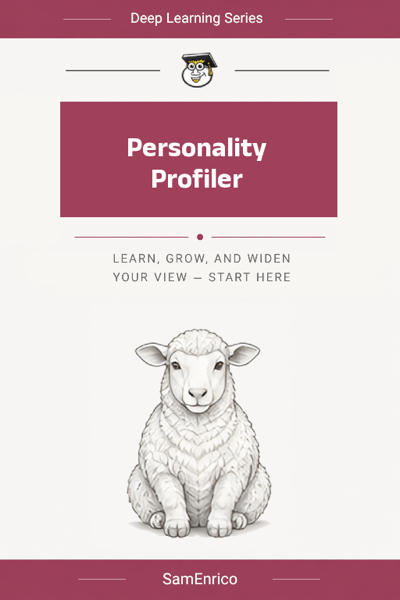
Non-FictionInformativeEducational
Personality Profiler eBook
A Coursebook on Personality Profiler
A Coursebook on Personality Profiler
Formats
Free sample
Chapter 1: The Broken Compass...--–- I used to believe I knew myself. That was my first mistake.The second mistake was taking the same personality test three times in five years and getting three different results. The first time, I was an INTJ – the “Architect.” Clever, strategic, a little intimidating. I printed the certificate and stuck it on my wall. The second time, two years later, I was an ENFP – the “Campaigner.” Enthusiastic, creative, suddenly interested in people.
I told myself I had grown. The third time, after a particularly brutal year of burnout, I tested as an ISTJ – the “Logistician.” Detail-oriented, rule-following, dependable. I didn’t know who I was anymore.Nothing about my brain had fundamentally changed. But my context had. My stress levels had.
My answers to questions like “Do you prefer to plan or go with the flow?” shifted depending on whether I was answering on a calm Sunday morning or after a week of missed deadlines. The test wasn’t measuring my personality. It was measuring my mood, my recent experiences, and my desire to be seen a certain way.This is the dirty secret of the multibillion-dollar personality industry: most of it is built on sand.That’s not to say personality isn’t real. It is. But the way we talk about it – the boxes, the labels, the four-letter codes, the animal metaphors, the colored stickers on our laptops – is dangerously oversimplified.
We have been handed broken compasses and told they point north.This book is not another personality test. It is not going to put you in a box. Instead, it is going to teach you how personality actually works – the science, the nuance, the uncomfortable limitations – and then give you the tools to observe, understand, and communicate with anyone, including yourself. By the end of this chapter, you will understand why your last personality test probably lied to you. By the end of this book, you will never need another one.Let’s start with a question that sounds simple but is anything but.The Most Dangerous Question in Psychology What is personality?If you ask ten psychologists, you will get eleven answers.
But after a century of research, a consensus has emerged around a definition that surprises most people: personality is a stable set of psychological characteristics that influence behavior across different situations and over time.There are three loaded words in that sentence: stable, influence, and behavior.Stable does not mean fixed. It means predictable enough that knowing someone’s personality gives you a statistical edge in guessing how they will act – not certainty, just better than a coin flip. Influence does not mean determine. Your personality nudges you toward certain choices, but it doesn’t lock the doors behind you. And behavior does not mean identity.
You are not your personality. You are a living, breathing, contradictory human who sometimes acts out of character.This last point is where most personality tests go wrong. They mistake description for destiny.Consider the difference between saying “I am an introvert” and saying “I generally prefer smaller social gatherings and need solitude to recharge.” The first statement is an identity claim. It feels permanent. It invites self-fulfilling prophecy: “I’m an introvert, so of course I didn’t speak up in that meeting.” The second statement is an observation.
It leaves room for exceptions: “Generally” means sometimes you do enjoy the party. “Prefer” means you can choose otherwise. And “need solitude to recharge” is a mechanism, not a life sentence.The most dangerous thing you can do with personality is turn it into a noun. “I am an introvert” becomes a cage. “I often behave in introverted ways” is a description of a pattern, not a prison.This book will train you to use the second language exclusively.
Every time you catch yourself saying “I am a [trait label],” you will stop and rephrase: “I tend to…” or “I prefer…” or “Under normal circumstances, I usually…” These small linguistic shifts change everything. They restore your agency. They remind you that personality is something you have, not something you are.The Trait-State-Disorder Distinction Before we go any further, we need to establish a framework that will appear throughout this book. It is the single most important conceptual tool you will learn, and it will prevent the kind of category errors that plague most personality discussions.Everything you observe about a person falls into one of three categories: traits, states, or disorders.Traits are enduring patterns of thinking, feeling, and behaving that are stable across time and situations. If someone is consistently punctual, organized, and detail-oriented – whether at work, at home, or on vacation – that is a trait.
Traits are the default settings of your psychological operating system. They emerge early, they are influenced by genetics and early environment, and they tend to remain stable relative to your peers over your lifetime. That last part is crucial. Stability doesn’t mean you never change. It means if you are more conscientious than 80% of people at age twenty, you will likely still be more conscientious than 80% of people at age fifty, even if everyone’s absolute level of conscientiousness increases slightly with age.
This is what researchers call rank-order stability.States are temporary conditions. They include moods, emotions, and situational reactions. Feeling anxious before a presentation, being irritable after a bad night’s sleep, feeling unusually social at a party where you know everyone – these are states. The critical difference between a trait and a state is duration and pervasiveness. A trait shows up across contexts.
A state is specific to a moment. A high-neuroticism person doesn’t just feel anxious before a presentation; they feel anxious before a presentation, during the presentation, afterward while replaying mistakes, and then again when thinking about the next presentation. The anxious state has become a trait when it follows you home.Disorders are patterns of thinking, feeling, and behaving that cause clinically significant distress or impairment in functioning. This is not a moral judgment. It is a threshold.
If your shyness means you avoid social situations entirely, cannot maintain relationships, and struggle to hold a job, that is no longer a trait or a state – that is a disorder requiring professional attention. The distinction between a high trait score and a disorder is dysfunction. A very conscientious person might be rigid and overly organized, but if they can hold a job, maintain relationships, and do not experience severe distress about their rigidity, it is a trait. When the rigidity prevents them from completing basic tasks, destroys relationships, or causes them constant suffering, it may be a disorder.Why does this distinction matter? Because the personality industry routinely conflates them.
Online tests label normal introversion as “social anxiety.” They call a preference for structure “obsessive-compulsive.” They turn normal human variation into pathology. And worse, they turn temporary states into permanent identities.Here is a rule you can take to the bank: Never take a personality test when you are hungry, tired, lonely, or stressed. Wait for a neutral day. Better yet, take it three times across three weeks and average your results. What you will discover is that…
This is the end of the free sample. Get the eBook to keep going. Buy now
About this book
Details
- Author
- Glynn Juliana
- Publisher
- SamEnrico
- Language
- English
- Genre
- Non-Fiction, Informative, Educational
- Released
- 2026-05-06
- Pages (approx.)
- 149
- Available as
- eBook, Audiobook

Read better in the ZLOADR app
Your eBooks on your phone or tablet. Sign in with your SamEnrico account and start reading.
More by Glynn Juliana
 Pre Talk Meal Timing GuideGlynn Juliana$11.99
 Adult Sibling Communication GuideGlynn Juliana$11.99
 HIIT Weight Loss ResultsGlynn Juliana$11.99
 Venture Debt Technical DefaultGlynn Juliana$11.99
 The Veena's Lament: Saraswati's Lost SymphonyGlynn Juliana$11.99
 How to Produce Ceramic Fiber ProductsGlynn Juliana$11.99
 Factoring in Brazil GuideGlynn Juliana$12.99
 How to Start a Lock Gates Business (Beginners Guide)Glynn Juliana$11.99
You may also like
 Hong Kong Handover 1997Dunn Johnnie$11.99
 Zumba For Postnatal Recovery CourseNeal Christian$11.99
 Zumba for BeginnersLadner Nikia$11.99
 YouTube Comment Mining GuideHumes Pandora$12.99
 Worry Box MeditationCarlin Rudy$11.99
 Workplace Stress MeditationNguyen Lynn$11.99
 Workplace Stress and Sleep RepairHawley Ivory$11.99
 Workplace Perfectionism CureDelaney Jeffry$11.99
 Workplace Injustice Anger GuideWallen Isabelle$11.99
 Work Addiction and Burnout LinkGreenwood Ester$11.99
 Women in Yoga and WellnessBeattie Galina$11.99
 Women in Stand Up ComedyChun Evangeline$11.99