
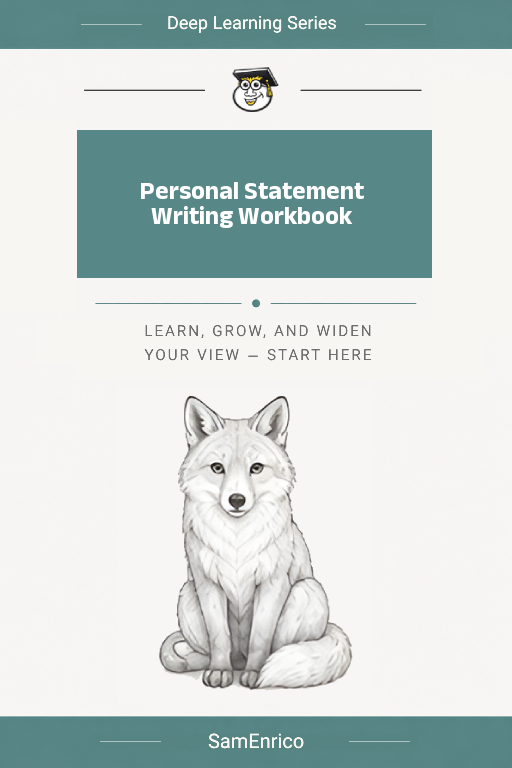
Non-FictionStudent's ShortcutEssay Writing
Personal Statement Writing Workbook eBook
Brainstorm meaningful topics, outline your story,
Brainstorm meaningful topics, outline your story, and revise until your authentic voice shines through.
Formats
Free sample
Chapter 1: The Inner Editor...--The blank page is not your enemy. Your enemy is the voice in your head that has already decided, before you have written a single word, that whatever you produce will not be good enough. That voice has a name, and you have been listening to it for far too long.Let me introduce you to the two people who live inside your skull every time you sit down to write anything important. The first is the Inner Editor. The Inner Editor is a grammar-obsessed, logic-policing, perfectionist bureaucrat who believes that every sentence should emerge from your fingertips fully formed, flawlessly structured, and dripping with sophistication.
The Inner Editor hates mess. The Inner Editor hates uncertainty. The Inner Editor would rather write nothing at all than write something embarrassing.The second is the Inner Storyteller. The Inner Storyteller is curious, messy, associative, and playful. The Inner Storyteller loves tangents.
The Inner Storyteller remembers the smell of your grandmother’s kitchen and the way your father hummed off-key when he was concentrating. The Inner Storyteller does not care about grammar. The Inner Storyteller cares about what happened and why it mattered.Here is the problem that has paralyzed millions of students before you: when you sit down to write your personal statement, you hand the pen to the Inner Editor. You ask the Editor to produce something beautiful on the first try. And the Editor, being a perfectionist, looks at the blank page and says, “I cannot guarantee perfection, so I will not begin.” Then you stare at the cursor blinking on your screen for forty-five minutes.
Then you open a new tab and watch videos of cats falling off furniture. Then you close your laptop and tell yourself you will write tomorrow.Tomorrow arrives, and the same thing happens.This chapter is going to break that cycle. Not by giving you better tips or more inspiring quotes. By giving you a completely different relationship to the blank page. By locking the Inner Editor in a closet—not forever, but for long enough to let the Inner Storyteller do its job.
And by giving you explicit permission to write something terrible.Because here is the secret that every professional writer knows and almost no student believes: you cannot edit a blank page. You can edit a bad page. A terrible page. A page full of clichés, repetition, grammatical errors, and sentences that go absolutely nowhere. That page is gold, because that page exists.
And anything that exists can be shaped, cut, rearranged, and polished into something good.A blank page cannot be shaped. A blank page is a void. A blank page is where good intentions go to die.So let us stop trying to write a good personal statement. For the next several chapters, we are not going to write a good personal statement at all. We are going to write a collection of raw, unpolished, possibly embarrassing chunks of memory and reflection.
And then, only then, we are going to turn those chunks into an essay that sounds like you—not like a thesaurus, not like your parents, not like some idealized version of a college applicant, but like the actual human being who has lived an actual life full of actual small moments that actually matter.But first, you need permission. Real permission. The kind that comes with a signature and a physical object you can tape to your desk.The Permission Slips At the end of this chapter, you will find a page that looks like a contract. It is a contract you are going to sign with yourself. The contract says the following things, and you are going to agree to all of them:I am allowed to write boring sentences.
Not every sentence can be a lightning bolt. Some sentences just need to get the reader from one place to another. Boring sentences are fine. They can be cut later, or they can stay as the quiet scaffolding that holds up the interesting parts. But you cannot write an interesting sentence if you are afraid of writing a boring one first.I am allowed to repeat myself.
In early drafts, repetition is not a flaw; it is a signal. When you write the same idea three different ways, you are not being redundant. You are circling around something that matters to you, trying to find the exact angle that captures it. Later, you will choose the best version and delete the others. But you cannot choose from options you have not written.I am allowed to use clichés.
Clichés are not evil. Clichés are placeholders. When you write “I was over the moon,” you are not committing a literary crime. You are saying, “Something made me very happy, and I do not yet have the specific language to describe it, so I am using this worn-out phrase as a chair to sit in while I figure out what actually happened.” Later, you will replace the cliché with a concrete detail. But you cannot replace something that is not there.I am allowed to go off topic.
The straightest line is rarely the most interesting path through a story. Some of the best moments in personal statements come from detours—the unexpected observation, the seemingly irrelevant memory, the sentence that starts with “This has nothing to do with anything, but…” Follow those detours. They are not distractions. They are the Inner Storyteller trying to show you where the real material lives.I am allowed to write a terrible first draft. Not a flawed draft.
Not a rough draft. A terrible draft. A draft that you would be embarrassed to show anyone. That draft is not a failure. That draft is a requirement.
Every single essay that has ever moved an admissions reader began as a terrible draft. The only difference between you and the writer of that essay is that they did not stop at the terrible draft. They kept going.Now, here is the most important part of this contract: you are going to sign it. Physically. With a pen.
And then you are going to tape it to your desk, or to the wall above your computer, or to the inside cover of this workbook. And for the next several chapters, whenever the Inner Editor starts whispering that you are not good enough, that your writing is embarrassing, that you should just give up and watch more cat videos—you are going to look at that signed permission slip and say, out loud if you have to: “I am allowed to write badly. I will fix it later.”Because you will fix it later. That is what Chapters 8 through 12 are for. But you cannot fix what does not exist.Two Voices, One Brain Let me describe the Inner Editor in more detail, because you need to recognize this voice when it speaks.
The Inner Editor sounds like your harshest English teacher, but meaner. The Inner Editor uses phrases like:“That sentence is awkward.”“No one will take you seriously if you write that.”“This has been said before.”“Your vocabulary is not sophisticated enough.”“You are not interesting enough to have…
This is the end of the free sample. Get the eBook to keep going. Buy now
About this book
Details
- Author
- Forman Jesusita
- Publisher
- SamEnrico
- Language
- English
- Genre
- Non-Fiction, Student's Shortcut, Essay Writing
- Released
- 2026-05-30
- Pages (approx.)
- 137
- Available as
- eBook, Audiobook

Read better in the ZLOADR app
Your eBooks on your phone or tablet. Sign in with your SamEnrico account and start reading.
More by Forman Jesusita
 Imposter For Students GuideForman Jesusita$11.99
 Body Position Reconstruction GuideForman Jesusita$11.99
 Parent Time Blocking GuideForman Jesusita$11.99
 Public Sector Talent RetentionForman Jesusita$11.99
 Flexible Time BlockingForman Jesusita$11.99
 The Startup Burn Rate GuideForman Jesusita$11.99
 Deep Work For EducatorsForman Jesusita$11.99
 Car Hypnosis Listening SafetyForman Jesusita$11.99
 The Lost Codex of the Silk Road: A Merchant's Secret LegacyForman Jesusita$11.99
 The Alchemists of Timbuktu: Unveiling Africa's Forgotten Scientific PioneersForman Jesusita$11.99
 How to Produce Pool Sweeps and VacuumsForman Jesusita$11.99
 How to Produce Downhill SkisForman Jesusita$11.99
You may also like
 Hong Kong Handover 1997Dunn Johnnie$11.99
 Zumba For Postnatal Recovery CourseNeal Christian$11.99
 Zumba for BeginnersLadner Nikia$11.99
 YouTube Comment Mining GuideHumes Pandora$12.99
 Worry Box MeditationCarlin Rudy$11.99
 Workplace Stress MeditationNguyen Lynn$11.99
 Workplace Stress and Sleep RepairHawley Ivory$11.99
 Workplace Perfectionism CureDelaney Jeffry$11.99
 Workplace Injustice Anger GuideWallen Isabelle$11.99
 Work Addiction and Burnout LinkGreenwood Ester$11.99
 Women in Yoga and WellnessBeattie Galina$11.99
 Women in Stand Up ComedyChun Evangeline$11.99