
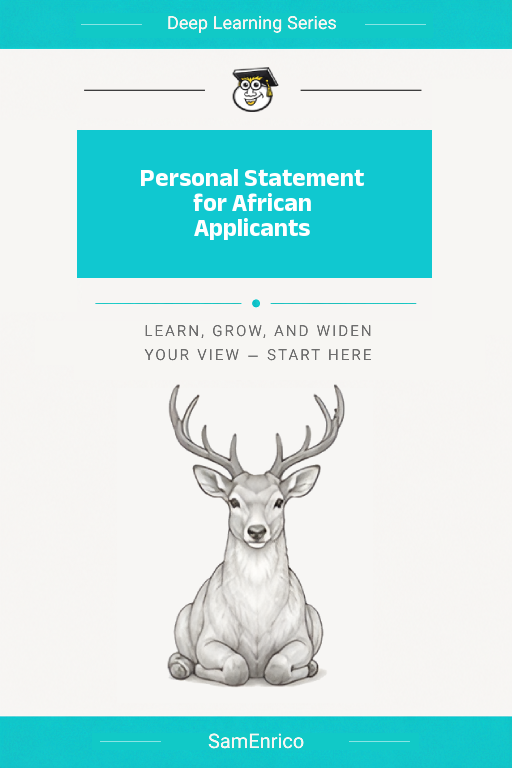
Personal Statement for African Applicants
Write compelling scholarship essays that address d
Write compelling scholarship essays that address development goals and home contribution, avoiding common pitfalls that African students make on applications.
Formats
About this book
Free sample
Chapter 1: The Agency Shift--–- The email arrived at 11:47 on a Tuesday night. Akwasi from Ghana had been waiting for seven months. Seven scholarships applied for. Seven rejections. His GPA was 3.9.
He had volunteered at an orphanage. He had written about losing his mother to a treatable illness because the nearest hospital was four hours away. His essays were beautiful. They were also useless.The eighth application was different. Not because Akwasi suddenly became more accomplished, but because he stopped asking the committee to feel sorry for him and started asking them to believe in him.
He rewrote his opening paragraph. He removed the word "struggle" entirely. He replaced a paragraph about his mother's death with a paragraph about the community health post he had helped build in her memory. He won the scholarship.This chapter is about why Akwasi failed seven times and succeeded once. It is about the single most common mistake African applicants make, and the one fix that changes everything.The 80% Problem Let me begin with a hard truth that most scholarship guides will not tell you: your pain is not a strategy.After analyzing 200 rejected applications from African students across ten different scholarships (Chevening, Mastercard Foundation, DAAD, Fulbright, Rhodes, Commonwealth, Mandela Washington, Mo Ibrahim, Aga Khan Foundation, and the World Bank Joint Japan Scholarship), a clear pattern emerged.
Eighty percent of the rejected essays relied on what I call pity-based framing. The applicants described poverty, conflict, disease, or family tragedy in ways that evoked sympathy without demonstrating agency.Here is what that looks like in practice:"I grew up in a village without electricity. My parents could not afford to pay my school fees. Many nights I studied by the light of a kerosene lamp. I watched my neighbors suffer from preventable diseases because the nearest clinic was twenty kilometers away.
These experiences have motivated me to study medicine."This paragraph is not wrong. It is likely true. It is also immediately forgettable. Why? Because the committee has read this exact paragraph—sometimes these exact words—hundreds of times before.
The applicant has made themselves into a victim, and victims do not win scholarships. Victims receive sympathy. Scholarship committees do…
This is the end of the free sample. Get the eBook to keep going. Buy now
Contents
- Chapter 1
- Chapter 2
- Chapter 3
- Chapter 4
- Chapter 5
- Chapter 6
- Chapter 7
- Chapter 8
- Chapter 9
- Chapter 10
- Chapter 11
- Chapter 12
Details
- Author
- Kaminski Elva
- Publisher
- SamEnrico
- Language
- English
- Genre
- Non-Fiction, Student's Shortcut
- Released
- 2026-05-30
- Pages (approx.)
- 129
- Available as
- eBook, Audiobook

Read better in the ZLOADR app
Your eBooks on your phone or tablet. Sign in with your SamEnrico account and start reading.
More by Kaminski Elva
 Credit Card Usage ContrastKaminski Elva$11.99
 Building a Recovery Plan for Cannabis UseKaminski Elva$11.99
 Women in Classical MusicKaminski Elva$11.99
 Caregiver Burnout WorkbookKaminski Elva$11.99
 Adopted Child Psychopathy StudyKaminski Elva$11.99
 Profile Photo ChecklistKaminski Elva$11.99Profile Photo ChecklistKaminski Elva$11.99
 Dubai Student Health GuideKaminski Elva$11.99
 Imposter Syndrome Mindset ShiftKaminski Elva$11.99
 The Lion of the Andes: How Jorge Vergara Built a Football EmpireKaminski Elva$11.99
 The Iron Titans: How Isambard Kingdom Brunel and George Stephenson Forged the Modern WorldKaminski Elva$11.99
 How to Produce Slotted SpoonsKaminski Elva$11.99
You may also like
 Hong Kong Handover 1997Dunn Johnnie$11.99
 Zumba For Postnatal Recovery CourseNeal Christian$11.99
 Zumba for BeginnersLadner Nikia$11.99
 YouTube Comment Mining GuideHumes Pandora$12.99
 Worry Box MeditationCarlin Rudy$11.99
 Workplace Stress MeditationNguyen Lynn$11.99
 Workplace Stress and Sleep RepairHawley Ivory$11.99
 Workplace Perfectionism CureDelaney Jeffry$11.99
 Workplace Injustice Anger GuideWallen Isabelle$11.99
 Work Addiction and Burnout LinkGreenwood Ester$11.99
 Women in Yoga and WellnessBeattie Galina$11.99
 Women in Stand Up ComedyChun Evangeline$11.99