
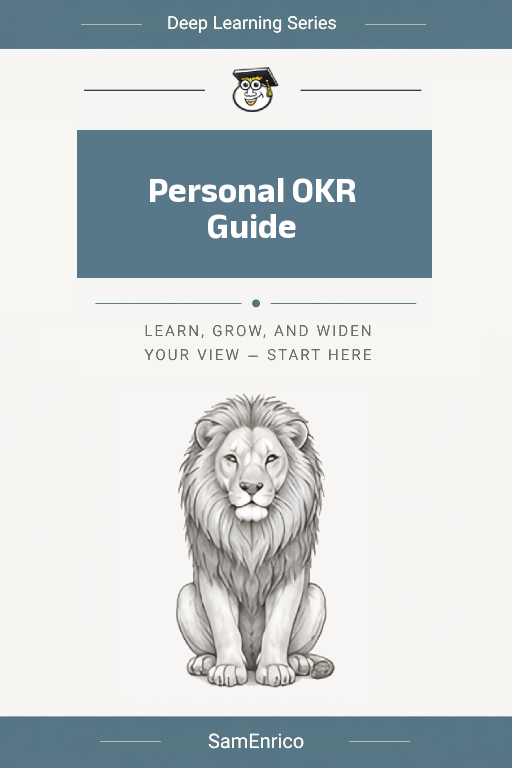
Non-FictionProfessional's Cheat SheetPersonalSelf-Help
Personal OKR Guide eBook
Apply corporate goal setting to your life and care
by Hartley Dean
Apply corporate goal setting to your life and career with this workbook.
Formats
Free sample
Chapter 1: The Sticky Note Lie--You have a sticky note on your monitor right now. Or a note in your phone. Or a voice memo you recorded on January 1st. It says something like “lose twenty pounds” or “save ten thousand dollars” or “finally finish that project.” You wrote it with genuine hope. You believed, in that moment, that this time would be different.It is now June.
How is that sticky note doing?Let me guess. You have not looked at it in months. Or worse, you have looked at it every single day, and every single day you have felt a small, quiet shame that you are not further along. The number on the scale is the same. The savings account balance is the same.
The project is still half-finished in a folder called “Old Work.”Here is the question this entire book will answer: Why do billion-dollar companies use a system called OKRs to achieve impossible goals, while you cannot seem to make progress on a single sticky note?The answer is not that you lack willpower. The answer is not that you are lazy. The answer is not that you secretly do not want what you think you want. The answer is far simpler and far more fixable than that. The answer is that you have been using the wrong system.
Or more precisely, you have been using no system at all.A sticky note is not a system. A resolution is not a plan. A vague hope is not a strategy. You have been trying to run a marathon by taping a picture of the finish line to your shoe and hoping for the best. And then, when you inevitably collapse at mile two, you blame yourself.
You tell yourself you lack discipline. You tell yourself that some people are just “goal-oriented” and you are not one of them.That is a lie.You are not the problem. Your tools are the problem.The 90% Failure Rate Is Not Your Fault Let us look at the data. Every year, approximately 40 percent of Americans make New Year’s resolutions. By the end of January, 25 percent of those people have already abandoned them.
By June, the failure rate approaches 90 percent. That is not a small failure. That is an almost universal failure. If 90 percent of pilots crashed their planes, we would not blame the pilots. We would redesign the planes.The same logic applies here.
When 90 percent of people fail at their personal goals, the problem is not a mass epidemic of laziness. The problem is the tool. The resolution. The sticky note. The vague intention.Corporate goal-setting used to have the same problem.
Before the 1970s, companies set vague annual goals like “increase profitability” or “become a market leader.” Then, at the end of the year, they would look back and realize nothing had changed. Sound familiar?Then a system emerged. It was called Management by Objectives, later refined into Objectives and Key Results by Andy Grove at Intel, and later popularized by John Doerr and Google. Companies that adopted this system stopped failing at 90 percent rates. They started achieving goals that seemed impossible.
Google, for example, used OKRs to grow from a search engine to a company that redefined email, video, mobile operating systems, and self-driving cars. Not all at once. One quarter at a time. One measurable Key Result at a time.If a system can help a team of engineers put a self-driving car on the road, that same system can help you lose twenty pounds or save ten thousand dollars. The difference is not the goal.
The difference is the architecture.The Two Brains Problem To understand why OKRs work and sticky notes fail, you need to understand a fundamental fact about how your brain is wired. You do not have one brain. You have two. And they rarely talk to each other.The first brain is your emotional/directional system. This is the part of you that feels things.
It dreams. It wants. It looks out the window on a Tuesday afternoon and thinks, “I should really learn to play the guitar.” This brain is responsible for every New Year’s resolution you have ever made. It is powerful. It is inspirational.
It is also completely useless at getting anything done.The second brain is your analytical/verification system. This is the part of you that calculates, measures, and verifies. It looks at a goal and asks, “How will I know when I have achieved that? What is the number? Where is the evidence?” This brain is precise.
It is logical. It is also, on its own, deeply unmotivating. “Run three times per week” is a precise measurement. It is also boring. It does not make you want to get out of bed at 6 a.m.
when it is raining.Here is the problem. Most personal goals engage only one of these two systems. A sticky note that says “get fit” engages the emotional system but gives the analytical system nothing to measure. What does “fit” even mean? Is it a number on a scale?
A time on a run? A feeling in your body? Without measurement, your analytical system shrugs and goes back to checking email. Nothing changes.Conversely, a goal that says “exercise three times per week” engages the analytical system but leaves the emotional system cold. You can do it.
You can check the box. But you will not feel inspired. You will not feel like you are becoming a different person. You will feel like a robot completing a checklist, and eventually, you will quit.The genius of OKRs is that they force both systems to work together. The Objective speaks to your emotional brain.
The Key Results speak to your analytical brain. And because both systems are engaged, you get both the motivation to start and the feedback to continue.Busyness Is Not Effectiveness Before we go further, I need you to understand a distinction that will change how you see your entire life. It is the distinction between busyness and effectiveness.Busyness is what most of us do all day. You answer emails. You attend meetings.
You run errands. You scroll through social media. You tidy your desk. You reorganize your files. At the end of the day, you are exhausted.
You feel like you did something. But if someone asked you to name the single most important thing you accomplished today, you would struggle. You were busy. You were not effective.Effectiveness is different. Effectiveness means doing fewer things but doing the right things.
It means being able to say, at the end of the day, “I moved my most important goal forward by a measurable amount.” Effectiveness is not about how many tasks you completed. It is about how much progress you made on what actually matters.Here is a hard truth that most self-help books will not tell you. You can be busy for fifty years and die without having achieved anything that mattered to you. Busyness is comfortable. It fills the day.
It gives you the illusion of progress. But illusions do not build careers, repair relationships, or fund retirements.OKRs are fundamentally an…
This is the end of the free sample. Get the eBook to keep going. Buy now
About this book
Details
- Author
- Hartley Dean
- Publisher
- SamEnrico
- Language
- English
- Genre
- Non-Fiction, Professional's Cheat Sheet, Personal, Self-Help, Personal OKRs
- Released
- 2026-06-09
- Pages (approx.)
- 129
- Available as
- eBook, Audiobook

Read better in the ZLOADR app
Your eBooks on your phone or tablet. Sign in with your SamEnrico account and start reading.
More by Hartley Dean
 International Trade Pandemic GuideHartley Dean$11.99
 The Foster Care Quiet ChildHartley Dean$11.99
 HGH Decline Natural PreventionHartley Dean$11.99
 Implementation IntentionsHartley Dean$11.99
 Networking Weekly ReviewHartley Dean$11.99
 Loving Kindness for OptometristsHartley Dean$11.99
 Church Building Memory PalaceHartley Dean$11.99
 Couch To 5K PlanHartley Dean$11.99
 The Alchemists of Ale: Renaissance Brewers and the Birth of Modern BeerHartley Dean$11.99
 How to Produce Masonry MaterialsHartley Dean$11.99
 A Collector's Handbook to the Morris Six MSHartley Dean$11.99
 Agent Background Checks IndiaHartley Dean$12.99
You may also like
 Hong Kong Handover 1997Dunn Johnnie$11.99
 Zumba For Postnatal Recovery CourseNeal Christian$11.99
 Zumba for BeginnersLadner Nikia$11.99
 YouTube Comment Mining GuideHumes Pandora$12.99
 Worry Box MeditationCarlin Rudy$11.99
 Workplace Stress MeditationNguyen Lynn$11.99
 Workplace Stress and Sleep RepairHawley Ivory$11.99
 Workplace Perfectionism CureDelaney Jeffry$11.99
 Workplace Injustice Anger GuideWallen Isabelle$11.99
 Work Addiction and Burnout LinkGreenwood Ester$11.99
 Women in Yoga and WellnessBeattie Galina$11.99
 Women in Stand Up ComedyChun Evangeline$11.99