
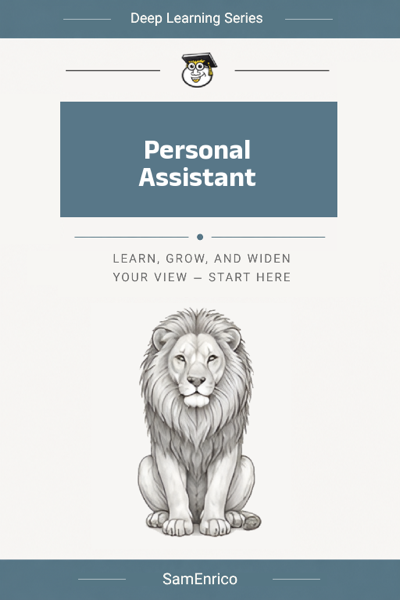
Non-FictionInformativeEducational
Personal Assistant eBook
A Coursebook on Personal Assistant
A Coursebook on Personal Assistant
Formats
Free sample
Chapter 1: Beyond the Calendar--The morning rush of a billion keystrokes begins in offices just like yours every day. Emails are answered, calendars are color-coded, coffee is brewed, and somewhere, an executive is saying, "My assistant handles the details." For decades, that phrase has been both a comfort and a cage. It has defined the role not by its potential but by its proximity to someone else's power. But something is shifting. The pandemic rewrote the rhythm of work.
Remote collaboration flattened hierarchies. Artificial intelligence began automating the very tasks that once justified a secretary's existence. And in that upheaval, a new question emerged: If a machine can schedule my meetings and book my flights, what is the human assistant actually for?The answer, it turns out, has been hiding in plain sight. It was never about the calendar. It was never about the coffee.
It was about the gap between what an executive knows they need and what they haven't yet imagined. It was about the quiet work of multiplying leverage. The modern personal assistant is not a gatekeeper. The modern personal assistant is a force multiplier.This chapter is not a history lesson. It is an unlearning.
Before you master a single skill in this book, you must abandon the mental model that has held back an entire profession. You must stop seeing yourself as the person who executes tasks and start seeing yourself as the person who amplifies results. That shift from task-doer to force multiplier is the single most important transformation you will make in your career. Everything else—calendar mastery, email triage, crisis management—is just technique. This chapter is about identity.The Old Story: Secretary, Gatekeeper, Scheduler Let us be honest about the ghost that haunts this profession.
The word "secretary" derives from the Latin secretus, meaning "set apart" or "hidden." For centuries, the role was exactly that: a keeper of secrets, a handler of paperwork, an invisible hand that kept offices running while visible executives took credit. There was dignity in that. There was also limitation. The secretary typed what she was told. She answered phones.
She filed documents. She was essential, but she was reactive. Her value was measured in speed and accuracy, not in judgment or initiative.That model persisted well into the twenty-first century. Even as titles changed to "administrative assistant" and "executive assistant," the underlying expectation remained largely the same: do what you are told, do it quickly, do it without error, and stay out of the spotlight. Many assistants internalized this so completely that they began to apologize for having ambitions of their own.
They learned to say, "I'm just an assistant," as if the word "just" belonged anywhere near that sentence.The calendar came to symbolize the ceiling of the role. Yes, an assistant managed the calendar. But managing a calendar is not the same as managing time. It is not the same as managing energy. It is not the same as managing strategy.
When executives say "my assistant handles my calendar," they are describing a service, not a partnership. And when assistants define themselves by that calendar, they lock themselves into a transactional relationship where their value expires at the end of every day.The New Story: Strategic Partner, Force Multiplier, Trusted Operator Now consider a different description. A private equity managing director walks into her office at eight in the morning. She has back-to-back calls until noon, a board presentation at two, a flight at six, and a family commitment she cannot miss at eight. Her assistant has already reviewed her email overnight, flagged three that require immediate attention, drafted responses for two others, and deleted the rest.
The assistant has also noticed from the calendar that the director has been scheduling back-to-back meetings without breaks for three weeks running, so he has quietly inserted thirty-minute buffers before each high-stakes call and moved a non-urgent internal meeting to next week. The director never asked for any of this. She does not even notice it. That is the point.This is not magic. It is not hyper-competence born from twenty years of experience.
It is a mindset. The assistant in this scenario did not wait to be told what to do. He observed patterns, anticipated needs, and acted preemptively. He asked himself not "What is on my to-do list?" but "What would make my executive radically more effective?" That question changes everything. It transforms the assistant from a task-doer into a force multiplier.A force multiplier is any factor that dramatically increases the combat effectiveness of a military unit.
One well-placed machine gunner can hold off a hundred advancing soldiers not because he is a hundred times stronger but because he changes the geometry of the battlefield. In business, a force multiplier does the same thing. She does not simply do more work. She makes the executive's work more effective. She protects the executive's attention.
She solves problems before they reach the executive's desk. She creates time and space for the executive to do the things that only the executive can do.The task-doer operates in a straight line: receive instruction, execute instruction, report completion. The force multiplier operates in three dimensions: observe, anticipate, execute, and measure impact. The task-doer asks "What do you need me to do?" The force multiplier asks "What are you trying to achieve?" The task-doer is replaceable. The force multiplier is indispensable.
And the difference between the two is not a certificate or a promotion. It is a choice.The Four Pillars of Elite Assistance Becoming a force multiplier requires more than a shift in mindset. It requires a foundation of core competencies that support every action you take. This book organizes those competencies around three pillars. The fourth pillar—discretion—is so critical that it receives its own full chapter later in this book.
For now, let us focus on the three pillars that define the architecture of elite assistance.The first pillar is trust. Without trust, nothing else matters. Your executive must believe that you will protect their reputation, their confidentiality, and their interests even when they are not watching. Trust is not given because of your résumé. It is earned slowly through consistent reliability, demonstrated judgment, and the quiet accumulation of small correct decisions.
Every time you handle a sensitive document appropriately, every time you keep a confidence without being reminded, every time you deliver under pressure without excuses, you deposit a coin in the trust bank. Withdrawals are easy to make and expensive to repay. One broken confidence can destroy years of trust in a single afternoon. This is why elite PAs treat trust not as a soft skill but as the hard currency of their career.The second pillar is foresight. Most people react.
Some people plan. A rare few anticipate. Foresight is the ability to see around corners, to recognize patterns, and to prepare for problems that have not yet materialized. It is what separates the assistant who asks "What time is your flight?" from the assistant who says "Your flight is at six, traffic is heavy on the 405, you have a thirty-minute window to leave, and I have already printed your boarding pass…
This is the end of the free sample. Get the eBook to keep going. Buy now
About this book
Details
- Author
- Heller Lorelei
- Publisher
- SamEnrico
- Language
- English
- Genre
- Non-Fiction, Informative, Educational
- Released
- 2026-05-04
- Pages (approx.)
- 143
- Available as
- eBook, Audiobook

Read better in the ZLOADR app
Your eBooks on your phone or tablet. Sign in with your SamEnrico account and start reading.
More by Heller Lorelei
 Teresa's Raptures ImpactHeller Lorelei$11.99
 Elder Care Sibling ConflictHeller Lorelei$11.99
 HIIT for Beginners ManualHeller Lorelei$11.99
 Warrant Expiration GuideHeller Lorelei$11.99
 Whispers in the Dark: The Vanishing of the SS BaychimoHeller Lorelei$11.99
 How to Start a Locksmiths BusinessHeller Lorelei$11.99
 How to Produce Ceramic ProductsHeller Lorelei$11.99
 Factoring Fee Structure HandbookHeller Lorelei$12.99
You may also like
 Hong Kong Handover 1997Dunn Johnnie$11.99
 Zumba For Postnatal Recovery CourseNeal Christian$11.99
 Zumba for BeginnersLadner Nikia$11.99
 YouTube Comment Mining GuideHumes Pandora$12.99
 Worry Box MeditationCarlin Rudy$11.99
 Workplace Stress MeditationNguyen Lynn$11.99
 Workplace Stress and Sleep RepairHawley Ivory$11.99
 Workplace Perfectionism CureDelaney Jeffry$11.99
 Workplace Injustice Anger GuideWallen Isabelle$11.99
 Work Addiction and Burnout LinkGreenwood Ester$11.99
 Women in Yoga and WellnessBeattie Galina$11.99
 Women in Stand Up ComedyChun Evangeline$11.99