
Non-FictionSelf-HelpVisual Memory
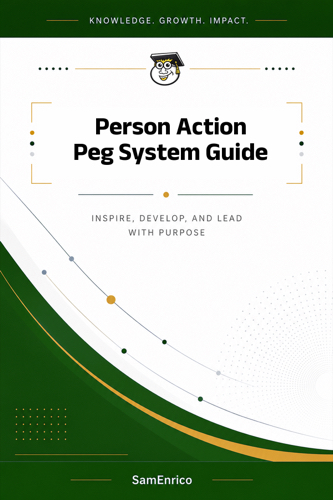
Person Action Peg System Guide eBook
Use memorable characters and actions as pegs with
Use memorable characters and actions as pegs with this practical mnemonic workbook.
Formats
Free sample
Chapter 1: The Memory Thief...--–- Every morning, you wake up with the same brain that humans have relied on for 200,000 years. It is a brain built to track lions, remember which berries caused vomiting, and recognize the faces of people who might share their food with you. It is not, by default, built to remember a grocery list, a five-digit confirmation code, or the name of the person you met thirty seconds ago at a networking event. And yet, here you are, living in the twenty-first century, asking that ancient organ to do exactly that. No wonder you forget.The problem is not that your memory is broken.
The problem is that you have been using the wrong tool for the job. When you try to remember a list by repeating it over and over, you are asking your brain to act like a filing cabinet. But your brain is not a filing cabinet. It never was. Your brain is a storyteller, a casting director, a theater where thousands of characters walk onto a stage, perform actions, and exit into the wings, waiting to be called back for an encore.
Every memory that sticks does so because it involves someone doing something. Every memory that vanishes does so because it was never given a character or a motion to begin with.This chapter will introduce you to the core mechanism of the Person-Action system. You will learn what a peg is, why a person combined with an action creates a virtually unbreakable memory hook, and how to build your first five test pegs from the raw material of your own life. By the end of this chapter, you will have experienced your first successful encoding using the PA system. More importantly, you will understand why the PA system works when traditional memory methods have failed you.The Anatomy of a Forgotten List Let us begin with a small experiment.
Right now, without looking back, try to recall the third item from the introduction of this book. Do not turn the page. Just sit with the question for a moment.You cannot, and that is not your fault. You were never asked to remember it. The introduction was designed to be read, not memorized.
But this small failure points to a larger truth: most of what you read, hear, and experience slips away within minutes because it was never anchored to anything memorable.Now try a different task. Think of a childhood friend you have not seen in twenty years. Can you see their face? Probably. Can you remember something specific they used to do?
Maybe the way they laughed, or a game you played together, or a strange habit they had. That memory has persisted not because you reviewed it daily, but because it involves a specific person performing a specific action. Your brain held onto it effortlessly.The Person-Action system hijacks this natural ability. It gives you a way to deliberately create the same kind of rich, person-plus-action memories for information that would otherwise evaporate. The key is something called a peg.What Is a Peg?In the memory training world, a peg is a mental hook.
You hang information onto the peg, and the peg holds it in place until you need to retrieve it. The most common peg systems use rhymes (one is a bun, two is a shoe) or shapes (one is a candle, two is a swan). These work, but they are fragile. A bun does not move. A shoe does not tell a story.
They are static objects, and static objects are exactly what your brain is worst at remembering.A Person-Action peg is different. It is not an object. It is a tiny one-second movie starring a specific character doing a specific thing.Here is the formula:Peg = A Specific Person + A Specific Action That is it. No numbers yet. No lists.
Just a person and an action fused into a single mental image.Consider this example: Einstein pulling a train.Close your eyes for two seconds. See Albert Einstein, wild white hair, sticking out his tongue slightly the way he did in that famous photograph. Now see him gripping the handle of a train car and pulling it with all his strength. The train does not move easily. His shoes skid on the tracks.
He grunts.That image is a peg. It took you less than three seconds to form, and you will not forget it easily because it contains two things your brain is wired to remember: a recognizable person and a dynamic action.Now here is the critical insight that separates the PA system from every other mnemonic method: the action is not decorative. The action is the engine of recall. When you watch Einstein pull a train, your brain activates motor imagery. The same neural regions that fire when you actually pull something fire when you imagine someone else pulling something.
This is called mirror neuron activation, and it is the reason you flinch when you see someone stub their toe. Your brain simulates the action. That simulation creates a deeper, more durable memory trace than any static image ever could.Why Persons Work Better Than Objects You might be thinking: why not just use a train as the peg? Why involve Einstein at all?Because your brain has a dedicated facial recognition system. The fusiform face area, a small region in your temporal lobe, lights up when you see a face.
It does not light up when you see a train. Evolution gave you this specialized hardware because recognizing individuals was a matter of survival. The person who shared food with you yesterday might share again today. The person who chased you with a spear yesterday will probably chase you again tomorrow. Your brain is, quite literally, a face-recording device.When you use a person as a peg, you are borrowing that ancient hardware.
Einstein triggers your face recognition system. Then you add an action, which triggers your motor simulation system. Two dedicated neural systems working together. That is why PA pegs stick when other pegs slip.But not any person will do. The person must be:Familiar.
You need a clear mental picture. Einstein works because almost everyone has seen his face. Your mother works because you have seen her face thousands of times. Brad Pitt works because you have watched him in movies. A person whose face you cannot picture clearly is useless as a peg.Vivid.
The person should have distinctive features. Einstein has wild hair and a droopy mustache. Your mother has a specific smile. A generic person—"a man," "some woman," "that guy from work whose name I forget"—will not work. Vividness is not about beauty; it is about distinctiveness.Emotionally charged (or at least interesting).
Your brain prioritizes emotional information. A person who makes you feel something—affection, annoyance, admiration, even mild amusement—will be easier to recall than a neutral person. If you cannot find an emotional connection, use absurdity instead. Absurdity mimics emotion in the brain.Why Actions Work Better Than Adjectives If persons are the actors, actions are the plot. An action is a verb in motion.
Pulling, shaking, kicking, throwing, spinning, lifting, biting, stomping, juggling, sniffing. These are actions. Standing, sitting, being, having, existing—these are not…
This is the end of the free sample. Get the eBook to keep going. Buy now
About this book
Details
- Author
- Phelps Rosemary
- Publisher
- SamEnrico
- Language
- English
- Genre
- Non-Fiction, Self-Help, Visual Memory
- Released
- 2026-06-06
- Pages (approx.)
- 150
- Available as
- eBook, Audiobook

Read better in the ZLOADR app
Your eBooks on your phone or tablet. Sign in with your SamEnrico account and start reading.
More by Phelps Rosemary
 Ecommerce Email Automation GuidePhelps Rosemary$11.99
 Selenium And Thyroid HealthPhelps Rosemary$11.99
 Recurring Dream Alarm Clock GuidePhelps Rosemary$11.99
 Self Hypnosis For Career Advancement GuidePhelps Rosemary$11.99
 The Arctic Apollo: How a Soviet Cosmonaut Survived a Crash in the IcePhelps Rosemary$11.99
 The Last Broadcast of Station ZPhelps Rosemary$11.99
 Trust Building Across CulturesPhelps Rosemary$12.99
 House Sitting Short Term GuidePhelps Rosemary$12.99
 Lead Operating EngineerPhelps Rosemary$11.99
 Ultimate Handbook Guide to San Francisco : (United States) Travel GuidePhelps Rosemary$11.99
You may also like
 Hong Kong Handover 1997Dunn Johnnie$11.99
 Zumba For Postnatal Recovery CourseNeal Christian$11.99
 Zumba for BeginnersLadner Nikia$11.99
 YouTube Comment Mining GuideHumes Pandora$12.99
 Worry Box MeditationCarlin Rudy$11.99
 Workplace Stress MeditationNguyen Lynn$11.99
 Workplace Stress and Sleep RepairHawley Ivory$11.99
 Workplace Perfectionism CureDelaney Jeffry$11.99
 Workplace Injustice Anger GuideWallen Isabelle$11.99
 Work Addiction and Burnout LinkGreenwood Ester$11.99
 Women in Yoga and WellnessBeattie Galina$11.99
 Women in Stand Up ComedyChun Evangeline$11.99