
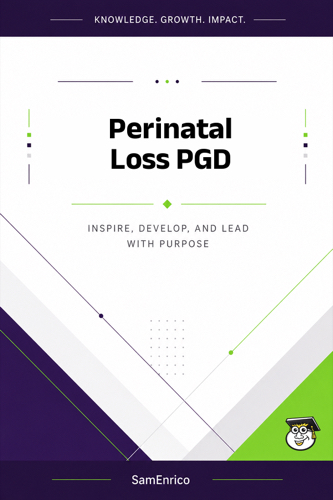
Non-FictionSelf-HelpPerinatal Loss
Perinatal Loss PGD eBook
Prolonged grief after stillbirth or neonatal death
Prolonged grief after stillbirth or neonatal death.
Formats
Free sample
Chapter 1: The Day the World Stopped...--–- The silence was the first thing you noticed. Not the quiet of a sleeping house or the hush before a storm, but something deeper—a vacuum where sound used to be. The delivery room had been full of noise just moments ago: the rhythmic beep of the fetal monitor, the murmuring of nurses, your own breathing through contractions. And then, nothing. The monitor went silent.
The nurse's hand reached for the ultrasound probe. The doctor's face changed. And in that single, soundless moment, your life split into two halves: everything that came before, and everything that would come after.This chapter is an unflinching look at the specific medical and psychological events of perinatal loss itself. It differentiates between the two distinct traumatic experiences of stillbirth and neonatal death, validates the physiological memories that haunt you, and explains why this particular loss breaks the rules of every conventional grief model. Most importantly, it normalizes what you are experiencing right now—the flashbacks, the intrusive images, the replaying of those final moments—as your brain's desperate, necessary attempt to process an event that should never have happened.If you are reading this chapter in the hours or days after your loss, know this first: you are not broken.
You are not going crazy. You are having a normal response to an abnormal event. And while this chapter will ask you to revisit the most painful moments of your life, it does so with a single purpose: to help you understand what happened so that, eventually, you can begin to carry it differently.The Two Roads of Perinatal Loss Before we go any further, we need to name something essential. The phrase "perinatal loss" covers two distinct experiences, and while the grief that follows shares much in common, the trauma of how you lost your baby shapes everything that comes next. You may have experienced one of these two roads.
You may know someone who traveled the other. Both are devastating. Both deserve their own language.Stillbirth: The Silence Before Birth Stillbirth is defined medically as the death of a baby after 20 to 24 weeks of pregnancy (the exact threshold varies by country) but before or during delivery. In practical terms, it means you carried your baby, felt them kick, prepared a nursery, and then—often without warning—you were told their heart had stopped.For many parents, the stillbirth diagnosis comes during a routine appointment. You lie down for an ultrasound, expecting to see a wiggling profile, a thumb in a mouth, a heartbeat.
Instead, the technician goes quiet. They leave the room to "get the doctor." When the doctor returns, their face tells you everything before their mouth opens. I'm so sorry. There's no heartbeat.For others, the discovery comes when the baby stops moving. You wait, counting the hours, trying to provoke a kick with cold water or a flashlight.
You drive to the hospital hoping you are overreacting. You are not overreacting.And then comes the most surreal medical experience imaginable: you are induced into labor, you deliver your baby, and the room is silent. No cry. No first breath. Your baby is placed on your chest—warm, perfect, still—and you hold them knowing you will never bring them home.Neonatal Death: The NICU Battle Neonatal death is defined as the death of a live-born baby within the first 28 days of life.
Unlike stillbirth, you saw your baby alive. You may have heard a cry, however faint. You may have held a tiny hand that curled around your finger. You may have watched them fight on a ventilator, their chest rising and falling with machinery, hoping against hope that the next X-ray would show improvement.For many parents, the neonatal death journey begins with a premature birth, a congenital anomaly diagnosed in utero, or a sudden crisis during delivery—cord prolapse, placental abruption, shoulder dystocia. Your baby is whisked to the NICU before you can even count their fingers and toes.
You learn a new language: CPAP, IVH, NEC, PPHN. You learn to wash your hands for three full minutes before entering the unit. You learn to love your baby through a plastic isolette.And then, one day, the doctors sit you down in a small, windowless room. They use words like "poor prognosis" and "comfort care" and "extubation." You are asked to make decisions no parent should ever make: whether to remove life support, whether to hold your baby as they die, whether to say yes to an autopsy.Both roads end in the same place: you leave the hospital without the baby you came with. But the route matters.
It matters for your flashbacks. It matters for your triggers. It matters for the specific kind of trauma that will replay in your mind at 3 AM.The Physiology of an Unprocessable Event Now we need to talk about your brain. Specifically, we need to talk about what your brain is doing right now, because understanding the mechanism of trauma is the first step to reclaiming some control over it.The human brain is designed to process events that make narrative sense. Something happens.
You respond. The event ends. Your brain files it away in long-term memory, and you move on. This is called memory consolidation, and it happens for most of life's experiences—even painful ones like a death after a long illness or a sudden accident that has a clear before-and-after.But perinatal loss is different. It is what trauma researchers call an unprocessable event.
There is no narrative logic to carrying a baby for nine months and leaving without them. There is no cause-and-effect that makes sense. There is no "after" that follows naturally from the "before." Instead, your brain encounters an event that contradicts every expectation: birth is supposed to end in life. Pregnancy is supposed to end in a baby. Your body is supposed to know what to do.When the brain cannot process an event, it does something remarkable and terrible: it refuses to file it away.
Instead, it keeps the event in active memory, replaying it over and over, trying to find an exit, a solution, a different ending. This is why you cannot stop seeing the ultrasound screen. This is why you hear the silence of the delivery room when you close your eyes. This is why you wake up reaching for a baby who isn't there.These are not signs that you are "going crazy." They are signs that your brain is doing exactly what it evolved to do: trying to solve an unsolvable problem. The problem is not your brain.
The problem is the event itself.The Two Forms of Re-Experiencing Trauma after perinatal loss typically takes two forms, and you may experience one or both.The first is intrusive imagery: vivid, uncontrollable snapshots of the worst moments. The ultrasound screen with no heartbeat. The ventilator alarm going off. The face of the doctor who gave you the news. The feeling of walking out of the hospital without a car seat.
These images appear without warning—while you are driving, while you are showering, while you are trying to fall asleep. They…
This is the end of the free sample. Get the eBook to keep going. Buy now
About this book
Details
- Author
- Cloud Violeta
- Publisher
- SamEnrico
- Language
- English
- Genre
- Non-Fiction, Self-Help, Perinatal Loss
- Released
- 2026-06-08
- Pages (approx.)
- 140
- Available as
- eBook, Audiobook

Read better in the ZLOADR app
Your eBooks on your phone or tablet. Sign in with your SamEnrico account and start reading.
More by Cloud Violeta
 Disability Resilience GuideCloud Violeta$11.99
 Mindfulness for Hair PullingCloud Violeta$11.99
 Dad Anger Management GuideCloud Violeta$11.99
 Founder Bookkeeper GuideCloud Violeta$11.99
 Self Care for Immigrant ParentsCloud Violeta$11.99
 S Corporation Tax Optimization ManualCloud Violeta$11.99
 GAD Symptom ChecklistCloud Violeta$11.99
 Enkidu's Lament: The Forgotten Hero of GilgameshCloud Violeta$11.99
 A Collector's Handbook to the Fiat 508cmmCloud Violeta$11.99
 How to Produce SwimwearCloud Violeta$11.99
 Currency Risk in Vendor ContractsCloud Violeta$12.99
 Branch International Exit LessonsCloud Violeta$12.99
You may also like
 Hong Kong Handover 1997Dunn Johnnie$11.99
 Zumba For Postnatal Recovery CourseNeal Christian$11.99
 Zumba for BeginnersLadner Nikia$11.99
 YouTube Comment Mining GuideHumes Pandora$12.99
 Worry Box MeditationCarlin Rudy$11.99
 Workplace Stress MeditationNguyen Lynn$11.99
 Workplace Stress and Sleep RepairHawley Ivory$11.99
 Workplace Perfectionism CureDelaney Jeffry$11.99
 Workplace Injustice Anger GuideWallen Isabelle$11.99
 Work Addiction and Burnout LinkGreenwood Ester$11.99
 Women in Yoga and WellnessBeattie Galina$11.99
 Women in Stand Up ComedyChun Evangeline$11.99