
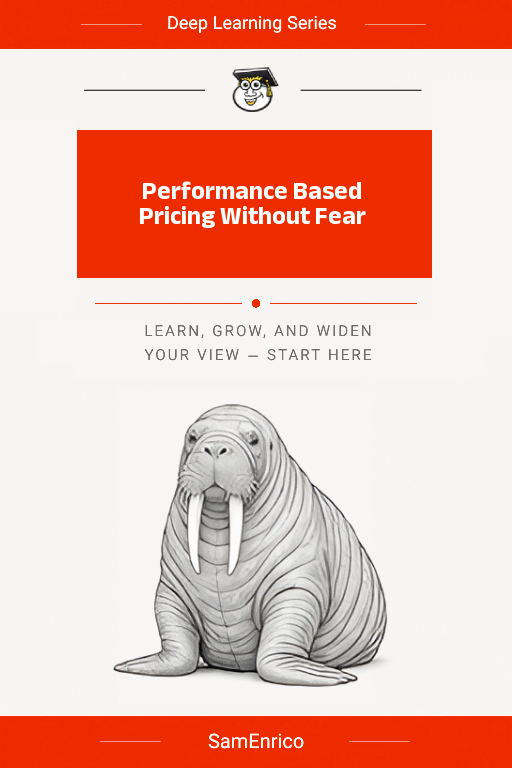
Non-FictionFirst 30 DaysPerformance
Performance Based Pricing Without Fear eBook
Tie fees to outcomes like leads or sales to align
by Amaya Elmira
Tie fees to outcomes like leads or sales to align incentives and justify premium rates.
Formats
Free sample
Chapter 1: The Saa S Graveyard--–- The first time I saw a CEO cry over a software bill, I thought it was an anomaly. The twenty-third time, I realized it was an epidemic.His name was Marcus, and he ran a mid-sized logistics company with 450 employees. He had just finished his quarterly Saa S audit—something his finance team had begged him to do for years. The numbers were devastating. His company was paying for 1,847 software seats across seventeen different platforms.
The actual number of employees who actively used those platforms? Four hundred and twelve. The rest were ghosts—licenses purchased for teams that never onboarded, accounts created during trials and never canceled, subscriptions that auto-renewed for three years after the project they supported had been shuttered."This is insane," Marcus said, sliding a spreadsheet across the table. "We spent $847,000 last year on software that my own employees don't want, don't use, and in some cases don't even know exists."I asked him the obvious question: "Why don't you just cancel them?"He laughed—a bitter, exhausted sound. "Because every time I try, the vendor tells me I'm locked in for another eleven months.
Or the department head swears they're 'about to start using it.' Or we're told that canceling would mean losing the data we've already put in." He paused. "The worst part? I don't even know which of these tools actually work. I pay for access. Whether they deliver value is completely irrelevant to the bill."Marcus was not an outlier.
He was a symptom of a broken system.The Invention of a Problem We Forgot Was Artificial Let me tell you a story that most people in Saa S don't want you to remember.Before the early 2000s, if you wanted to use business software, you bought it. Once. A perpetual license. You paid a large upfront fee—sometimes hundreds of thousands of dollars—and the software was yours forever. You installed it on your own servers.
Your IT team maintained it. When a new version came out, you decided whether to pay for an upgrade.Then came Salesforce in 1999, and with it, the birth of Software as a Service. The model was brilliant: instead of paying 50,000upfront,youpaid50,000 upfront, you paid 50,000upfront,youpaid50 per user per month. No servers to maintain. No upgrades to manage.
Just a simple, predictable subscription.For a decade, this felt like liberation. Small businesses could afford enterprise-grade software. Finance teams loved predictable recurring revenue forecasts. Venture capitalists loved the valuation multiples that came with high "net revenue retention."But something happened on the way to the revolution. The per-seat subscription model—designed to reduce friction—became a trap.Here's what I mean.
When software was sold as a perpetual license, the vendor had to convince you that the product was worth buying once. The sales cycle was long. The demos were rigorous. The proof of value was exhaustive. Because if you bought it and it didn't work, you wouldn't buy from that vendor again for a decade.With subscriptions, the calculus changed.
Vendors realized they didn't need to prove value before the sale. They just needed to get you to sign a twelve-month contract. If you didn't use the software? That was your problem. If it didn't deliver results?
The autorenewal would trigger before you remembered to cancel.The per-seat subscription didn't align incentives. It inverted them.The Saa S Graveyard: A Tour of Wasted Capital I want to take you on a brief tour of a place that exists in every company with more than fifty employees. I call it the Saa S Graveyard.Walking through the Saa S Graveyard, you'll notice three distinct types of tombstones.The first type belongs to Ghost Seats. These are licenses purchased for employees who never logged in. Perhaps the software was bought by a well-intentioned manager during a trial, but the rollout was abandoned.
Perhaps the employee left the company six months ago, and their account was never deprovisioned. In one study of 1,200 companies, researchers found that 31% of all Saa S seats were completely unused. That's not a rounding error. That's nearly a third of all software spending, vaporized.The second type belongs to Zombie Subscriptions. These are tools that were once useful but are no longer needed—yet they continue to bill month after month.
A project management tool purchased for a six-month initiative that ended two years ago. A customer support platform bought for a product that was discontinued. A compliance tool required for a certification that expired. The software keeps running. The invoices keep coming.
No one remembers why.The third type is the most insidious: Misaligned Incentive Seats. These are tools that employees actively use, but the vendor's incentive to make them better is completely disconnected from whether they actually improve business outcomes. A sales engagement platform that gets paid per user, not per meeting booked. A customer support platform that gets paid per agent, not per ticket resolved. An analytics tool that gets paid per data source, not per insight generated.I've seen the Saa S Graveyard from inside more than two hundred companies.
The stories all sound the same. A chief financial officer discovers that 40% of their software spend is waste. A procurement director realizes they have no leverage over vendors because switching costs are deliberately high. A CEO learns that the "efficient" subscription model has locked them into contracts for tools that actively make their teams less productive.The Saa S Graveyard is not a failure of individual companies. It is a predictable outcome of a pricing model that rewards vendors for selling access, not delivering results.The 2025–2026 Tipping Point: Why Everything Is Changing Now For years, the Saa S Graveyard was an open secret.
Everyone knew it existed. No one knew how to fix it. The vendors held all the cards. The contracts were deliberately complex. The switching costs were deliberately high.Then three things happened in rapid succession, and together they created a tipping point.First: The Great Saa S Audit of 2023–2024.
As companies faced economic pressure, finance departments did something unprecedented. They hired third-party firms to audit every single software contract. These firms—companies like Productiv, Zylo, and Torii—built technology that could log into every Saa S tool a company used, track actual usage, and calculate waste. The results were staggering. One Fortune 500 company discovered $47 million in annual Saa S waste.
Another found that they were paying for 22,000 unused Zoom licenses. The data was undeniable: the subscription model was bleeding companies dry.Second: The Rise of Outcome-Based Pricing Pioneers. A small but growing group of vendors began experimenting with a radically different approach. Instead of charging per seat, they charged per outcome. Hub Spot's January 2026 announcement of $0.50-per-resolution pricing wasn't a bolt from the blue.
It was the culmination of years of experimentation by companies like Fin (charging per resolved ticket), Intercom (evolving from per-seat to per-resolution), and a handful of AI-native startups that had no legacy contracts to protect.These pioneers proved something that the incumbents had insisted was impossible: you could build a profitable, scalable business without locking customers into unused seats. In fact, you could build a more profitable…
This is the end of the free sample. Get the eBook to keep going. Buy now
About this book
Details
- Author
- Amaya Elmira
- Publisher
- SamEnrico
- Language
- English
- Genre
- Non-Fiction, First 30 Days, Performance
- Released
- 2026-06-01
- Pages (approx.)
- 152
- Available as
- eBook, Audiobook

Read better in the ZLOADR app
Your eBooks on your phone or tablet. Sign in with your SamEnrico account and start reading.
More by Amaya Elmira
 Probiotics For Ulcerative ColitisAmaya Elmira$11.99
 Webinar Hosting MasteryAmaya Elmira$11.99
 Lake Meditation MBSR GuideAmaya Elmira$11.99
 Outsourcing FulfillmentAmaya Elmira$11.99
 Amina Zoubir: Painting the Soul of a ContinentAmaya Elmira$11.99
 How to Start a Loudspeaker Business (Beginners Guide)Amaya Elmira$11.99
 Natural Language Understanding and GenerationAmaya Elmira$11.99
 How to Produce Cat Furniture AccessoriesAmaya Elmira$11.99
You may also like
 Hong Kong Handover 1997Dunn Johnnie$11.99
 Zumba For Postnatal Recovery CourseNeal Christian$11.99
 Zumba for BeginnersLadner Nikia$11.99
 YouTube Comment Mining GuideHumes Pandora$12.99
 Worry Box MeditationCarlin Rudy$11.99
 Workplace Stress MeditationNguyen Lynn$11.99
 Workplace Stress and Sleep RepairHawley Ivory$11.99
 Workplace Perfectionism CureDelaney Jeffry$11.99
 Workplace Injustice Anger GuideWallen Isabelle$11.99
 Work Addiction and Burnout LinkGreenwood Ester$11.99
 Women in Yoga and WellnessBeattie Galina$11.99
 Women in Stand Up ComedyChun Evangeline$11.99