
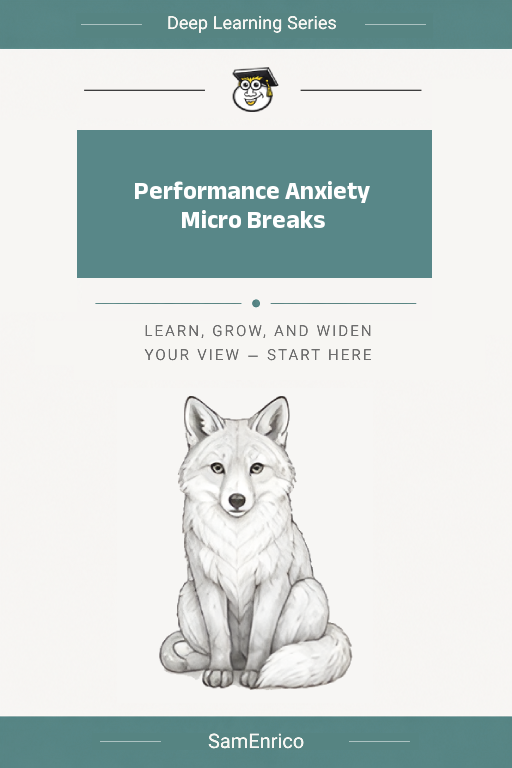
Non-FictionMental WealthPerformance Psychology
Performance Anxiety Micro Breaks eBook
Uses micro-breaks before presentations, performanc
Uses micro-breaks before presentations, performances, or interviews to regulate performance anxiety and access optimal nervous system state.
Formats
Free sample
Chapter 1: Your Anxiety Fingerprint--You are about to discover something that most people never learn about their own anxiety: it has a pattern.Not a random, chaotic storm of nerves that strikes without warning. Not a mysterious force that you are powerless against. A pattern. A predictable, repeatable, almost boringly consistent signature that your nervous system has been using for years, across dozens of performances, presentations, interviews, and high-stakes moments. And once you see that pattern—really see it, name it, understand it—everything changes.Before we go any further, I want you to think back to the last time performance anxiety hit you hard.
Maybe it was a presentation at work in front of forty people. A job interview for a position you desperately wanted. A first date where you could feel your throat tightening before you even ordered a drink. A musical performance where your hands started shaking as you reached for the first note. Or even just speaking up in a meeting when you felt your mind start to race and your cheeks flush with heat.Now ask yourself: what happened first?Not the panic itself.
Not the sweating or the stammering or the embarrassed walk back to your seat. The very first thing you noticed. Was it a physical sensation—a flutter in your stomach, a tightness in your chest, a tremor in your fingertips? Was it a sudden thought—“I’m going to mess this up,” “Everyone can see how nervous I am,” “Why did I agree to this”? Was it an urge to do something—check your notes, look away from the audience, grab your water bottle, leave the room entirely?Most people cannot answer this question.
They remember the flood, but not the first drop. They remember standing in the wreckage of their performance, but they cannot tell you the exact moment the ship started to sink. And that is precisely why traditional anxiety advice fails them. You cannot interrupt a wave you do not see coming. You cannot defuse a bomb when you do not know which wire is the trigger.This chapter will teach you to see the wave coming.
You will learn the four distinct archetypes of performance anxiety, identify which one (or two) you belong to, and discover your 10-second warning signs—the physiological and psychological signals that give you just enough time to deploy a micro break before panic takes over. You will also learn the 90-Second Rule, a piece of brain science that will fundamentally change how you understand your own nervous system.By the end of this chapter, you will no longer be a victim of your anxiety. You will become an anthropologist of it. You will watch your own symptoms with curiosity rather than fear, because you will finally understand what they are trying to tell you. And that shift—from sufferer to observer, from prey to witness—is the single most important transformation you will make in this entire book.The Four Faces of Performance Anxiety After years of studying performers, speakers, athletes, executives, and musicians—and synthesizing the best research from the ten most influential books on anxiety and performance (you will find them all in the bibliography at the end of this book)—a clear pattern emerged from the data.
Performance anxiety is not one thing. It is four things. And depending on which type you are, the micro break that saves you will be completely different.Let me introduce you to the four archetypes. Read each description carefully. You will likely recognize yourself in one or two of them.The Freezer You know the feeling.
You are standing at the podium, or sitting across from the interviewer, or holding the microphone at an open mic night. Your mind was working fine three seconds ago. You knew exactly what you wanted to say. You rehearsed it in the car. You had the opening line ready.
And then—nothing. The thought evaporates like smoke. The next sentence vanishes from your mental stage. You are standing in silence while your brain desperately searches a room that has suddenly gone completely empty.The Freezer does not necessarily feel their heart pounding. They do not tremble visibly.
Their hands might be perfectly still. Their primary symptom is cognitive: the mind goes blank. And here is the cruel irony—the harder they try to remember, the more blank their mind becomes. It is as if the act of searching deletes the very files they are looking for.This happens because the Freezer's brain has activated a threat response that literally shuts down the prefrontal cortex. That is the part of your brain responsible for recall, sequencing, planning, and verbal fluency.
Under extreme stress, your brain decides that thinking is less important than surviving, and it reroutes resources away from the thinking centers and toward the survival centers. The result? You stand there, perfectly safe from predators, with absolutely nothing to say.Freezers often report feeling like they are watching themselves from outside their body. Time slows down to a crawl. The silence stretches into an eternity.
And the thing they fear most is not judgment from the audience—it is the humiliation of standing there with nothing to say, the unbearable emptiness of a mind that has abandoned them.If this sounds like you, take note: breathing techniques alone will not save you. You need grounding. You need to shift attention from your head to your body. You need to stop trying to think your way out of a problem that thinking created. We will cover exactly how in Chapter 4.The Shaker This is the most visible form of performance anxiety.
Your hands tremble when you reach for the water glass. Your voice quavers when you speak your first sentence. Your knees feel like they might buckle if you have to stand for much longer. You are not imagining it—your audience can see it too, which of course makes you shake even more. The more you try to hide it, the worse it gets.The Shaker's nervous system has flooded their body with adrenaline.
Adrenaline is designed to prepare you for physical action—to fight a predator or flee from danger. Your muscles tense. Your heart rate increases. Your blood vessels dilate. The problem is that you are not fighting a tiger or fleeing a bear.
You are standing still, holding a piece of paper or a microphone or a cup of coffee, and your body is vibrating with unspent energy that has nowhere to go.Shakers often try to hide their trembling by gripping things tighter—the lectern, the water glass, their notes, the edge of the table. This makes it worse. A tight muscle under adrenaline shakes more, not less. The solution is counterintuitive: you need to release tension, not clamp down on it. You need to let the energy move through you rather than trying to lock it in place.Shakers also experience vocal tremors because the cricothyroid muscle—which controls pitch and tension in the vocal cords—tightens under stress.
When that muscle locks up, your voice comes out thin, wavering, or cracked. You might sound like you are about to cry even…
This is the end of the free sample. Get the eBook to keep going. Buy now
About this book
Details
- Author
- Benefield Ethelyn
- Publisher
- SamEnrico
- Language
- English
- Genre
- Non-Fiction, Mental Wealth, Performance Psychology
- Released
- 2026-06-01
- Pages (approx.)
- 136
- Available as
- eBook, Audiobook

Read better in the ZLOADR app
Your eBooks on your phone or tablet. Sign in with your SamEnrico account and start reading.
More by Benefield Ethelyn
 Food Intolerance in SeniorsBenefield Ethelyn$11.99
 Submarine War Book GuideBenefield Ethelyn$11.99
 Anger for JournalistsBenefield Ethelyn$11.99
 Workaholism in HRBenefield Ethelyn$11.99
 The One Percent Improvement GuideBenefield Ethelyn$11.99
 The Pink Panther Heist: Colombia's Most Audacious Jewel ThievesBenefield Ethelyn$11.99
 How to Become a Drophammer OperatorBenefield Ethelyn$11.99
 Beauty ManagerBenefield Ethelyn$11.99
 Cooperative Climate AdaptationBenefield Ethelyn$12.99
 Understanding Sprengel DeformityBenefield Ethelyn$17.99
You may also like
 Hong Kong Handover 1997Dunn Johnnie$11.99
 Zumba For Postnatal Recovery CourseNeal Christian$11.99
 Zumba for BeginnersLadner Nikia$11.99
 YouTube Comment Mining GuideHumes Pandora$12.99
 Worry Box MeditationCarlin Rudy$11.99
 Workplace Stress MeditationNguyen Lynn$11.99
 Workplace Stress and Sleep RepairHawley Ivory$11.99
 Workplace Perfectionism CureDelaney Jeffry$11.99
 Workplace Injustice Anger GuideWallen Isabelle$11.99
 Work Addiction and Burnout LinkGreenwood Ester$11.99
 Women in Yoga and WellnessBeattie Galina$11.99
 Women in Stand Up ComedyChun Evangeline$11.99