
Non-FictionSelf-HelpPerfectionism
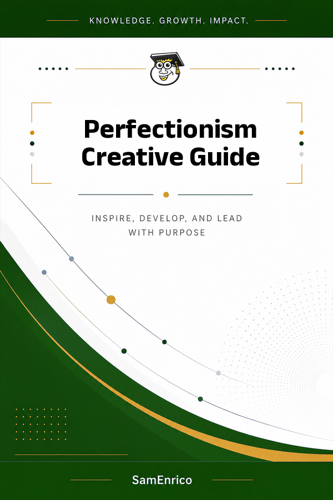
Perfectionism Creative Guide eBook
Release impossible standards and embrace imperfect
Release impossible standards and embrace imperfect action with this workbook.
Formats
Free sample
Chapter 1: The Someday Trap--–- You are reading this book for one of two reasons. Either you have already realized that your perfectionism is not your greatest strength but your heaviest chain, or you are still convinced that being hard on yourself is the only reason you have achieved anything at all. Either way, welcome. You are exactly where you need to be.Let me tell you something that will sound like heresy: your perfectionism is lying to you. It has convinced you that it is the guardian of your success, the driver of your excellence, the voice that keeps you from embarrassment.
In truth, it is the single greatest obstacle between you and the creative life you actually want.This chapter is called The Someday Trap because that is where perfectionism keeps you—in a beautiful, imaginary future where conditions are perfect, where you have more time, more skill, more confidence, and where failure is impossible. That future never arrives. It cannot arrive, because perfectionism has rigged the game. The standards rise exactly as fast as your abilities do. You never catch up.
You never feel ready. You never ship.By the end of this chapter, you will understand why your perfectionism is not a virtue but an avoidance strategy. You will learn the single most important framework of this entire book: the Imperfect Action Protocol. And you will take your first small, messy, glorious step toward creative freedom.The Perfectionism Paradox Let us start with a paradox that will sound painfully familiar. The more you try to avoid criticism by withholding your work, the more you guarantee that you will never receive any response at all—neither criticism nor praise.
You stay safe, but safety is not the same as creative fulfillment. Safety is the absence of failure. Creativity is the presence of trying.Perfectionism promises protection. It whispers: If you wait until it is flawless, no one can hurt you. But here is what it does not tell you: no work is ever flawless.
The waiting never ends. The protection is actually a prison.Consider the writer who revises the first chapter forty-seven times and never writes chapter two. Consider the painter who stares at a blank canvas for six months because they cannot decide on the perfect color palette. Consider the entrepreneur who builds seventeen versions of a website in private but never hits publish. These are not lazy people.
These are not untalented people. These are people trapped by the false promise that someday, magically, they will feel ready.That day does not come on its own. It must be built—not by achieving perfection, but by releasing it.Adaptive Striving vs. Maladaptive Perfectionism Here is a distinction that will change how you see yourself. Not all high standards are harmful.
There is a form of excellence-seeking that is flexible, growth-oriented, and genuinely productive. Psychologists call this adaptive striving. And then there is the rigid, shame-driven obsession with flawlessness that actually prevents progress. That is maladaptive perfectionism.Let me break this down.Adaptive striving sounds like this: "I want to do good work. I will learn from feedback.
I will adjust my goals as I go. Mistakes are part of the process."Maladaptive perfectionism sounds like this: "This must be flawless or I am a failure. I cannot show anyone until it is perfect. If I make a mistake, it means I am fundamentally inadequate."Adaptive striving sets high standards but remains flexible. Maladaptive perfectionism sets impossible standards and then uses failure to meet them as evidence of worthlessness.
Adaptive striving leads to growth. Maladaptive perfectionism leads to paralysis, procrastination, and burnout.Here is what makes this tricky: maladaptive perfectionism often wears a disguise. It tells you that it is the reason you have succeeded. It points to your accomplishments and says, You did that because of me. But here is the truth that perfectionism will never tell you: you succeeded despite it, not because of it.
The voice that kept you up at night rewriting the same email seventeen times did not make the email better. The voice that made you delay your book launch for three years did not improve the book. It just delayed your life.The Someday Trap in Detail Let me paint a picture of the Someday Trap so you can see whether you recognize yourself in it.The Someday Trap has four stages.Stage One: The Vision. You imagine a creative project—a novel, a painting, a business, a song. In your imagination, it is magnificent.
It is the best thing you have ever made. You feel a rush of excitement.Stage Two: The Comparison. You look at the gap between your magnificent vision and your current skills. The gap feels enormous. Instead of seeing it as a learning journey, you see it as evidence that you are not ready yet.Stage Three: The Delay.
You decide to wait until you are better, until you have more time, until conditions improve. You read another book. You watch another tutorial. You reorganize your supplies. You do everything except the actual work.Stage Four: The Shame.
Weeks or months pass. The project remains undone. You feel ashamed of your lack of progress, which makes starting even harder. The shame confirms what your perfectionism told you all along: you were not good enough. The cycle repeats.The cruelest part of the Someday Trap is that it feels productive.
Reading, planning, organizing, researching—these are all legitimate parts of creative work. But when they become substitutes for doing, they are no longer productive. They are safety behaviors. They are ways of avoiding the terrifying act of putting something imperfect into the world.I want you to pause here. Think of one creative project you have been dreaming about for more than six months but have not started—or have started and abandoned.
Write down its name. Keep it in your mind. We are going to come back to it.Safety Behaviors: The Hidden Engine of Stagnation This is a term we will use throughout this book, so let me define it clearly. Safety behaviors are anything you do to avoid the discomfort of imperfection. They are the strategies your perfectionism uses to keep you "safe" from judgment, failure, and shame.
And they are the single biggest reason you stay stuck.Safety behaviors come in many forms. Here are the most common ones among creatives:Withholding. You finish a project but do not share it. You tell yourself it is not ready yet. It needs one more revision.
It needs someone else to look at it first. Months pass. The project sits in a drawer or a hard drive, perfectly preserved and perfectly useless.Over-preparation. You spend weeks researching instead of writing. You watch tutorials instead of painting.
You create spreadsheets instead of making phone calls. You tell yourself you are being thorough. In reality, you are avoiding the vulnerability of starting.Endless revision. You finish a draft and then revise it. Then revise it again.
Then again. Each revision makes marginal improvements at best, but you cannot stop because you are chasing an imaginary version of the project that exists only in your…
This is the end of the free sample. Get the eBook to keep going. Buy now
About this book
Details
- Author
- Vasquez Rachael
- Publisher
- SamEnrico
- Language
- English
- Genre
- Non-Fiction, Self-Help, Perfectionism
- Released
- 2026-06-09
- Pages (approx.)
- 141
- Available as
- eBook, Audiobook

Read better in the ZLOADR app
Your eBooks on your phone or tablet. Sign in with your SamEnrico account and start reading.
More by Vasquez Rachael
 Self Esteem Without Weight Loss Goals ManualVasquez Rachael$11.99
 Real Estate Agent Commission StressVasquez Rachael$11.99
 Death Road Expedition LogVasquez Rachael$11.99
 Aging Planning MythsVasquez Rachael$11.99
 Partner Anger Triggers GuideVasquez Rachael$11.99
 Mindfulness For JealousyVasquez Rachael$11.99
 Startup Workaholic CultureVasquez Rachael$11.99
 The Last Broadcast of Radio Luxembourg: How a Secret WWII Transmission Changed the WarVasquez Rachael$11.99
 The Last Light of the Abyss: The Titanic’s Secret Deep-Sea DiscoveryVasquez Rachael$11.99
 Ultimate Handbook Guide to Lianjiang : (China) Travel GuideVasquez Rachael$11.99
 Sound Waves JEE Main GuideVasquez Rachael$12.99
 Chinese Student Accommodation GuideVasquez Rachael$12.99
You may also like
 Hong Kong Handover 1997Dunn Johnnie$11.99
 Zumba For Postnatal Recovery CourseNeal Christian$11.99
 Zumba for BeginnersLadner Nikia$11.99
 YouTube Comment Mining GuideHumes Pandora$12.99
 Worry Box MeditationCarlin Rudy$11.99
 Workplace Stress MeditationNguyen Lynn$11.99
 Workplace Stress and Sleep RepairHawley Ivory$11.99
 Workplace Perfectionism CureDelaney Jeffry$11.99
 Workplace Injustice Anger GuideWallen Isabelle$11.99
 Work Addiction and Burnout LinkGreenwood Ester$11.99
 Women in Yoga and WellnessBeattie Galina$11.99
 Women in Stand Up ComedyChun Evangeline$11.99