
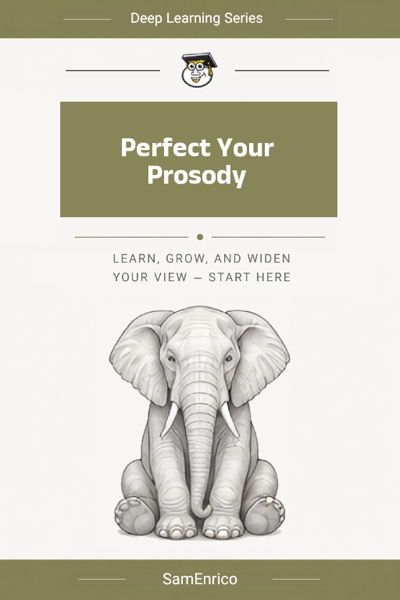
Non-FictionInformativeEducational
Perfect Your Prosody eBook
A Coursebook on Perfect Your Prosody
by Hooks Ethan
A Coursebook on Perfect Your Prosody
Formats
Free sample
Chapter 1: The Invisible Orchestra...--You have been misunderstood today.Not in the way you think. Not because you said the wrong words. Not because your argument was flawed or your facts were inaccurate. You chose your words carefully. You rehearsed the key points.
And still, somewhere in the last twenty-four hours, someone misread you completely. They thought you were joking when you were serious. They thought you were angry when you were merely tired. They interrupted you mid-sentence, or worse, they nodded along blankly while their eyes drifted to their phone. The words were correct.
But the music beneath the words—the invisible orchestra of pitch, timing, and emphasis—played the wrong tune.This book is about that orchestra.Prosody is the term linguists and poets use for the music of spoken language. It is everything in speech that is not the dictionary definition of the words themselves: the rise and fall of your pitch, the syllables you stretch or clip, the pauses you insert or omit, the words you hit with extra force and the ones you let fade into shadow. Most people never think about prosody consciously. They speak on autopilot, trusting that their meaning will travel from their mouth to another ear without distortion. But meaning does not travel like light through empty space.
It travels like a radio signal through static. And prosody is the difference between a signal that arrives crystal clear and one that arrives garbled, scrambled, or completely inverted.Consider this: you can say the word “really” in more than twenty distinguishable ways that convey completely different meanings. “Really?” with rising pitch asks for confirmation. “Really.” with falling pitch expresses flat acknowledgment. “Reaaaaally” with stretched vowel signals skepticism.
“Really!” with sharp emphasis conveys excitement. “Re-al-ly” with staccato syllables communicates disbelief bordering on insult. The letters are identical. The dictionary definition is identical. But the prosody transforms the word into a question, a statement, an exclamation, a sarcasm, or a dismissal.Now consider the stakes.
If you are a manager giving performance feedback, your prosody will determine whether the employee hears “You made a mistake, and I trust you to fix it” or “You are a mistake, and I have given up on you.” If you are a parent negotiating bedtime, your prosody will determine whether your child hears “I love you, but the rule is firm” or “I am exhausted and don’t actually care anymore.” If you are on a first date, your prosody will determine whether your companion hears genuine interest or performative politeness. If you are giving a presentation, your prosody will determine whether your audience leans forward or scrolls through email.The science is unambiguous. Multiple studies in psycholinguistics have demonstrated that when prosody and word meaning conflict—when someone says “That’s great” in a flat, descending monotone—listeners overwhelmingly trust the prosody over the words. The body does not lie, and neither does the voice. Your pitch, your pacing, your pauses: these are the acoustic fingerprints of your emotional and intentional state.
You cannot hide in your words. Your prosody is always telling the truth about you, whether you know it or not.This book exists because most people never learn to conduct their own orchestra. They go through life with a perfectly good instrument—a human voice capable of astonishing nuance—playing only two or three notes. They speak in a narrow pitch range, unaware that their voice could rise and fall through more than an octave without strain. They place stress on the same syllable in every sentence, regardless of meaning.
They rush through pauses as if silence were a failure, unaware that a well-timed pause can be more powerful than any word. They have been playing a Stradivarius like a kazoo.The good news is that prosody is not a talent you are born with or without. It is a skill. It can be learned, practiced, and mastered. This book is a coursebook—a structured, progressive curriculum that will take you from the foundations of acoustic phonetics through the complexities of poetic meter, conversational turn-taking, and public performance.
By the end, you will not only understand prosody. You will hear it everywhere. You will control it in yourself. And you will never be misunderstood in quite the same way again.The Four Pillars: Pitch, Volume, Duration, Silence Before you can conduct your orchestra, you must learn to hear each instrument individually. The music of speech is built from four acoustic dimensions.
Every prosodic effect you will learn in this book is a combination of these four pillars.Pitch: The Melody of Meaning Pitch is the highness or lowness of your voice, determined by the frequency at which your vocal folds vibrate. Faster vibrations produce higher pitch; slower vibrations produce lower pitch. The average speaking pitch for adult males ranges from approximately 85 to 180 Hertz (vibrations per second). For adult females, the range is approximately 165 to 255 Hertz. But these are averages, not limits.
Trained speakers routinely command a range of two octaves or more.Pitch does more than convey emotion. It conveys grammatical structure. In standard English, a rising pitch at the end of a phrase signals a yes/no question. “You are coming?” with final rise means “I am asking whether you will attend.” The same words with a final fall mean “I am confirming that you are coming, and I may be surprised or skeptical.” This is not a cultural add-on. It is a grammatical rule of the language, as binding as subject-verb agreement.
You cannot speak English natively without knowing this rule. But knowing it unconsciously and controlling it deliberately are different things.Pitch also signals your relationship to your own words. A wide pitch range—moving frequently between high and low—signals enthusiasm, engagement, and emotional availability. A narrow pitch range, staying within three or four semitones, signals detachment, boredom, or depression. In clinical settings, reduced pitch range is one of the diagnostic markers of major depressive disorder and of the flat affect sometimes associated with autism spectrum conditions.
Your pitch range is not just an ornament. It is a broadcast of your internal state, readable by every listener within earshot.Volume: The Physics of Emphasis Volume is the amplitude of your vocal signal: how much acoustic energy you are producing. Louder speech requires more respiratory force and more tension in the vocal folds. Quieter speech relaxes both. Volume is the most intuitive prosodic dimension—everyone knows that shouting conveys anger or urgency while whispering conveys intimacy or secrecy—but its subtleties run deeper.Volume interacts with pitch and duration to create accent.
A syllable that is louder, higher in pitch, and longer than its neighbors will be perceived as stressed. Remove any one of these components, and the stress weakens. Remove two, and it disappears. This is why stress is not a binary switch but a continuous variable. You can put a little stress on a syllable (slightly louder, slightly higher, slightly longer) or a lot of stress (much louder, much higher, much longer).
The gradient nature of stress allows for infinite nuance.Volume also signals social dominance and submission. In almost every culture, people in positions of authority speak more loudly…
This is the end of the free sample. Get the eBook to keep going. Buy now
About this book
Details
- Author
- Hooks Ethan
- Publisher
- SamEnrico
- Language
- English
- Genre
- Non-Fiction, Informative, Educational
- Released
- 2026-05-11
- Pages (approx.)
- 152
- Available as
- eBook, Audiobook

Read better in the ZLOADR app
Your eBooks on your phone or tablet. Sign in with your SamEnrico account and start reading.
More by Hooks Ethan
 Proxemics Personal Space GuideHooks Ethan$11.99
 Mindful Retirement MBSR GuideHooks Ethan$11.99
 Nutrition and Teen Self EsteemHooks Ethan$11.99
 Handling Micromanagement GracefullyHooks Ethan$11.99
 Twitter Compulsive Checking WorkbookHooks Ethan$11.99
 Whispers of the Crystal Forest: The Last Glowworms of WaitomoHooks Ethan$11.99
 How to Start a Building Boards Made of Paper Business (Beginners Guide)Hooks Ethan$11.99
 Influencer Brief GenerationHooks Ethan$12.99
 Understanding Microcephaly With Normal Intelligence, ImmunodeficiencyHooks Ethan$17.99
You may also like
 Hong Kong Handover 1997Dunn Johnnie$11.99
 Zumba For Postnatal Recovery CourseNeal Christian$11.99
 Zumba for BeginnersLadner Nikia$11.99
 YouTube Comment Mining GuideHumes Pandora$12.99
 Worry Box MeditationCarlin Rudy$11.99
 Workplace Stress MeditationNguyen Lynn$11.99
 Workplace Stress and Sleep RepairHawley Ivory$11.99
 Workplace Perfectionism CureDelaney Jeffry$11.99
 Workplace Injustice Anger GuideWallen Isabelle$11.99
 Work Addiction and Burnout LinkGreenwood Ester$11.99
 Women in Yoga and WellnessBeattie Galina$11.99
 Women in Stand Up ComedyChun Evangeline$11.99