
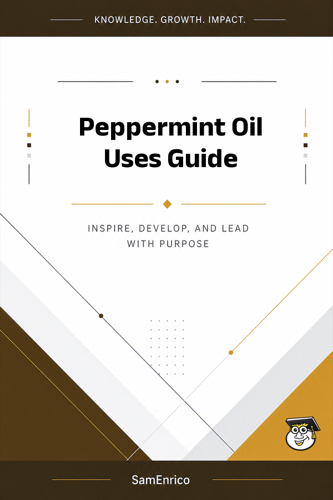
Non-FictionHealth & WellnessEssential Oils
Peppermint Oil Uses Guide eBook
Harness invigorating peppermint oil for headaches,
by Parham Andre
Harness invigorating peppermint oil for headaches, digestion, and energy boosts.
Formats
Free sample
Chapter 1: The People’s Oil--–- On a humid July afternoon in 2017, a 34-year-old graphic designer named Maya found herself lying on her bathroom floor, a cold tile pressed against her cheek. She had just finished her third espresso of the day to combat the 2 PM slump, but instead of energy, she was rewarded with a throbbing tension headache wrapped around her skull like a vise. Her medicine cabinet held four different pain relievers—each with its own list of potential side effects ranging from liver damage to stomach bleeding. In that moment of desperation, she remembered the small amber bottle her holistic-minded sister had given her six months earlier. The label simply read: Mentha piperita – Peppermint Essential Oil.
She had never used it. Within fifteen minutes of applying a single diluted drop to her temples, the headache that three ibuprofens couldn’t touch had receded to a dull whisper. Maya wasn’t a naturopath or a wellness influencer. She was just an overworked creative who had stumbled upon what millions of people across five thousand years already knew: peppermint oil is, quite simply, the people’s oil.This book exists because stories like Maya’s are not anomalies. They are the rule.
Across continents and centuries, peppermint has earned its reputation as the single most versatile, affordable, and accessible natural remedy in the human pharmacopoeia. Unlike rare essential oils that require elaborate distillation processes or exotic plants that grow only in specific climates, peppermint thrives in backyard gardens across North America, Europe, and Asia. Unlike expensive pharmaceuticals that target only one symptom, peppermint addresses three fundamental bodily systems simultaneously: pain, digestion, and energy. And unlike trendy wellness products that come and go with each season, peppermint has been continuously used for healing for over five thousand years—a track record that no synthetic drug can match.But here is the problem that this book will solve: Most people who own a bottle of peppermint oil use it for exactly one or two purposes, usually the ones they read about on the back of the bottle or saw in a social media post. They dab it on their temples for headaches, maybe add a few drops to a diffuser for a fresh scent, and then let the bottle gather dust on a shelf.
They are using perhaps five percent of the oil’s actual potential. The remaining ninety-five percent—the ability to stop an IBS flare-up in its tracks, to replace afternoon caffeine with clean mental energy, to naturally repel pests from a home, to ease sore muscles after a workout, to soothe an insect bite, to improve memory retention during exams, to clear sinus congestion without chemical decongestants—remains untapped. This book is the key to unlocking that ninety-five percent.The journey from casual user to confident healer begins with a single question: Why does peppermint oil work at all? Not just “it works” but the actual biological mechanisms that allow a few molecules of menthol to stop a migraine, settle a churning stomach, and wake up a tired brain. Once you understand the why, the how becomes intuitive.
You will no longer need to memorize recipes; you will be able to invent your own based on first principles. This chapter lays that foundation—the history that proves its safety, the chemistry that explains its power, and the three core benefits that make peppermint the undisputed champion of home essential oils.A Five-Thousand-Year Prescription Before peppermint oil could be distilled into a bottle, peppermint leaves were simply…mint. The plant Mentha piperita is actually a natural hybrid of watermint (Mentha aquatica) and spearmint (Mentha spicata), first identified in England in the late seventeenth century. But the use of mint for healing predates its formal classification by thousands of years. The oldest surviving medical text, the Ebers Papyrus from ancient Egypt (circa 1550 BCE), lists mint as a remedy for digestive pain and flatulence.
Egyptian physicians would prepare mint leaves infused in wine or honey, administering the mixture to patients complaining of stomach cramps or gas. The same text notes that mint was also used in poultices applied to the feet to reduce fevers—a practice that modern research would later validate, as the feet contain numerous nerve endings that respond to menthol’s cooling signals.The ancient Greeks and Romans elevated mint from folk remedy to formal medicine. The Greek physician Dioscorides, whose five-volume work De Materia Medica remained the authoritative medical text for over 1,500 years, devoted an entire section to mint. He noted that mint “strengthens the stomach” and “stops vomiting,” and he recommended mint baths for patients with nervous disorders. The Romans, ever practical, scattered mint leaves on their floors to purify the air and repel insects—a practice that would later be explained by the discovery that menthol is toxic to many arthropods.
Roman soldiers carried mint with them on campaigns, using it to treat wounds and digestive issues caused by unfamiliar foods. The Roman naturalist Pliny the Elder wrote that mint “reanimates the spirit and gives energy to the mind,” an observation that anticipated the twenty-first-century discovery that inhaled menthol activates the hippocampus.The Arabic physician Avicenna (Ibn Sina), whose Canon of Medicine was the standard medical textbook in both the Islamic world and Europe until the seventeenth century, wrote extensively about mint’s ability to relieve headaches and digestive complaints. He recommended mint oil (prepared by pressing the leaves) for “cold humors of the stomach”—what we would today call indigestion and bloating. Avicenna also noted that mint “sharpens the senses,” particularly when inhaled before study or debate. This is the earliest known written reference to mint as a cognitive enhancer, predating modern research by nearly a thousand years.European herbalists of the seventeenth and eighteenth centuries refined these ancient practices into codified protocols.
Nicholas Culpeper, the English botanist whose Complete Herbal (1653) was found in nearly every colonial American home, wrote that mint “is very good for the stomach, stays vomiting, and is profitable for the head and memory.” Culpeper’s contemporary, the physician John Gerard, recommended mint for “the pains of the head” and noted that “the smell of mint rejoiceth the heart of man.” These were not primitive superstitions. They were clinical observations made by careful practitioners who lacked our understanding of molecular biology but possessed something equally valuable: centuries of accumulated evidence across thousands of patients.The modern era of peppermint essential oil began with the advent of steam distillation in the Middle Ages, perfected in the Renaissance, and industrialized in the nineteenth century. By the 1800s, peppermint oil had become a standard item in the physician’s medicine chest. The United States Pharmacopeia (USP) listed peppermint oil as an official medicine from its first publication in 1820 through the mid-twentieth century. It was prescribed for flatulence, nausea, colic, and as a flavoring for more unpleasant medicines.
Soldiers in the American Civil War were issued peppermint oil as a standard medical supply, used for everything from stomach complaints to wound care (though modern antiseptics are superior for wounds). The British Army similarly listed peppermint oil as a required item in its medical kits through World War I.Why did peppermint endure while countless other…
This is the end of the free sample. Get the eBook to keep going. Buy now
About this book
Details
- Author
- Parham Andre
- Publisher
- SamEnrico
- Language
- English
- Genre
- Non-Fiction, Health & Wellness, Essential Oils
- Released
- 2026-06-10
- Pages (approx.)
- 134
- Available as
- eBook, Audiobook

Read better in the ZLOADR app
Your eBooks on your phone or tablet. Sign in with your SamEnrico account and start reading.
More by Parham Andre
 Remote Team Async Onboarding CourseParham Andre$11.99
 Hostage Diary and Memory Retention GuideParham Andre$11.99
 Hypnotic Burn Pain ReliefParham Andre$11.99
 Academic Comparison Social Media ImpactParham Andre$11.99
 The War of the Wigs: The Feud That Shook the 18th CenturyParham Andre$11.99
 The Lost Caravans: Bedouin Guides and the Secrets of the OutbackParham Andre$11.99
 Understanding Congenital ToxoplasmosisParham Andre$17.99
 How to Become a Ion Implant Machine OperatorParham Andre$11.99
 Dubai Fitness Student GuideParham Andre$12.99
 Water Scarcity Supply RiskParham Andre$12.99
 Swimming Pool Chemical HandlingParham Andre$11.99
You may also like
 Hong Kong Handover 1997Dunn Johnnie$11.99
 Zumba For Postnatal Recovery CourseNeal Christian$11.99
 Zumba for BeginnersLadner Nikia$11.99
 YouTube Comment Mining GuideHumes Pandora$12.99
 Worry Box MeditationCarlin Rudy$11.99
 Workplace Stress MeditationNguyen Lynn$11.99
 Workplace Stress and Sleep RepairHawley Ivory$11.99
 Workplace Perfectionism CureDelaney Jeffry$11.99
 Workplace Injustice Anger GuideWallen Isabelle$11.99
 Work Addiction and Burnout LinkGreenwood Ester$11.99
 Women in Yoga and WellnessBeattie Galina$11.99
 Women in Stand Up ComedyChun Evangeline$11.99