
Non-FictionInformativeEducational
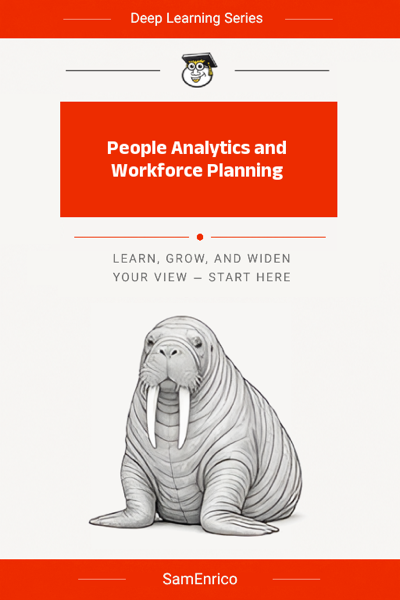
People Analytics and Workforce Planning eBook
A Coursebook on People Analytics and Workforce Pla
A Coursebook on People Analytics and Workforce Planning
Formats
Free sample
Chapter 1: The $2 Trillion Blindspot--–- In most large organizations, the single largest expense line item—often exceeding 50% of operating costs—is also the least rigorously managed. That expense is people. Finance departments would never tolerate managing cash reserves with intuition alone, nor would supply chain leaders rely on gut feelings to forecast inventory. Yet year after year, the vast majority of organizations make their most critical talent decisions—who to hire, who to promote, who to develop, who to retain—based on anecdote, hierarchy, and habit. This is the $2 trillion blindspot: the gap between what organizations spend on their workforces and the analytical rigor they apply to managing that investment.The Scale of the Opportunity Consider the numbers.
Global workforce costs—salaries, benefits, training, recruiting, severance—exceed $50 trillion annually across advanced economies. In a typical Fortune 500 company, employee-related expenses represent 40% to 70% of operating revenue. For professional services firms like consulting or accounting, that figure can climb above 80%. A 1% improvement in workforce productivity or retention, therefore, is not a minor efficiency gain. It is a billion-dollar swing for the largest enterprises.Yet when executives are asked how they make decisions about their workforces, the answers are revealing.
“We’ve always done it this way.” “Our best managers have good instincts.” “That’s just how our culture works.” These are not the language of strategy. They are the language of tradition, and tradition is a dangerous substitute for evidence.The thesis of this book is straightforward: organizations that apply rigorous data analysis to their talent decisions—a discipline known as People Analytics—and that systematically align their workforce capabilities with long-term business strategy—Strategic Workforce Planning—will dramatically outperform those that do not. This is not a prediction. It is a conclusion drawn from a growing body of empirical evidence, which this chapter will survey. The remainder of this book will teach you exactly how to join that winning group.What This Chapter Covers Before we dive into frameworks and formulas, we must establish a shared foundation.
This chapter accomplishes four goals. First, it defines People Analytics and Strategic Workforce Planning with precision, distinguishing them from adjacent fields like HR reporting or operational workforce management. Second, it traces the historical evolution of HR from a purely administrative function to a strategic partner, explaining why the timing is now right for this transformation. Third, it introduces the ABCs of Business Influence—a framework that will appear throughout this book—to show how people decisions translate into financial outcomes. Fourth, it presents a detailed case study demonstrating a causal link between people analytics and stock performance.
By the end of this chapter, you will understand not merely what people analytics is, but why it is one of the most underleveraged competitive advantages in modern business.Defining the Disciplines: People Analytics and Strategic Workforce Planning One of the first obstacles newcomers encounter is terminological confusion. “People Analytics,” “HR Analytics,” “Talent Analytics,” “Workforce Analytics,” and “Strategic Workforce Planning” are often used interchangeably, but they are not the same. Precision matters because imprecision leads to misaligned expectations. A leader who asks for “workforce analytics” but actually needs a five-year strategic plan will be disappointed. A practitioner who builds predictive attrition models when the organization lacks basic data hygiene is building on sand.People Analytics is the practice of using statistical methods, data visualization, and predictive modeling to analyze employee data for the purpose of improving individual and organizational outcomes.
It encompasses descriptive analytics (“what happened,” such as turnover rates), diagnostic analytics (“why it happened,” such as regression analysis identifying drivers of turnover), predictive analytics (“what will happen,” such as flight risk scores), and prescriptive analytics (“how to make it happen,” such as A/B testing a new retention program). People Analytics focuses on the workforce as it exists today and in the near term—typically a one- to two-year horizon.Strategic Workforce Planning (SWP), in contrast, is the process of forecasting an organization’s future talent needs based on its business strategy and then developing action plans to meet those needs. SWP operates on a three- to ten-year horizon. It asks questions like: “If we enter three new markets in five years, what capabilities will we need?” “Which roles will become obsolete due to automation?” “Do we have a pipeline of leaders ready for succession?” While People Analytics tends to be reactive and diagnostic (analyzing existing data to solve current problems), SWP is proactive and generative (building future scenarios to prevent problems before they emerge).Throughout this book, we treat these as complementary disciplines. People Analytics provides the empirical foundation—the data, the models, the insights about current behavior—that informs SWP.
SWP provides the strategic container—the long-term vision, the capability maps, the scenario plans—that gives People Analytics its direction. Without analytics, workforce planning is guesswork. Without workforce planning, analytics is tactical and short-sighted. Together, they are transformative.A brief note on terminology: this book uses “People Analytics” as the umbrella term for the analytical practices described in Chapters 3 through 6, and “Strategic Workforce Planning” for the practices in Chapters 7 and 8. The two are integrated throughout, but each receives dedicated treatment because they require different skill sets, data sources, and stakeholder relationships.The Resurgence of Analytics: From Cost Center to Profit Center To understand why people analytics is emerging now—and why your competitors are likely investing in it—we must understand where HR has been.
The human resources function has undergone three distinct eras over the past century, and we are now entering a fourth.Era One: Personnel Administration (1900–1970)The earliest HR departments, typically called “Personnel,” focused on compliance and administration. Their job was to ensure that payroll was processed, that workers’ compensation claims were filed, and that labor laws were followed. The dominant mindset was legal and clerical. Data, to the extent it existed, consisted of paper personnel files and handwritten time sheets. The question Personnel answered was: “Did we follow the rules?” This era was necessary but not strategic.Era Two: Human Resource Management (1970–2000)As competition intensified and service industries grew, organizations began to see employees as assets rather than costs to be minimized.
The term “Human Resource Management” (HRM) emerged, and with it came functions like recruiting, training, performance appraisal, and compensation design. HR gained a seat at the management table, albeit often a small one. Data became electronic—HRIS systems replaced filing cabinets—but analysis remained rudimentary. The dominant question was: “Are we managing our people effectively?” Still, most decisions were driven by benchmarking (e.g., “our turnover is 12%, and industry average is 10%”) rather than causal analysis.Era Three: Talent Management (2000–2015)The early 2000s brought the concept of “talent management,” driven by books like Mc Kinsey’s “The War for Talent.” Organizations began segmenting their workforces into “critical roles” and “high-potential employees.” Succession planning, leadership development, and retention strategies became formalized. The dominant question became: “Do we have the right people in the right roles?” Data expanded to include performance ratings, 360-degree feedback, and engagement surveys.
However, analytics remained largely descriptive (“what is our retention rate for high potentials?”) and was often siloed within individual functions. The connection between talent decisions and business outcomes was asserted rather than demonstrated.Era Four: People…
This is the end of the free sample. Get the eBook to keep going. Buy now
About this book
Details
- Author
- Tremblay Edelmira
- Publisher
- SamEnrico
- Language
- English
- Genre
- Non-Fiction, Informative, Educational
- Released
- 2026-06-02
- Pages (approx.)
- 160
- Available as
- eBook, Audiobook

Read better in the ZLOADR app
Your eBooks on your phone or tablet. Sign in with your SamEnrico account and start reading.
More by Tremblay Edelmira
 Stone Dream Jungian ViewTremblay Edelmira$11.99
 Self Hypnosis For Remote Viewing GuideTremblay Edelmira$11.99
 Grocery Store Walking MindfulnessTremblay Edelmira$11.99
 Yubitsume Finger Shortening RitualTremblay Edelmira$11.99
 Tongue Diagnosis BasicsTremblay Edelmira$11.99
 Spouse Loss PTSD GuideTremblay Edelmira$11.99
 Phantom Limb AwarenessTremblay Edelmira$11.99
 Lagos Wholesale Pop Up SourcingTremblay Edelmira$11.99
 Anki Shared Decks GuideTremblay Edelmira$11.99
 Merlin’s Lament: The Forgotten Songs of CamelotTremblay Edelmira$11.99
 The Navigator of the Cosmic Tides: Ancient Seafarers and the Secrets of RelativityTremblay Edelmira$11.99
 The Last Broadcast: The War of the Worlds Hoax That Changed AmericaTremblay Edelmira$11.99
You may also like
 Hong Kong Handover 1997Dunn Johnnie$11.99
 Zumba For Postnatal Recovery CourseNeal Christian$11.99
 Zumba for BeginnersLadner Nikia$11.99
 YouTube Comment Mining GuideHumes Pandora$12.99
 Worry Box MeditationCarlin Rudy$11.99
 Workplace Stress MeditationNguyen Lynn$11.99
 Workplace Stress and Sleep RepairHawley Ivory$11.99
 Workplace Perfectionism CureDelaney Jeffry$11.99
 Workplace Injustice Anger GuideWallen Isabelle$11.99
 Work Addiction and Burnout LinkGreenwood Ester$11.99
 Women in Yoga and WellnessBeattie Galina$11.99
 Women in Stand Up ComedyChun Evangeline$11.99