
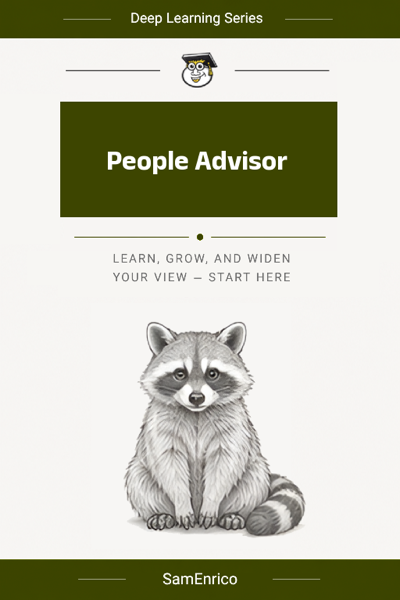
Non-FictionInformativeEducational
People Advisor eBook
A Coursebook on People Advisor
by Leake Pura
A Coursebook on People Advisor
Formats
Free sample
Chapter 1: The Policy Trap--–- The email arrived at 4:47 PM on a Tuesday. I had been in my role as Head of People for exactly eleven days. The subject line read: "Urgent – Maternity Leave Request – Policy Violation." I opened it to find a six-paragraph explanation from our legal counsel explaining that a production floor employee, eight months pregnant, had requested a chair. Our facility policy, written in 1987 and unchanged since, stated that "production floor personnel shall remain standing during active work hours except during designated break periods." The employee had been denied the chair. She had then filed a complaint.
Legal's recommendation was to "deny the accommodation pending review" because approving it would "set a precedent requiring all production staff to have chairs, which would violate the uniform application of the policy."I closed my laptop, walked down three flights of stairs to the production floor, and found her. Her name was Maria. She had worked for the company for fourteen years. She was forty-seven years old. She was standing on a concrete floor, eight months pregnant, assembling circuit boards.
Her ankles were swollen to twice their normal size. She had not complained to anyone except her supervisor, who had cited the policy. She had then gone to HR, which had cited the policy. She had then gone to legal, which had cited the policy. No one had asked her a single question about what she needed.
No one had asked her supervisor why a chair was impossible. No one had asked legal whether protecting a forty-seven-year-old policy was worth the cost of a human being's dignity.I asked Maria, "What would help you do your job right now?" She looked at me like I had asked her the meaning of life. Then she started to cry. "A stool," she said. "Just a stool.
I can still reach the table. I just need to sit down."The stool cost forty-seven dollars. We bought it. The policy remained unchanged. No precedent was set.
No other employee requested a chair. Maria worked until her due date, took her leave, returned, and retired from that company seven years later. She told that story for the rest of her career—not as a complaint, but as proof that someone had finally asked her the right question.That was the day I stopped doing HR. That was the day I became a People Advisor.The Four-Letter Word No One Wants to Say When did "HR" become a four-letter word? Not literally, of course.
But functionally. Ask any employee what they think when they hear "Human Resources" and you will hear a cascade of associations: paperwork, policies, protection (of the company, not them), forms, approvals, denials, investigations, and the quiet, sinking feeling that you are about to be told "no." Ask any CEO what they think, and you will hear: compliance, risk, liability, cost center, necessary evil. Ask any HR professional what they think, and if they are honest, you will hear exhaustion.The traditional HR model was not designed for human beings. It was designed for industrial efficiency. It emerged from the early twentieth century, when Frederick Taylor's scientific management principles dominated.
Taylor believed that workers were fundamentally lazy, that they would shirk responsibility if given the chance, and that the only way to achieve productivity was to break work into tiny, repeatable motions, measure everything, and enforce compliance through strict policies and supervision. This worldview gave us time clocks, punch cards, standardized breaks, and the assumption that any deviation from the rule was a form of theft.Here is the problem: that worldview is wrong. It has always been wrong, but for most of the twentieth century, it was functional because the economy was built on physical labor and hierarchical command. A factory worker in 1950 could be told "stand here, do this, don't ask why" and the work would get done. Not because the worker was happy about it, but because the alternatives were worse.
The post-war economy offered few choices. You stood where you were told or you went hungry.The knowledge economy changed everything. Today, the most valuable work is not physical repetition but cognitive creativity. Engineers, designers, strategists, marketers, product managers, data scientists—these roles cannot be policed into productivity. You cannot watch a software engineer type and measure their output by keystrokes.
You cannot stand behind a designer and monitor their pixel placement. The most important work happens inside someone's head, and no policy, no time clock, no compliance manual can access that space.And yet, most companies still run their people functions as if it were 1955. They have employee handbooks that rival the tax code. They have approval matrices that require five signatures for a laptop upgrade. They have performance review forms that take forty-five minutes to complete and predict absolutely nothing.
They have HR departments whose primary job is to say "no" and whose secondary job is to document why they said "no" in case they get sued.This book is for everyone who has ever looked at that system and thought: There has to be a better way.The People Advisor: A New Archetype There is a better way. It is called the People Advisor. This is not a job title change or a rebranding exercise. It is a fundamental shift in identity, mindset, and behavior.Let me define what a People Advisor is not. A People Advisor is not a policy enforcer.
They do not walk around with a rulebook looking for violations. They do not measure their success by how many forms were processed or how many compliance trainings were completed. They do not see employees as risks to be mitigated or resources to be optimized.Here is what a People Advisor is. A People Advisor is a strategic partner to both employees and leaders, using curiosity, data, and compassionate challenge to create conditions where people do their best work. They ask "what does the human need?" before they ask "what does the policy say?" They understand that rules exist to serve people, not the other way around.
They know when to enforce and when to flex. They have the courage to say "no" when necessary and the wisdom to say "yes" when possible.The difference between traditional HR and People Advisory is not cosmetic. It is structural, philosophical, and behavioral. Consider the following contrasts:When an employee asks for an accommodation, traditional HR asks: "What does the policy allow?" The People Advisor asks: "What does the human need to succeed?"When a manager wants to terminate someone, traditional HR asks: "Have we documented enough?" The People Advisor asks: "Have we coached enough?"When a team is underperforming, traditional HR asks: "Who is at fault?" The People Advisor asks: "What is the system producing?"When a leader proposes a new initiative, traditional HR asks: "What are the legal risks?" The People Advisor asks: "What are the human risks and opportunities?"When an employee is struggling, traditional HR asks: "How do we protect the company?" The People Advisor asks: "How do we help this person?"This is not idealism. It is pragmatism.
The traditional approach is failing. Employee engagement is at historic lows. Turnover costs companies trillions. Burnout is epidemic. The companies…
This is the end of the free sample. Get the eBook to keep going. Buy now
About this book
Details
- Author
- Leake Pura
- Publisher
- SamEnrico
- Language
- English
- Genre
- Non-Fiction, Informative, Educational
- Released
- 2026-05-18
- Pages (approx.)
- 153
- Available as
- eBook, Audiobook

Read better in the ZLOADR app
Your eBooks on your phone or tablet. Sign in with your SamEnrico account and start reading.
More by Leake Pura
 Public Speaking for MilitaryLeake Pura$11.99
 Warrant Stacking GuideLeake Pura$11.99
 HIIT Training HandbookLeake Pura$11.99
 The Remote Happy Hour GuideLeake Pura$11.99
 The Hollow Hill: Where the Fair Folk Still LurkLeake Pura$11.99
 Climate Insurance Renewal NegotiationLeake Pura$12.99
 How to Produce Cement and Concrete ProductsLeake Pura$11.99
 How to Start a Log Transport Within The Forest Business (Beginners Guide)Leake Pura$11.99
You may also like
 Hong Kong Handover 1997Dunn Johnnie$11.99
 Zumba For Postnatal Recovery CourseNeal Christian$11.99
 Zumba for BeginnersLadner Nikia$11.99
 YouTube Comment Mining GuideHumes Pandora$12.99
 Worry Box MeditationCarlin Rudy$11.99
 Workplace Stress MeditationNguyen Lynn$11.99
 Workplace Stress and Sleep RepairHawley Ivory$11.99
 Workplace Perfectionism CureDelaney Jeffry$11.99
 Workplace Injustice Anger GuideWallen Isabelle$11.99
 Work Addiction and Burnout LinkGreenwood Ester$11.99
 Women in Yoga and WellnessBeattie Galina$11.99
 Women in Stand Up ComedyChun Evangeline$11.99