
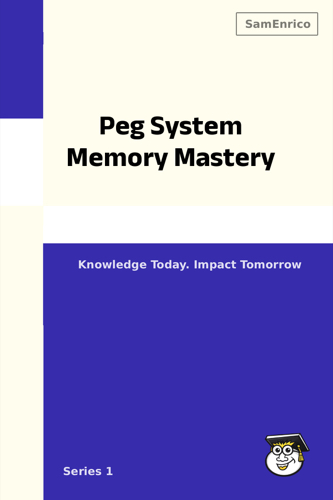
Peg System Memory Mastery eBook
Master number shape and rhyme pegs to remember lis
Master number shape and rhyme pegs to remember lists, codes, and sequences permanently.
Formats
Free sample
Chapter 1: The Forgetting Epidemic--–- You are standing in the grocery store aisle, staring at your phone, trying to remember the three items you walked in for. You know there were three. You can feel the shape of them in your mind, like ghosts. But the actual words won't come. Milk.
Eggs. Butter. That was it. Simple. And yet, fifteen minutes ago, standing in your kitchen, you told yourself you would not forget.
You repeated the words like a chant. Milk. Eggs. Butter. Milk.
Eggs. Butter. And then you opened the front door, and the air hit your face, and the chant vanished as if it had never existed.You are not alone. This is not a sign of dementia, early Alzheimer's, or cognitive decline. This is the Forgetting Epidemic, and it is the normal, predictable, miserable result of living in the twenty-first century with a brain that was designed for the savanna.The Modern Memory Crisis Let me paint a fuller picture of your daily life.
You wake up and check your phone. You have three passwords to remember just to access your email, your banking, and your social media. Your brain holds, on average, one hundred passwords across various accounts. You reset at least twelve of them every year. Each reset costs you three minutes of frustration, multiplied by twelve, multiplied by the years of your life.
That is hours. That is days. That is time you will never get back.You walk into your office. A colleague introduces you to a new team member. You shake their hand, look them in the eye, repeat their name inside your head — "Sarah, Sarah, Sarah" — and then, thirty seconds later, when someone asks you to introduce her to the rest of the team, her name is gone.
Vapor. You say, "This is... I'm sorry, I've forgotten already." You laugh it off, but inside, you feel small. You feel like someone who doesn't care enough to remember. But you do care.
That is the cruelest part.You sit down at your computer. Your screen is filled with numbers. Confirmation codes. Ticket numbers. Invoice IDs.
A sixteen-digit credit card number that you have typed so many times your fingers remember it but your mind does not. A phone number your mother has had for seven years, and still, you look it up every single time. A PIN for your debit card that you do not actually know — you only know the pattern of finger movements on the keypad. If someone asked you to write down the digits, you could not.You go to the doctor. She gives you three instructions.
Take the red pill with food. Take the blue pill before bed. Come back in two weeks for a follow-up. You nod. You understand perfectly in the moment.
And by the time you reach the parking lot, you have lost one of them. Which pill was with food? Which was before bed? You are not careless. You are not stupid.
You are human.This is the Forgetting Epidemic. It is not your fault. But it is your problem.Why Your Brain Betrays You To understand why you forget, you must first understand what your brain was actually designed to do. Spoiler alert: it was not designed to remember shopping lists, passwords, or credit card numbers.The human brain evolved over two hundred thousand years on the African savanna. Your ancestors lived in small tribes of about one hundred fifty people.
Their survival depended on remembering faces (who was friend, who was foe), locations (where to find water, where the lions slept), and sequences (first you track the antelope, then you throw the spear, then you run like hell). They did not need to remember abstract symbols. They did not need to recall arbitrary strings of digits. They did not need to differentiate between a capital 'O' and the number zero at 2 AM when resetting a password.Your brain is, in essence, a biological machine for remembering three things: what is dangerous, what is rewarding, and what is unusual. Everything else is noise.
The brain filters out noise aggressively, efficiently, and without your permission.This is called the attention-to-memory bottleneck. Every second, your senses collect eleven million bits of information. Your conscious mind can process only about fifty bits per second. Your working memory — the scratch pad of your conscious thought — holds a maximum of about four discrete items at once, and even those begin to decay within seconds unless you actively rehearse them.This is not a theory. It is settled cognitive science.
The psychologist George Miller famously proposed that working memory could hold "seven plus or minus two" items, but more recent research has revised that number downward. You have a thimble trying to hold an ocean.So when you stand in the grocery store aisle, unable to remember milk, eggs, and butter, you are not broken. You are normal. The problem is not your memory. The problem is that you are using a hunting-and-gathering brain to do the work of a supercomputer.The Two Ways to Remember (One of Them Is a Lie)There are two fundamentally different ways to put information into your brain.
One of them is a trap. The other is the key to everything that follows in this book.Maintenance Rehearsal: The Trap Maintenance rehearsal is what you do when you repeat something over and over again. You say the phone number out loud, ten times in a row. You chant the shopping list under your breath. You recite the password as you type it.
This feels productive because you can feel the information sitting there, right on the tip of your consciousness. But here is the truth that memory researchers have known for decades: maintenance rehearsal is almost completely useless for long-term retention.Why? Because repetition does not create meaning. Your brain forgets things that have no meaning. When you repeat "milk, eggs, butter" twenty times, you are not telling your brain that these items matter.
You are simply exercising your mouth muscles. The moment you stop repeating, the neural trace begins to fade. Within thirty seconds, it is gone.Worse, maintenance rehearsal creates what psychologists call illusions of competence. You feel like you know the information because you can access it right now. But "right now" is not the same as "thirty minutes from now when you are distracted." The feeling of knowing is not the same as knowing.
This false confidence leads you to stop using real memory techniques, which leads you to forget, which leads you to feel stupid, which leads you to try harder at the thing that never worked in the first place. It is a vicious cycle.Elaborative Encoding: The Truth Elaborative encoding is the opposite of repetition. Instead of saying the same thing over and over, you transform it. You connect it to something you already know. You turn it into an image.
You make it weird, vivid, emotional, and absurd. You give it meaning.Here is an example. Which is easier to remember: the number 1776 repeated ten times, or the image of a gun (1) firing a firework (7) at a second gun (7) that hits a…
This is the end of the free sample. Get the eBook to keep going. Buy now
About this book
Details
- Author
- Holloman Hannelore
- Publisher
- SamEnrico
- Language
- English
- Genre
- Non-Fiction, Self-Help
- Released
- 2026-06-09
- Pages (approx.)
- 133
- Available as
- eBook, Audiobook

Read better in the ZLOADR app
Your eBooks on your phone or tablet. Sign in with your SamEnrico account and start reading.
More by Holloman Hannelore
 Fear of Flying HandbookHolloman Hannelore$11.99
 Spain Tourism Recovery ReportHolloman Hannelore$11.99
 Verbal Triggers for TraumaHolloman Hannelore$11.99
 Nonverbal Persuasion TechniquesHolloman Hannelore$11.99
 The Diamond Syndicate Wars: How South Africa's Blood Diamonds Forged Global LawHolloman Hannelore$11.99
 AI-Powered NFT Art BusinessHolloman Hannelore$11.99
 Tutoring Burnout Prevention GuideHolloman Hannelore$12.99
 Instagram Ad Campaign Starter HandbookHolloman Hannelore$12.99
 Understanding Ovarian DwarfismHolloman Hannelore$17.99
 How to Start a Packing Cases Made of Fibre Board Business (Beginners Guide)Holloman Hannelore$11.99
You may also like
 Hong Kong Handover 1997Dunn Johnnie$11.99
 Zumba For Postnatal Recovery CourseNeal Christian$11.99
 Zumba for BeginnersLadner Nikia$11.99
 YouTube Comment Mining GuideHumes Pandora$12.99
 Worry Box MeditationCarlin Rudy$11.99
 Workplace Stress MeditationNguyen Lynn$11.99
 Workplace Stress and Sleep RepairHawley Ivory$11.99
 Workplace Perfectionism CureDelaney Jeffry$11.99
 Workplace Injustice Anger GuideWallen Isabelle$11.99
 Work Addiction and Burnout LinkGreenwood Ester$11.99
 Women in Yoga and WellnessBeattie Galina$11.99
 Women in Stand Up ComedyChun Evangeline$11.99