
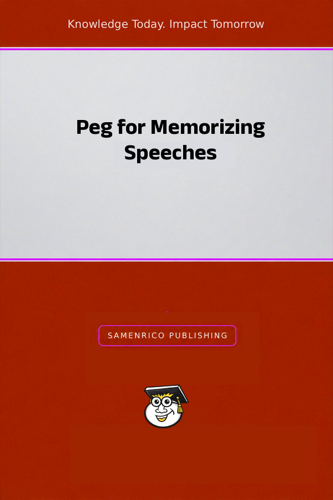
Non-FictionSelf-HelpSpeech Memory
Peg for Memorizing Speeches eBook
Use numbered pegs to remember key points in order.
by Larue Caroll
Use numbered pegs to remember key points in order.
Formats
Free sample
Chapter 1: The 3 AM Panic--–- Sarah’s eyes snapped open at 3:14 AM. The hotel room was pitch black, but she didn’t need light to feel the familiar dread crawling up her chest. Tomorrow morning—no, later this morning—she would stand in front of the executive board and deliver the presentation that would determine whether she became a director or remained a senior manager forever. She had rehearsed the ten-minute pitch forty-seven times. She knew the slides backward.
She had practiced in the shower, in the car, and in front of her patient husband until he could recite her opening line from memory. And yet, at 3:14 AM, her mind was a white void. She tried to run through the first three key points. Point one: market trends. She could see that.
Point two: competitive landscape. Still there. Point three? Nothing. A blank wall where a concept should be.
She sat up in bed, heart pounding. “Point three,” she whispered into the darkness. “Point three was about… about…” The words would not come. She had experienced the cliff effect before—that terrifying moment during a college presentation when one forgotten word triggered a cascade collapse of her entire memory. But that was a classroom.
This was the boardroom. The difference between a career and a quiet exit. By 4:00 AM, she had given up on sleep. By 6:00 AM, she had rewritten her notecards three times. By 9:00 AM, she would freeze for eleven seconds in front of the CEO.
And by 10:00 PM that night, she would sit in her parked car in her own driveway and ask herself whether she should quit altogether. This chapter is for Sarah. And for everyone who has ever felt their memory betray them at the worst possible moment. The good news—the extraordinary news—is that Sarah’s memory was never broken. Neither is yours.
You have simply been using the wrong tool.The Cliff Effect: Why Rote Repetition Fails Let us name the enemy. The enemy is rote repetition—the method you were taught in grade school, the method most professionals still rely on, the method that failed Sarah at 3:14 AM. Rote repetition is the process of repeating a string of words over and over until they feel automatic. It is the equivalent of trying to memorize a phone number by chanting it five hundred times. It works, sort of, for about twenty-four hours.
And then it evaporates. The reason is neurological. When you repeat a sequence of words without attaching them to images, locations, or emotions, you are storing them in your short-term verbal memory—specifically, your phonological loop. This is a narrow, fragile channel of working memory that can hold information for approximately fifteen to thirty seconds before it begins to decay. You can refresh it by repeating the words again (and again, and again), but the moment you stop rehearsing, the decay accelerates.
This is why you can recite a poem perfectly in your living room at midnight and then completely lose the third stanza when standing in front of an audience at 2:00 PM. The stress of performance does not simply distract you; it actively degrades the phonological loop, because your brain diverts resources toward threat detection and away from verbal maintenance.The cliff effect is the specific phenomenon where forgetting one element of a memorized sequence triggers the collapse of everything that follows. Picture a row of dominoes. If you memorize a speech as a linear string of words (word A leads to word B leads to word C), then losing word B does not just cost you word B. It severs the link between A and C, leaving you stranded with no way to recover.
This is why you see speakers freeze, shuffle their notecards frantically, or utter the phrase “I seem to have lost my place” as if their place were a set of car keys. Their place was never anchored. It was floating in the phonological loop, waiting for a single gust of anxiety to blow it away. The ancient world knew a different way. Roman senators spoke for two hours without notes.
Medieval scholars memorized entire books. West African griots recited genealogies spanning centuries. None of them used rote repetition. They used what we are about to teach you.The Peg System: Your Brain’s Native Language The peg system—also called the hook method or the number-rhyme system—works because it speaks your brain’s native language. Your brain did not evolve to remember abstract symbols like words and numbers.
It evolved to remember images, locations, sequences, and threats. Consider this: you can likely describe the layout of your childhood bedroom in vivid detail, down to the scratch on the dresser and the color of the curtains. You can recall the face of a cashier you saw once three years ago. You can remember exactly where you were when you heard news of a major event. But you cannot remember a twelve-digit number without writing it down.
That is not a flaw. That is a design feature. The peg system exploits this design by translating abstract information (speech points, statistics, quotes) into concrete images that you then “hang” onto a pre-memorized set of numbered hooks. The hooks themselves are simple, unforgettable images based on rhymes or shapes. For example: 1 = bun (rhyme), 2 = shoe (rhyme), 3 = tree (rhyme).
Once you have memorized these ten (or twenty, or one hundred) hooks, you can attach any piece of information to them by creating a bizarre, vivid, multisensory image that links the hook to the content. When you need to recall point number three, you simply think “tree,” and the image you created springs to mind, carrying the content with it.This is not a trick. It is a form of elaborative encoding, a well-documented phenomenon in cognitive psychology. Studies consistently show that information encoded with visual imagery is recalled at significantly higher rates than information encoded through rote rehearsal alone. The more bizarre, emotional, and multisensory the image, the stronger the encoding.
This is because the hippocampus—the brain’s primary memory formation center—responds more strongly to novel, surprising, or emotionally charged stimuli than to mundane or repetitive ones. When you picture a bun (Hook 1) calmly sitting next to a calculator, your hippocampus yawns. When you picture a calculator drowning in a bowl of soup while a screaming anthropomorphic bun cuts dollar bills with tiny scissors, your hippocampus sits up and pays attention. That attention translates directly into recall.The Herennium Pattern: Active Recall Over Passive Review The Rhetorica ad Herennium, the oldest surviving Latin text on rhetoric and memory (circa 90 BCE), contains a concept that modern education has largely forgotten: active recall. Most people study by reviewing material repeatedly—reading their notes, listening to recordings, saying their speech aloud over and over.
This is passive review. It feels productive because it is familiar, but it is one of the least efficient study methods known to cognitive science. Passive review tricks you into fluency. You recognize the material because you have just seen it. That recognition feels like mastery.
But recognition is not recall. Recall is the ability to retrieve information from memory without any external cue. Passive review builds…
This is the end of the free sample. Get the eBook to keep going. Buy now
About this book
Details
- Author
- Larue Caroll
- Publisher
- SamEnrico
- Language
- English
- Genre
- Non-Fiction, Self-Help, Speech Memory
- Released
- 2026-06-07
- Pages (approx.)
- 135
- Available as
- eBook, Audiobook

Read better in the ZLOADR app
Your eBooks on your phone or tablet. Sign in with your SamEnrico account and start reading.
More by Larue Caroll
 Workaholic Identity RecoveryLarue Caroll$11.99
 Comparison Culture Origins GuideLarue Caroll$11.99
 Weekend Morning RoutineLarue Caroll$11.99
 Persuasion For Customer SupportLarue Caroll$11.99
 The Magnesium Miracle GuideLarue Caroll$11.99
 Amazon Brand Registry GuideLarue Caroll$12.99
 Ghana Independence 1957 GuideLarue Caroll$11.99
 The Sugar Barons of the Caribbean: How African Entrepreneurs Built EmpiresLarue Caroll$11.99
 Burn Sunscreen ProtectionLarue Caroll$11.99
 The Quantum Leap That Changed Everything: The Story of the First Entangled PhotonsLarue Caroll$11.99
 Doberman Pinscher: Sharp & LoyalLarue Caroll$11.99
 A Collector's Handbook to the Austin 20 HP ShortLarue Caroll$11.99
You may also like
 Hong Kong Handover 1997Dunn Johnnie$11.99
 Zumba For Postnatal Recovery CourseNeal Christian$11.99
 Zumba for BeginnersLadner Nikia$11.99
 YouTube Comment Mining GuideHumes Pandora$12.99
 Worry Box MeditationCarlin Rudy$11.99
 Workplace Stress MeditationNguyen Lynn$11.99
 Workplace Stress and Sleep RepairHawley Ivory$11.99
 Workplace Perfectionism CureDelaney Jeffry$11.99
 Workplace Injustice Anger GuideWallen Isabelle$11.99
 Work Addiction and Burnout LinkGreenwood Ester$11.99
 Women in Yoga and WellnessBeattie Galina$11.99
 Women in Stand Up ComedyChun Evangeline$11.99