
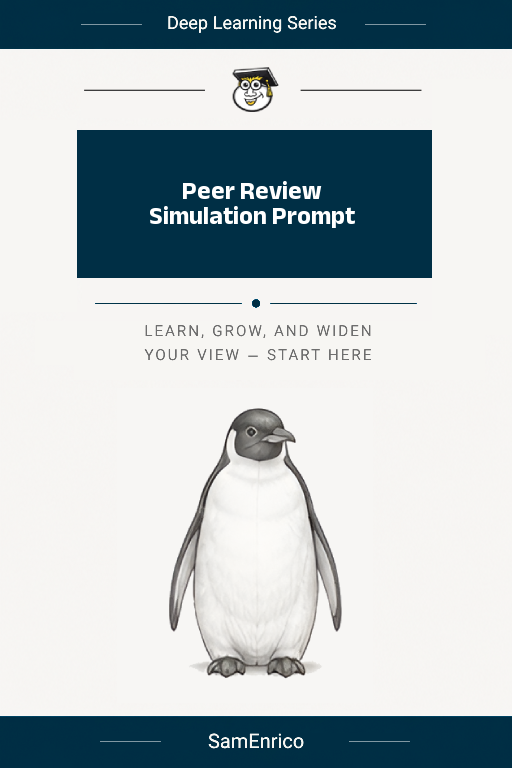
Peer Review Simulation Prompt
Ask GPT to critique your draft as a harsh professo
Ask GPT to critique your draft as a harsh professor or peer reviewer, identifying weak arguments and unclear passages.
Formats
About this book
Free sample
Chapter 1: The Executioner’s Appointment--You have just finished what you believe is a solid draft. Maybe it is a journal article, a book chapter, a grant proposal, or a dissertation section. You feel the familiar mixture of exhaustion and cautious pride. You send it to a trusted colleague or a kindly advisor. Days pass.
Then the feedback arrives: “This is interesting. A few small suggestions. Good work.” And you are left wondering: What does that actually mean? What are the small suggestions? Which parts are merely interesting versus actually convincing?
And most importantly: can you trust this feedback to help you improve, or is it simply the academic equivalent of a participation trophy?This is the quiet crisis of academic and professional writing. We submit drafts to peers who are overworked, conflict-averse, and trained from childhood to soften criticism. We receive feedback that is polite, vague, and ultimately useless. Then we revise blindly, submit to journals or supervisors, and get rejected—not because our ideas lack merit, but because no one had the courage or the time to tell us the truth earlier. The system is broken.
And the solution is not to find nicer reviewers. It is to find harsher ones. Specifically, it is to simulate a reviewer who has no social anxiety, no fear of hurting your feelings, and no patience for weak arguments or unclear sentences. That reviewer is artificial intelligence. And this book will teach you how to turn it into your personal, pitiless, peer-review executioner.The Problem with Polite Feedback Let us begin with an uncomfortable truth.
Most peer review—whether formal for a journal or informal between colleagues—is systematically biased toward politeness over precision. This is not because reviewers are malicious or lazy, though some are. It is because human beings are social animals first and critical thinkers second. We evolved to maintain group harmony, not to eviscerate each other’s prose. When a colleague asks for feedback, our brain’s default setting is: Do not burn this bridge.
So we reach for the compliment sandwich: start with something nice (“This is a really interesting topic”), insert a mild…
This is the end of the free sample. Get the eBook to keep going. Buy now
Contents
- Chapter 1
- Chapter 2
- Chapter 3
- Chapter 4
- Chapter 5
- Chapter 6
- Chapter 7
- Chapter 8
- Chapter 9
- Chapter 10
- Chapter 11
- Chapter 12
Details
- Author
- Spicer Kendall
- Publisher
- SamEnrico
- Language
- English
- Genre
- Non-Fiction, Student's Shortcut, Revision, Critical Feedback
- Released
- 2026-05-30
- Pages (approx.)
- 142
- Available as
- eBook, Audiobook

Read better in the ZLOADR app
Your eBooks on your phone or tablet. Sign in with your SamEnrico account and start reading.
More by Spicer Kendall
 Stress Management for Long Distance LoveSpicer Kendall$11.99
 Before Meeting Breath FocusSpicer Kendall$11.99
 Listening In Aviation GuideSpicer Kendall$11.99
 Joyful Parenting Through GratitudeSpicer Kendall$11.99
 The Delegation FearSpicer Kendall$11.99The Delegation FearSpicer Kendall$11.99
 Mental Health First Aid TrainingSpicer Kendall$11.99
 Athlete Master GuideSpicer Kendall$11.99
 Dream Shadow JournalSpicer Kendall$11.99
 The Grape HarvestSpicer Kendall$11.99
 The Silk and Steel Diaries: How a Spinster Outwitted the TonSpicer Kendall$11.99
 Whispers in the Dark: The Forgotten Uprising of the MaroonsSpicer Kendall$11.99