
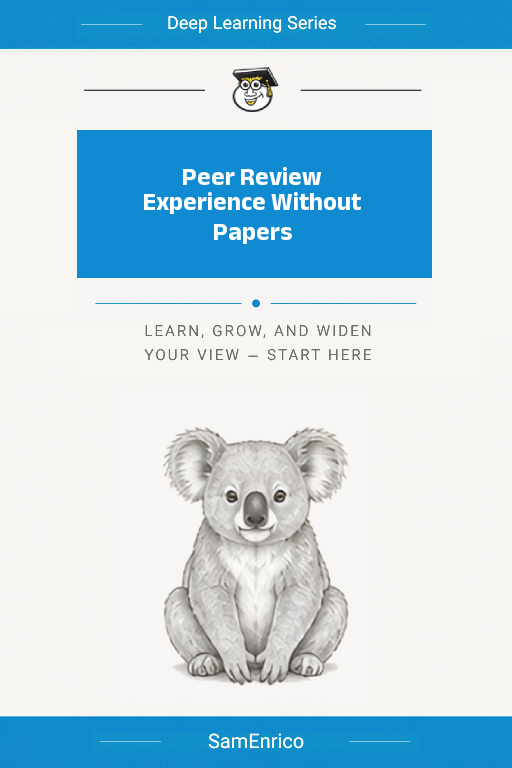
Non-FictionStudent's ShortcutPeer Review
Peer Review Experience Without Papers eBook
Mention serving as a peer reviewer for undergradua
by Cramer Jone
Mention serving as a peer reviewer for undergraduate journals or conferences to show engagement with academic publishing.
Formats
Free sample
Chapter 1: X-Ray Vision--–- The first time someone asked me to peer review a paper, I almost said no. I was a sophomore. I had never published anything. I had barely written a paper that I was proud of. The request came from a professor who had seen me stay after class to ask questions about citation practices.
She handed me a student manuscript from an undergraduate journal and said, “I think you’re ready to see how the sausage gets made.” I panicked. Who was I to judge someone else’s work? What qualified me to tell another student that their argument needed work? I had imposter syndrome before I even knew that term existed.That panic is exactly why this book exists.What I discovered changed my academic life. When I finally said yes – after the professor walked me through a simple rubric and promised to co-sign my review – I learned more about writing in two hours than I had in two semesters of composition classes.
Reading that anonymous student’s paper as a reviewer, not as a passive reader, gave me something no textbook ever could: x-ray vision into the hidden structure of academic arguments. I saw where the thesis cracked under pressure. I saw where evidence was supposed to connect to claims but instead just floated next to them. And most painfully, I saw those same cracks in my own writing reflected back at me.This chapter reframes peer review as what it actually is: not a chore for tenured professors, but a high-impact learning practice that any undergraduate can use to accelerate their writing skills, improve their grades, and build a professional portfolio – all without having published a single paper of their own.The Myth of the Expert Reviewer Let me name the lie that keeps most students from ever reviewing: the belief that you need to be an expert to evaluate someone else’s work. This is false.
It is sustained by the hidden curriculum of academia, the unspoken rules that everyone seems to know except the people who need to know them most.Professional peer reviewers are not omniscient. They are not always full professors with decades of experience. In fact, many journals – especially undergraduate journals – actively recruit student reviewers precisely because student perspectives catch things that jaded experts miss. A student reviewer will notice when a methods section is incomprehensible because they are the intended audience. A student reviewer will flag jargon that no undergraduate would ever understand.
A student reviewer brings fresh eyes, and fresh eyes are valuable.The 2025 IEEE study on student barriers to scholarly dissemination found that seventy-eight percent of undergraduates who were invited to review declined because they felt unqualified. But here is the crucial follow-up finding that most people miss: of the twenty-two percent who accepted, ninety-four percent completed their reviews successfully, and eighty-seven percent said the experience improved their own writing within one semester. The barrier was not skill. The barrier was confidence.This chapter will dismantle that confidence barrier systematically. By the time you finish reading, you will understand exactly what you already know that qualifies you to review, exactly what you will learn by doing it, and how to take the first step even if your hands are shaking.X-Ray Vision: What Reviewers See That Readers Miss When you read a paper as a student, you are usually reading for content.
What is the author saying? Do I agree? What will be on the exam? That is surface reading. It is like looking at a finished house and admiring the paint color.When you read a paper as a reviewer, you are reading for structure.
You are reading the blueprints. You are asking different questions entirely: Where is the thesis? Does the evidence actually support it? Is there a logical path from the introduction to the conclusion, or did the author get lost? Is the contribution new, or has someone already said this?
Reviewers read for the skeleton beneath the skin.That shift in reading mode is the “x-ray vision” this book promises. It is not magic. It is a set of questions you learn to ask automatically. Here is a preview of the five x-ray questions you will master in the coming chapters:1. What conversation is this paper joining?
Every academic paper responds to something – a debate, a gap, a problem. Reviewers spot whether the author has named that conversation or just started talking into the void.2. Where is the thesis, and does it hold weight? A thesis can be too vague (“This paper explores X”), too obvious (“Water is wet”), or too ambitious (“This paper solves climate change”). Reviewers learn to distinguish a working thesis from a placeholder.3.
Does the evidence fit the claim? Many papers present evidence that is adjacent to the claim but does not actually prove it. Reviewers catch these gaps.4. Is the method sound enough to trust the conclusion? You do not need a Ph D in statistics to spot a missing control group or a survey that asked leading questions.
You just need a checklist.5. So what? The most devastating question in academic reviewing. Even a beautifully written paper fails if it cannot answer why anyone should care.These questions seem simple because they are. The difficulty is not in understanding them.
The difficulty is in remembering to ask them consistently. That is what practice as a reviewer trains.The Tangible Payoff: Grades, Theses, and Job Applications Let me be blunt about why this matters beyond the abstract satisfaction of being helpful. Peer review experience translates directly into three tangible outcomes that will affect your academic and professional trajectory.Higher Grades Through Rubric Literacy Most students lose points on papers because they do not actually understand the grading rubric. They glance at it, think “I get it,” and then write what feels right. But professors design rubrics to reflect the same values that peer reviewers use: clarity of thesis, quality of evidence, logical structure, appropriate citation.
When you learn to review, you learn to see through a rubric. You learn what “thesis is clearly stated and defensible” actually looks like in practice because you have seen five versions of it – some successful, some disastrous.Students who serve as peer reviewers report that their own grades improve by an average of one full letter grade within two semesters, according to data from undergraduate research programs at fourteen universities. The mechanism is simple: you cannot unsee the structural flaws once you learn to spot them. When you sit down to write your own introduction, you will hear a reviewer in your head asking, “Where is the thesis?” That voice is annoying. It is also correct.A Better Honors Thesis or Capstone Project The most common feedback on undergraduate theses is also the most useless: “This needs more structure.” What does that mean?
Students hear it and panic. They add more headings. They rearrange paragraphs randomly. They do not actually fix the underlying problem because no one taught them how to diagnose structural issues.Peer review teaches diagnosis. When you review three or four papers before writing your own thesis, you will have seen every possible structural failure: the introduction that…
This is the end of the free sample. Get the eBook to keep going. Buy now
About this book
Details
- Author
- Cramer Jone
- Publisher
- SamEnrico
- Language
- English
- Genre
- Non-Fiction, Student's Shortcut, Peer Review
- Released
- 2026-06-01
- Pages (approx.)
- 150
- Available as
- eBook, Audiobook

Read better in the ZLOADR app
Your eBooks on your phone or tablet. Sign in with your SamEnrico account and start reading.
More by Cramer Jone
 Survey Question Performance with AICramer Jone$11.99
 OCD And Panic Disorder OverlapCramer Jone$11.99
 Power Poses And Confidence HandbookCramer Jone$11.99
 Parenting Only Child GuideCramer Jone$11.99
 Process Improvement InnovationCramer Jone$11.99
 The Great Moon Hoax: How a Newspaper Fooled the WorldCramer Jone$11.99
 How to Start a Construction of Irrigation Systems (canals) Business (Beginners Guide)Cramer Jone$11.99
 Clinical Research PhysicianCramer Jone$11.99
 Italian University Master GuideCramer Jone$12.99
You may also like
 Hong Kong Handover 1997Dunn Johnnie$11.99
 Zumba For Postnatal Recovery CourseNeal Christian$11.99
 Zumba for BeginnersLadner Nikia$11.99
 YouTube Comment Mining GuideHumes Pandora$12.99
 Worry Box MeditationCarlin Rudy$11.99
 Workplace Stress MeditationNguyen Lynn$11.99
 Workplace Stress and Sleep RepairHawley Ivory$11.99
 Workplace Perfectionism CureDelaney Jeffry$11.99
 Workplace Injustice Anger GuideWallen Isabelle$11.99
 Work Addiction and Burnout LinkGreenwood Ester$11.99
 Women in Yoga and WellnessBeattie Galina$11.99
 Women in Stand Up ComedyChun Evangeline$11.99