
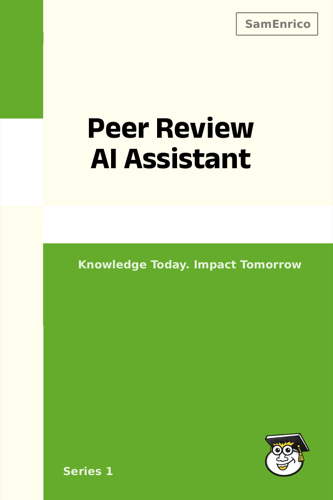
Non-FictionAI OperatorPeer Assessment
Peer Review AI Assistant
Structure peer feedback protocols and analyze revi
Structure peer feedback protocols and analyze reviewer comments for quality.
Formats
About this book
Free sample
Chapter 1: The Architecture of Trust...--–- Peer review is broken. Not because reviewers are lazy or malicious, but because the vast majority have never been taught how to review well. They mimic what was done to them—sometimes helpful, often painful, rarely efficient. The result is a system where a single ambiguous comment can cost an author three months of revisions, where editors struggle to distinguish signal from noise, and where good science gets delayed or rejected for the wrong reasons.This book exists because that system is about to collide with artificial intelligence—and most academics are completely unprepared. Some will use AI to write lazy, generic reviews that damage their reputations.
Others will refuse to use AI at all and fall behind their peers. A small minority will learn to collaborate with AI in ways that make them faster, sharper, and more respected. This chapter is the foundation for becoming one of that minority.But before we can talk about AI, we need to talk about what makes a great review in the first place. You cannot improve something you cannot measure. You cannot delegate something you cannot define.
And you certainly cannot teach an AI assistant to help you if you do not understand the architecture of quality feedback.The Myth of Subjective Review Most reviewers operate under a dangerous assumption: that peer review is fundamentally an opinion-based exercise. "I liked the paper" or "I didn't like it." "The methodology seems solid" or "I have concerns." This is the language of taste, not of rigor.Here is the truth that separates professional reviewers from amateurs: peer review is structured information architecture. Every great review follows a hidden grammar, whether the reviewer knows it or not. And once you learn that grammar, you can write better reviews in less time, you can train AI assistants to amplify your strengths, and you can spot a bad review instantly—whether it comes from a human or a machine.The evidence for this comes from an unexpected place: editorial offices. When journals analyze what makes a review useful to editors and authors, they consistently…
This is the end of the free sample. Get the eBook to keep going. Buy now
Contents
- Chapter 1
- Chapter 2
- Chapter 3
- Chapter 4
- Chapter 5
- Chapter 6
- Chapter 7
- Chapter 8
- Chapter 9
- Chapter 10
- Chapter 11
- Chapter 12
Details
- Author
- Mccann Janeth
- Publisher
- SamEnrico
- Language
- English
- Genre
- Non-Fiction, AI Operator, Peer Assessment
- Released
- 2026-06-06
- Pages (approx.)
- 130
- Available as
- eBook, Audiobook

Read better in the ZLOADR app
Your eBooks on your phone or tablet. Sign in with your SamEnrico account and start reading.
More by Mccann Janeth
 From Refugee To CEOMccann Janeth$11.99
 Norwegian Postman ResistanceMccann Janeth$11.99
 Parenting Stress In Teen YearsMccann Janeth$11.99
 Mastering Urgent vs Important DecisionsMccann Janeth$11.99
 Nefertiti's Lost Heir: The Curse of the Golden CrownMccann Janeth$11.99
 Payroll AccountantMccann Janeth$11.99
 Understanding Mathieu–de Broca–bony SyndromeMccann Janeth$17.99
 Executive Buffer Block SystemMccann Janeth$12.99
 USA Raise Negotiation PlaybookMccann Janeth$12.99
 How to Become a Dividend ClerkMccann Janeth$11.99
You may also like
 Hong Kong Handover 1997Dunn Johnnie$11.99
 Zumba For Postnatal Recovery CourseNeal Christian$11.99
 Zumba for BeginnersLadner Nikia$11.99
 YouTube Comment Mining GuideHumes Pandora$12.99
 Worry Box MeditationCarlin Rudy$11.99
 Workplace Stress MeditationNguyen Lynn$11.99
 Workplace Stress and Sleep RepairHawley Ivory$11.99
 Workplace Perfectionism CureDelaney Jeffry$11.99
 Workplace Injustice Anger GuideWallen Isabelle$11.99
 Work Addiction and Burnout LinkGreenwood Ester$11.99
 Women in Yoga and WellnessBeattie Galina$11.99
 Women in Stand Up ComedyChun Evangeline$11.99