
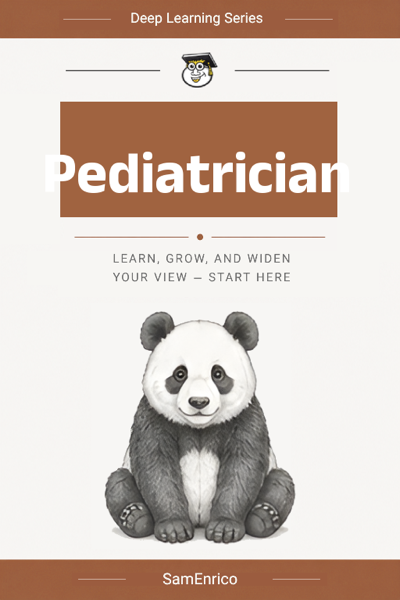
Non-FictionInformativeEducational
Pediatrician eBook
A Coursebook on Pediatrician
A Coursebook on Pediatrician
Formats
Free sample
Chapter 1: The Quiet Exam...--The first time I saw a child die, I was twenty-six years old, three months into my pediatric residency, and completely unprepared. His name was Marcus. He was four. He had come to the emergency department with a fever and a limp—symptoms so common that the senior resident had almost sent him home with a prescription for ibuprofen and instructions to follow up with his primary care doctor in the morning. But something made me pause.
Something about the way his mother held him, the way his eyes stayed closed even when the triage nurse called his name, the way his breathing had a quality I could not name but could not ignore. I asked for a second opinion. The attending physician came down, examined Marcus for thirty seconds, and turned pale. Within an hour, Marcus was in the pediatric intensive care unit on a ventilator. Within six hours, his kidneys had failed.
Within eighteen hours, he was gone. The cause was septic shock from a bacterial infection that had started in his hip joint—septic arthritis that had been brewing for days, masked by the parent's understandable belief that "kids just get fevers" and the previous clinician's equally understandable desire to avoid unnecessary testing. Marcus's death was not the result of negligence or malice. It was the result of a gap—a gap between what the medical textbooks said and what a frightened parent could communicate, a gap between the normal vital signs on a chart and the subtle deterioration happening in a small body, a gap between the science of pediatrics and the art of truly seeing a child.That gap is what this book is about.I wrote Pediatrician for the medical students, residents, nurse practitioners, and physician assistants who are about to enter the most rewarding and terrifying field in medicine. Pediatricians do not treat "small adults." We treat developing organisms whose physiology changes month by month, whose symptoms are filtered through the anxiety of caregivers, and whose ability to tell us what hurts is often limited to a scream or a silence.
The best pediatric textbooks—Nelson, the Illustrated Textbook of Paediatrics, the Harriet Lane Handbook—teach the science brilliantly. They provide differential diagnoses, management algorithms, and medication dosing tables that are essential to practice. What they do not teach is the art: how to build trust with a parent who has been dismissed by three other doctors, how to examine a screaming toddler whose ears you desperately need to visualize, how to break the news of a cancer diagnosis to a mother who came in expecting antibiotics for an ear infection, and how to go home at the end of a day when a child died and still find the strength to return the next morning.This book bridges that gap. It is a coursebook on child health from newborn to adolescence, written in the narrative clinical voice that guides the best physicians—warm enough to build relationships, rigorous enough to save lives. Each chapter opens with a patient story, then reverse-engineers the clinical lessons from that story.
You will learn the medicine because you first feel the humanity. And by the end of these twelve chapters, you will not only know how to diagnose and manage the conditions that affect children. You will know how to be the pediatrician that every child deserves.This first chapter establishes the foundation for everything that follows: the well-child visit. It may seem counterintuitive to begin a clinical coursebook with the "routine" checkup rather than the dramatic resuscitation. But here is the truth that experienced pediatricians know and new trainees must learn: the way you conduct a well-child visit determines everything about how you will handle a crisis.
The habits you build in the quiet moments—how you listen, how you touch, how you explain, how you anticipate danger before it arrives—are the same habits that will save a child's life when the room is filled with monitors and the parents are weeping in the corner. Trust is not built in the emergency department. Trust is built in examination room number four on a Tuesday afternoon, when you take an extra three minutes to ask about sleep and car seats and whether the grandmother's cough might be whooping cough.Let us begin.The Philosophy of the Well-Child Visit: Moving Beyond "Doctor Versus Parent"The traditional model of the medical encounter positions the physician as the expert and the patient as the passive recipient of care. In adult medicine, this model is problematic but sometimes functional. In pediatrics, it is actively harmful.
A child cannot consent to treatment. A child cannot describe their symptoms with precision. A child cannot fill a prescription or adjust a dosage or recognize the early signs of a medication reaction. All of these tasks fall to the parent or caregiver—and if the parent does not trust you, if the parent feels judged or dismissed or confused, then the best medical advice in the world will go unfollowed.The well-child visit must therefore be a collaborative partnership, not an adversarial exchange. Your goal is not to "win" the argument about vaccines or screen time or sleep training.
Your goal is to equip the parent with the information and confidence they need to make good decisions for their child—and to position yourself as a resource they will turn to when things go wrong.This requires a fundamental shift in how you think about your role. You are not the parent's supervisor. You are not the child's savior. You are a consultant to the family, an expert in child health who provides guidance, support, and occasionally firm direction when safety is at stake. The parent, by contrast, is the expert on their child.
They know the sound of the child's genuine cry versus the sound of the child's manipulative cry. They know which foods the child will actually eat versus which foods the child will throw on the floor. They know whether the child's fussiness today is a new development or just Tuesday.Dr. Benjamin Spock, whose 1946 book The Common Sense Book of Baby and Child Care revolutionized pediatric practice, captured this philosophy in his famous opening line: "Trust yourself. You know more than you think you do." Spock understood that parental anxiety was the single greatest obstacle to effective pediatric care, and that the pediatrician's first job was not to dispense medical knowledge but to dispel fear.
A parent who trusts their own instincts is a parent who will notice subtle changes in their child's behavior, who will seek care appropriately rather than too early or too late, and who will follow through on treatment recommendations because they understand the why behind them.However—and this is a critical however—Spock wrote in a different era. Some of his specific recommendations have been overturned by evidence. He advised putting babies to sleep on their stomachs, believing this reduced the risk of aspiration. We now know that supine sleeping reduces the risk of Sudden Infant Death Syndrome by 50%. He was skeptical of vaccination schedules, believing that clustering multiple vaccines could overwhelm the immune system.
We now have overwhelming evidence that the recommended schedule is safe and that delays increase the period of vulnerability to…
This is the end of the free sample. Get the eBook to keep going. Buy now
About this book
Details
- Author
- Schwarz Rosalina
- Publisher
- SamEnrico
- Language
- English
- Genre
- Non-Fiction, Informative, Educational
- Released
- 2026-05-08
- Pages (approx.)
- 158
- Available as
- eBook, Audiobook

Read better in the ZLOADR app
Your eBooks on your phone or tablet. Sign in with your SamEnrico account and start reading.
More by Schwarz Rosalina
 Remote Work Decluttering ProtocolSchwarz Rosalina$11.99
 Tariff Supply Shift EffectsSchwarz Rosalina$11.99
 The Turkey Vendor GuideSchwarz Rosalina$11.99
 The Close Friends Circle GuideSchwarz Rosalina$11.99
 The Cursed Trenches of Siberia: Ghosts of the Russian Civil WarSchwarz Rosalina$11.99
 Board Report Template GuideSchwarz Rosalina$12.99
 Learn to Play the ViolinSchwarz Rosalina$11.99
 How to Start a Bishopsgate Institute Business (Beginners Guide)Schwarz Rosalina$11.99
You may also like
 Hong Kong Handover 1997Dunn Johnnie$11.99
 Zumba For Postnatal Recovery CourseNeal Christian$11.99
 Zumba for BeginnersLadner Nikia$11.99
 YouTube Comment Mining GuideHumes Pandora$12.99
 Worry Box MeditationCarlin Rudy$11.99
 Workplace Stress MeditationNguyen Lynn$11.99
 Workplace Stress and Sleep RepairHawley Ivory$11.99
 Workplace Perfectionism CureDelaney Jeffry$11.99
 Workplace Injustice Anger GuideWallen Isabelle$11.99
 Work Addiction and Burnout LinkGreenwood Ester$11.99
 Women in Yoga and WellnessBeattie Galina$11.99
 Women in Stand Up ComedyChun Evangeline$11.99