
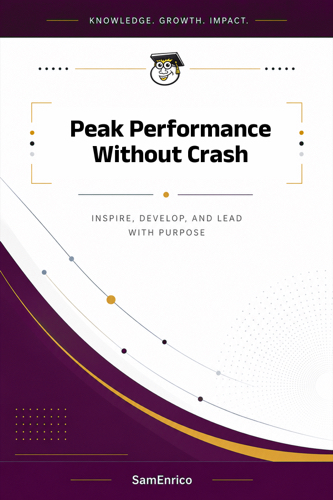
Non-FictionSelf-HelpPeak PerformanceFlow
Peak Performance Without Crash eBook
Achieve flow state and high output while respectin
by Irish Mara
Achieve flow state and high output while respecting your body's need for oscillation and rest.
Formats
Free sample
Chapter 1: The Collapse Point--The first time I collapsed, I was holding a latte.It was 3:47 PM on a Tuesday at Chicago O'Hare, Gate B17. I had just closed a $2.1 million deal over the phone—the kind of deal that makes you feel invincible, the kind you post about on Linked In with a caption about "grinding while others sleep." I remember ordering a triple-shot latte to celebrate, because in hustle culture, caffeine is the champagne of achievement. I remember walking toward the gate, phone still buzzing with congratulatory texts. And then I remember the floor rising up to meet my face.The latte went everywhere. So did my dignity.The paramedics who arrived within three minutes couldn't find anything wrong.
My heart wasn't having a heart attack. My brain wasn't having a stroke. My blood sugar was fine. By every conventional medical measure, I was a perfectly healthy thirty-four-year-old man who had just collapsed in an airport for no apparent reason.The ER doctor who reviewed my chart later that evening gave me the diagnosis I didn't want to hear. She was in her sixties, the kind of doctor who had probably seen a thousand versions of me—successful, driven, exhausted, and in denial.
She sat down on the edge of the gurney, looked me in the eyes, and said something I have never forgotten:"You don't need a vacation. You need a new relationship with work. Your body is not a machine. It's a wave. You've been trying to make it a straight line.
That's not how waves work."I told her I didn't have time for a new relationship with work. I had another deal to close. A flight to catch. A team depending on me. She nodded like she had heard it all before, because she had.
Then she asked me a question that stopped me cold:"How many more collapses do you have in you?"The 77 Percent Problem Let me tell you something that will either terrify you or liberate you, depending on where you are in your own journey toward the edge.You are not alone in this.In fact, you are in the overwhelming majority. According to a 2023 global study by Mc Kinsey Health Institute, 77 percent of professionals report experiencing burnout at their current job. That's not "occasional stress." That's not "a rough quarter." That is more than three out of every four people in offices, hospitals, classrooms, and home workspaces quietly falling apart while pretending to have it all together.Seventy-seven percent. Let that number sit with you for a moment.We have more productivity apps than ever before. More time-management systems.
More caffeine, more nootropics, more "hustle porn" podcasts telling us to wake up at 4 AM and cold plunge our way to greatness. We have noise-canceling headphones to block out the world so we can grind harder. We have standing desks, ergonomic chairs, and blue-light-blocking glasses—all the accessories of a high-performance lifestyle.And despite all of it—maybe because of all of it—we have never been more exhausted, more anxious, or closer to the edge of collapse.The math doesn't add up. Unless you've been using the wrong equation.The wrong equation—the one that has been sold to us by every motivational speaker, every Linked In influencer, every "rise and grind" meme—is this:Success = Effort × Hours × Sacrifice More effort equals more success. More hours equals more success.
More sacrifice equals more success. It's a straight line. A linear function. Push harder, get further. Grind more, achieve more.It is also a lie.
And it is a lie that is killing us.The Straight Line Lie Here is what the straight line model of performance assumes: that the human body and brain are infinite resources. That you can pour more in and get more out, indefinitely, without consequence. That rest is downtime—something you do only when you've earned it, only after you've achieved enough to justify stopping.This assumption is not just wrong. It is biologically absurd.Think about anything else in nature that performs at a high level. A cheetah sprinting across the savanna does not maintain top speed for hours.
It sprints in bursts, then rests. A heart does not beat continuously without a pause between beats—the pause is called diastole, and without it, the heart would seize and stop. A wave does not rise in a straight line; it rises, crests, falls, and rises again. That oscillation is not a bug in the system. It is the system.Your body operates on the same principle.
It always has. It always will. No amount of hustle culture brainwashing will change your biology.Here is what actually happens when you push through fatigue for weeks or months at a time. Your body, in its infinite wisdom, tries to protect you. It releases cortisol—the primary stress hormone—to keep you alert, to keep you going, to help you survive what it perceives as an ongoing threat.
Cortisol is brilliant for short-term crises. It is why you can outrun a bear or finish a presentation after three hours of sleep.But your body cannot tell the difference between a bear and a deadline. Between a predator and a quarterly report. Between running for your life and running on empty.When cortisol stays elevated for weeks, it stops being a survival tool and starts being a poison.The Neuroscience of Running on Empty Let me walk you through what was happening inside my brain during those six months before I collapsed at Gate B17. The details might sound familiar.The Hippocampus: This is the memory center of your brain.
It helps you learn new information, recall important details, and regulate your emotional responses. Cortisol is toxic to the hippocampus. Chronically elevated cortisol literally shrinks hippocampal volume. By the time I collapsed, my memory was shot. I would walk into a room and forget why.
I would read a paragraph three times and still not absorb it. I thought I was getting dumber. I was. The stress was eating my memory center.The Prefrontal Cortex: This is the CEO of your brain. It handles decision-making, impulse control, planning, and focus.
When cortisol levels stay high, the prefrontal cortex goes offline. Not metaphorically—neurologically. Blood flow decreases. Neural firing slows. You become reactive instead of thoughtful.
You make impulsive decisions. You snap at people. You feel like you're operating with half a brain because you are.The Amygdala: This is your brain's alarm system. Under chronic stress, the amygdala becomes hyperactive. It starts seeing threats everywhere—a mildly critical email becomes a catastrophe; a missed deadline becomes an identity crisis.
Your emotional responses become disproportionate because your alarm system is stuck in the "on" position.Here is the cruelest irony of the straight line model: pushing through fatigue does not make you tougher. It makes you dumber, more reactive, and less capable of exactly the kind of strategic thinking that high performance requires.You are not building resilience. You are building a collapse.The Credit Card Metaphor I want to give you a framework that will stick with you for the rest of this book. It is the simplest way I know to…
This is the end of the free sample. Get the eBook to keep going. Buy now
About this book
Details
- Author
- Irish Mara
- Publisher
- SamEnrico
- Language
- English
- Genre
- Non-Fiction, Self-Help, Peak Performance, Flow
- Released
- 2026-06-09
- Pages (approx.)
- 146
- Available as
- eBook, Audiobook

Read better in the ZLOADR app
Your eBooks on your phone or tablet. Sign in with your SamEnrico account and start reading.
More by Irish Mara
 DOJ Securities ProsecutionsIrish Mara$11.99
 Anger After Brain InjuryIrish Mara$11.99
 Self Hypnosis for Table TennisIrish Mara$11.99
 Senior Move Loan BridgeIrish Mara$11.99
 The Last Queen of the Pacific: How Hawaii’s Monarchs FellIrish Mara$11.99
 The Day the Internet Broke: How a Single Bug Brought the World to Its KneesIrish Mara$11.99
 Global Talent Visa UK GuideIrish Mara$12.99
 CBC Buenos Aires GuideIrish Mara$12.99
 Auction DriverIrish Mara$11.99
 Understanding Dilated Cardiomyopathy: Cardiomyopathy Dilated With Conduction Defect Type 1, Cardiomyopathy Dilated With Conduction Defect Type 2, Cardiomyopathy, Familial DilatedIrish Mara$17.99
 How to Start a Cycle Bags Made of Leather Business (Beginners Guide)Irish Mara$11.99
You may also like
 Hong Kong Handover 1997Dunn Johnnie$11.99
 Zumba For Postnatal Recovery CourseNeal Christian$11.99
 Zumba for BeginnersLadner Nikia$11.99
 YouTube Comment Mining GuideHumes Pandora$12.99
 Worry Box MeditationCarlin Rudy$11.99
 Workplace Stress MeditationNguyen Lynn$11.99
 Workplace Stress and Sleep RepairHawley Ivory$11.99
 Workplace Perfectionism CureDelaney Jeffry$11.99
 Workplace Injustice Anger GuideWallen Isabelle$11.99
 Work Addiction and Burnout LinkGreenwood Ester$11.99
 Women in Yoga and WellnessBeattie Galina$11.99
 Women in Stand Up ComedyChun Evangeline$11.99