
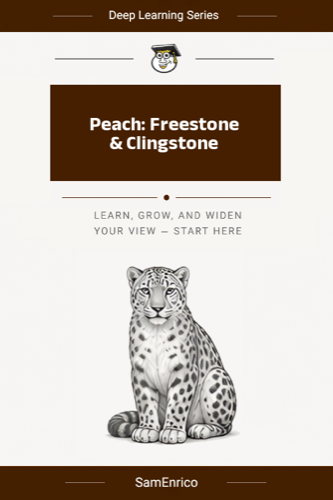
Peach: Freestone & Clingstone eBook
This harvesting publication, published by SamEnric
This harvesting publication, published by SamEnrico, covers Peach: Freestone & Clingstone
Formats
Free sample
Chapter 1: The Peach Lie--You have been lied to about peaches.Not maliciously, perhaps. Not by some grand conspiracy of fruit vendors. But lied to nonetheless. The lie is everywhere—in farmers’ markets where shoppers squeeze every peach on the table, in cookbooks that treat all peaches as identical, and in backyards across America where home growers harvest their trees at the wrong moment, year after year, wondering why their fruit is either rock-hard or rotten, never just right.The lie is simple: A peach is a peach.It sounds harmless. But this single false assumption has ruined more harvests, produced more mealy canned peaches, and created more baking disappointments than any other mistake in home fruit growing.
Because here is the truth that changes everything: there are two entirely different categories of peaches, and if you treat one like the other, you will fail.These categories are freestone and clingstone.They look similar on the outside. They grow on trees that appear identical. A casual observer might spend a lifetime never noticing the difference. But the moment you bite into one, the moment you try to slice it for a pie, the moment you drop it into a canning jar—that is when the truth reveals itself. One type will release its pit with a gentle twist, surrendering its flesh willingly to your knife.
The other will fight you, clinging to its stone with fibrous determination, refusing to let go.And here is the most important thing you will read in this entire book: Your harvest technique, your preservation strategy, and your culinary success depend entirely on knowing which type you are holding before you pick it.This chapter is where that knowledge begins.The Anatomy of a Peach: What Lies Beneath the Fuzz To understand the difference between freestone and clingstone, you must first understand what a peach actually is. Beneath that velvety skin and sweet flesh lies a structure that has evolved for one purpose: to protect a seed and convince an animal to eat it.The peach is a drupe—the same family of fruits that includes cherries, plums, apricots, and almonds. All drupes share a common architecture. On the outside is the exocarp (the skin), then the mesocarp (the juicy flesh we eat), and finally the endocarp (the hard pit or stone). Inside that pit is the kernel, the actual seed.The difference between freestone and clingstone lies entirely in how the mesocarp attaches to the endocarp.In a freestone peach, the flesh separates cleanly from the pit when the fruit reaches maturity.
The cell walls between the mesocarp and endocarp are thinner and more brittle, designed to break apart easily. This is an evolutionary adaptation for animals that swallow fruit whole and pass the seed later—the pit is smooth and clean, ready for its journey through a digestive tract.In a clingstone peach, fibrous strands of flesh are physically locked into the surface of the pit. These strands are not a defect; they are a survival strategy. Clingstone peaches are generally earlier-ripening and harder, which made them more resilient in the wild. The clinging flesh also makes the fruit less appealing to small rodents who might nibble around a loose pit—they have to work harder to get the seed.But here is where most people get confused: a clingstone peach can become easier to separate as it over-ripens.
Leave a clingstone on the tree until it is nearly rotting, and the flesh will begin to break down, making the pit seem looser. This does not make it a freestone. It makes it an overripe clingstone. And by that point, the fruit is mush.The Semi-Freestone Myth: Marketing or Reality?Walk into any nursery that sells peach trees, and you will see a word that causes endless confusion: semi-freestone. These varieties are marketed as the best of both worlds—the easy pitting of a freestone with the firmness of a clingstone.The truth is more complicated.Semi-freestone is a real botanical category, but it is not a third type.
It is a hybrid that behaves like a clingstone early in its ripening window and only begins to release its pit as it approaches full maturity. In practice, this means that a semi-freestone picked at "firm-ripe" (the stage you want for canning) will cling to its pit like a true clingstone. Only when the fruit reaches "soft-ripe" (the stage you want for fresh eating) will it release cleanly.This creates a useful rule of thumb that will appear throughout this book:Harvest a semi-freestone early (firm-ripe), treat it like a clingstone. Clip the stem. Expect resistance.
Use it for preserves.Harvest a semi-freestone late (soft-ripe), treat it like a freestone. Twist gently. The pit should release. Eat it fresh.The danger is assuming that "semi" means "easy all the time." It does not. Until the ground color has fully transitioned from green to yellow or gold, a semi-freestone is functionally a clingstone.
Accelerate its ripening with ethylene (see Chapter 9) only after that color change is complete.Taste Chemistry: The Sugar and Acid Balance Now we arrive at a question that every peach grower asks eventually: Which type tastes better?The answer is not as simple as "freestone good, clingstone bad" or the reverse. The truth involves chemistry, harvest timing, and personal preference.Clingstone peaches generally have a higher brix (sugar content) and higher acidity than freestones harvested from the same orchard at the same time. This is not a value judgment; it is a measurable fact. Laboratory analysis of popular varieties shows that clingstones like Babygold 5 regularly test at 14-16° brix, while freestones like Redhaven test at 12-14° brix. The acidity difference is even more pronounced, with clingstones containing up to 30% more titratable acidity.What does this mean for your tongue?Higher sugar plus higher acid creates a more intense, complex flavor—the kind of peach that makes your jaw tingle and your mouth water.
This is why commercial canners have always preferred clingstones. That flavor intensity survives the canning process and stands up to sugar syrups.Freestones, by contrast, have a "melting" texture and a more delicate, balanced flavor. They are generally less acidic and slightly less sweet, but the way their flesh seems to dissolve on your tongue creates a luxurious eating experience that many people prefer for fresh consumption.However—and this is crucial—a poorly timed clingstone harvest will be less sweet than a perfectly timed freestone harvest. Sugar is locked in at the moment of picking (a fact we will explore in depth in Chapter 3). A clingstone picked too early has not reached its potential sugar ceiling.
A freestone picked at its absolute peak can be gloriously sweet.So which is "better"? The honest answer is neither. Clingstones have a higher potential sugar ceiling when harvested at the correct stage. Freestones have a superior fresh-eating texture. Your goal as a grower is not to declare one type victorious.
Your goal is to match the peach to the purpose.A Brief History: How the Two Types Shaped Peach Culture The distinction between freestone and clingstone is not new. It has shaped peach cultivation for centuries, though most home growers have never heard…
This is the end of the free sample. Get the eBook to keep going. Buy now
About this book
Details
- Author
- Scroggins Gwenda
- Publisher
- SamEnrico
- Language
- English
- Genre
- Non-Fiction, Informative, Educational
- Released
- 2026-05-11
- Pages (approx.)
- 145
- Available as
- eBook, Audiobook

Read better in the ZLOADR app
Your eBooks on your phone or tablet. Sign in with your SamEnrico account and start reading.
More by Scroggins Gwenda
 Labeling Judgments Anger GuideScroggins Gwenda$11.99
 Shift Work Sleep Medication GuideScroggins Gwenda$11.99
 The Mother's Celebrity AffairScroggins Gwenda$11.99
 Failure Shame Detox GuideScroggins Gwenda$11.99
 Thermic Effect TrackingScroggins Gwenda$11.99
 Money Anxiety Coping HandbookScroggins Gwenda$11.99
 The Visionary: How Mo Ibrahim Built Africa's First Sports EmpireScroggins Gwenda$11.99
 Midnight in Monaco: The Phantom of the Grand PrixScroggins Gwenda$11.99
 How to Produce Probes and FindersScroggins Gwenda$11.99
 How to Produce Electric Riding VehiclesScroggins Gwenda$11.99
 EU Trade Preference Programs GuideScroggins Gwenda$12.99
 Alibaba Negotiation vs Amazon Fixed Price WorkbookScroggins Gwenda$12.99