
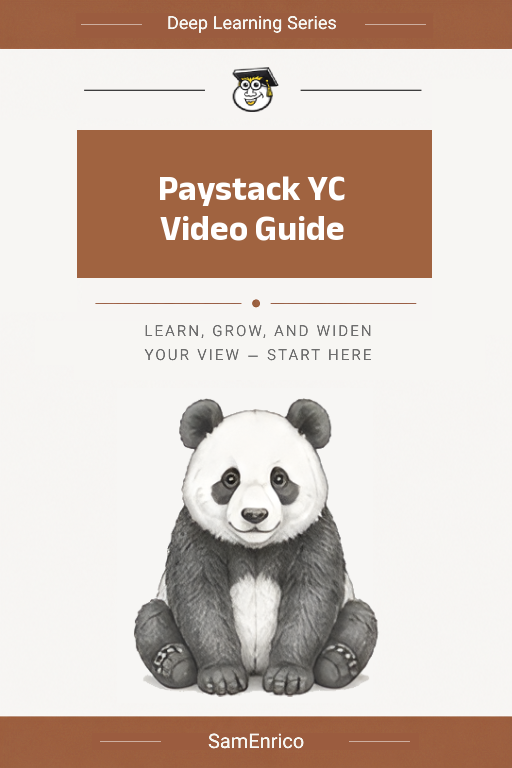
Paystack YC Video Guide eBook
Study Paystack's successful YC video to learn paci
Study Paystack's successful YC video to learn pacing, demo structure, and problem framing.
Formats
Free sample
Chapter 1: Quiet Competence--The video is two minutes and thirty-seven seconds long. It has been viewed millions of times. It features a founder who, at the time of recording, was processing exactly two hundred dollars in monthly transaction volume. By every conventional metric of startup success, this video should have been ignored. Instead, it secured the first Nigerian company’s entry into Y Combinator, led to a two hundred million dollar acquisition by Stripe, and fundamentally changed how investors think about pitching outside Silicon Valley.The question that haunts every founder who watches it is deceptively simple: How did he do it?The answer is not what you expect.
It is not a secret hack or a rhetorical trick. It is not about speaking faster, projecting louder, or using more aggressive body language. The answer is something far more radical and far more uncomfortable for founders who have been trained to believe that pitching is a performance. Paystack succeeded because Shola Akinlade broke every rule of what a Silicon Valley pitch was supposed to look like. He spoke slowly.
He focused on a market most investors did not understand. He spent more time explaining the problem than celebrating his solution. And when he revealed that he had processed only two hundred dollars the previous month, he did not flinch or make excuses. He simply let the number sit in the air, trusting that the context he had already built would make it impressive rather than embarrassing.This chapter is about why that worked. It is about the mythology of the perfect pitch, the three sacred cows that Paystack slaughtered without apology, and the concept that will anchor this entire book: quiet competence.Let us begin by understanding what Paystack was up against.The Myth of the Perfect Pitch Before Paystack, before the video went viral, before any founder outside the United States believed they had a realistic shot at Y Combinator, there was a dominant narrative about how to raise money.
This narrative was not written down in any single document, but it was taught in every accelerator, repeated in every blog post, and internalized by every founder who dreamed of standing on a Demo Day stage. The narrative said that a great pitch must do three things.First, it must project a massive total addressable market. Investors wanted to hear about billion dollar opportunities. They wanted to see slides showing exponential growth curves and hockey stick projections. If your market was too small or too unfamiliar, you were supposed to expand the definition until it sounded impressive.
A founder selling payment infrastructure in Nigeria should call themselves the Stripe for Africa not because that explained their market, but because it signaled ambition.Second, the pitch must use a simple, memorable analogy. The formula was almost comically predictable. Uber for X. Airbnb for Y. Stripe for Z.
Investors loved analogies because they reduced cognitive load. They could nod along without having to understand the specific mechanics of your business. The problem was that these analogies were almost always wrong. Uber for laundry ignored everything that made Uber work. Stripe for Nigeria ignored everything that made Nigeria different.
But founders kept using them anyway because the alternative was explaining something unfamiliar, and explaining takes time, and time is the one thing a pitch never has enough of.Third, the pitch must promise disruption. You were not supposed to say we are building a slightly better version of what already exists. You were supposed to say we are revolutionizing, transforming, fundamentally changing. The language of Silicon Valley was the language of revolution. Incremental improvement was for incumbents.
Startups were supposed to burn the boats and declare war.Paystack violated every single one of these rules.Instead of projecting a massive TAM, Paystack focused narrowly on Nigeria. Instead of a lazy analogy, they used a context bridge. Instead of promising disruption, they promised competence. And the result was not a weaker pitch. It was a stronger one.
Because what investors actually fear is not a small market or an unfamiliar problem. What investors actually fear is losing money on a founder who does not know what they are doing.Let me say that again because it is the most important sentence in this chapter. Investors do not fear small markets. Investors do not fear unfamiliar problems. Investors fear losing money on founders who cannot execute.
Every other concern regulatory risk, market timing, competitive pressure is downstream of that one question. Can this founder actually do what they say they can do?Paystack answered that question before anyone had to ask it.The Three Sacred Cows Let us examine each of Paystack violations in detail, because understanding why they worked reveals the hidden logic beneath the surface of successful pitching.The first sacred cow was the massive TAM. The standard advice was to project a billion dollar market or go home. But Paystack did the opposite. Their total addressable market was not Africa.
It was not even Nigeria. It was the specific slice of Nigerian e commerce that was currently unable to accept online payments. By conventional standards, this was a fatal mistake. Investors would see a small number and walk away.But here is what actually happened. When Paystack said we are focused on Nigeria, they signaled something far more valuable than a large number.
They signaled honesty. They signaled that they had done the work of actually understanding their market rather than inflating it to please investors. And crucially, they signaled that they were not delusional. A founder who projects a billion dollar TAM before they have processed two hundred dollars in revenue is either lying or naive. Either way, they are dangerous to invest in.
A founder who says we are starting here, in this specific place, with these specific customers signals that they understand how businesses actually grow.The second sacred cow was the lazy analogy. Standard pitch advice said to use a simple comparator. Stripe for Africa. Uber for Nigeria. The problem is that these analogies are almost always wrong.
Stripe worked in the United States because the banking infrastructure was already relatively standardized. Nigeria was the opposite. Banks had different APIs, different settlement timelines, different levels of reliability. A direct copy of Stripe would have failed. So Paystack did something smarter.
They used the analogy as a starting point, not an ending point. They said we are building the Stripe for Africa, and then they immediately explained why Africa needed something different. Seven day settlement times. Fragmented APIs. Weeks of integration work.
The analogy gave investors a mental scaffold. The context bridge filled in the details that actually mattered.This is the difference between a generic analogy and a context bridge. A generic analogy is a shortcut that avoids explanation. A context bridge is a tool that makes explanation easier. One signals laziness.
The other signals deep understanding.The third sacred cow was the disruption narrative. Standard pitch advice said to promise revolution. Paystack promised nothing of the sort. They did not say we will transform African commerce. They did not say we will bank the unbanked.
They said online payments are broken in Africa and we are fixing them. That is not a revolution. That is…
This is the end of the free sample. Get the eBook to keep going. Buy now
About this book
Details
- Author
- Cochrane Dede
- Publisher
- SamEnrico
- Language
- English
- Genre
- Non-Fiction, Startup Guide, Video Pitch, Demo Strategy
- Released
- 2026-05-29
- Pages (approx.)
- 146
- Available as
- eBook, Audiobook

Read better in the ZLOADR app
Your eBooks on your phone or tablet. Sign in with your SamEnrico account and start reading.
More by Cochrane Dede
 Senior Life Story GuideCochrane Dede$11.99
 The Femtech Capital ForecastCochrane Dede$11.99
 Paternity Leave RequestCochrane Dede$11.99
 Freudian Recurring Dream AnalysisCochrane Dede$11.99
 Loneliness Meditation GroupCochrane Dede$11.99
 Senior Anxiety HypnosisCochrane Dede$11.99
 Burnout Recovery for Graduate StudentsCochrane Dede$11.99
 Self Hypnosis ScriptbookCochrane Dede$11.99
 Antwerp Heist Prosecutor CaseCochrane Dede$11.99
 The Last Heist of the 'Gentleman Bandit'Cochrane Dede$11.99
 The Crown of Castile: Forge of a Global EmpireCochrane Dede$11.99
 Pinterest Ads Media BuyingCochrane Dede$11.99