
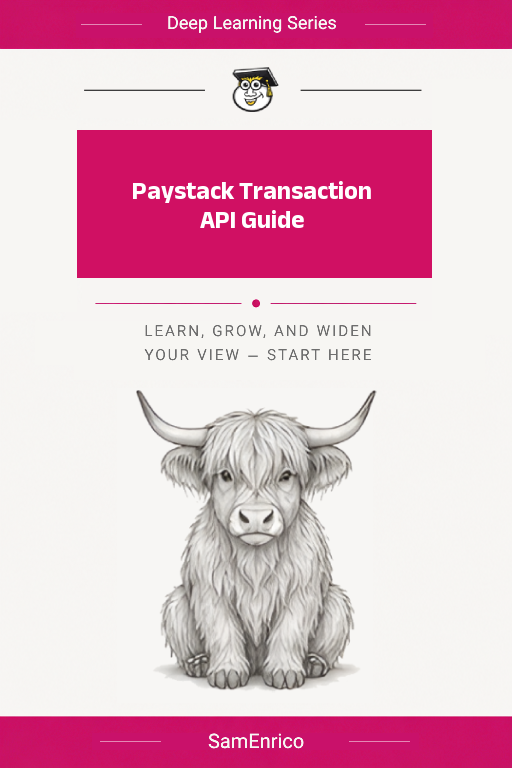
Paystack Transaction API Guide eBook
Implement Paystack charge API for one-time and rec
Implement Paystack charge API for one-time and recurring payments. Handle authorization and capture flows.
Formats
Free sample
Chapter 1: The Silent Killer--–- Every developer who integrates Paystack for the first time makes the same mistake. It is not about forgetting to verify a transaction, though that happens. It is not about using the wrong API key, though that is embarrassing. The mistake is far more subtle, far more dangerous, and it will cost you real money before you even realize something is wrong.The mistake is assuming that a successful payment notification means a successful payment.You read that correctly. Paystack can tell you "charge.success" and your database can mark an order as paid, and yet—days or weeks later—the money never actually settles in your bank account.
The transaction can fail after the "success" webhook. The bank can reverse the charge. The customer's card can be flagged for fraud post-authorization. And your system, if built naively, will have already shipped the product, granted access to the premium feature, or released the concert ticket.This chapter exists to prevent that nightmare. Before you write a single line of integration code, before you generate your first API key, you need to understand the landscape of African payments, the vocabulary that Paystack uses (with precise, consistent definitions that will hold for the entire book), and the core architectural patterns that separate production-ready integrations from hobby projects.By the end of this chapter, you will have a mental map of how Paystack fits into your application, a glossary of terms you will use every day, and a healthy skepticism for any payment notification that arrives without full verification.
You will understand why this book exists, why most online tutorials are dangerously incomplete, and how the next eleven chapters will transform you from a beginner who copies code from Stack Overflow into a Payment Architect who builds systems that never lose money.The African Payments Reality Before we talk about APIs, we need to talk about where Paystack operates. Paystack is not Stripe. Stripe was built for markets where nearly every adult has a credit card, where bank transfers clear within seconds, where fraud rates are low and dispute resolution is predictable. Paystack was built for Nigeria, Ghana, Kenya, South Africa, and other African markets where the payment landscape is fundamentally different.In Nigeria, for example, fewer than 5% of adults have an international credit card. The majority of online payments happen via bank transfers (where customers manually transfer money from their banking app to a virtual account number generated by Paystack), USSD codes (dialed from any feature phone), or mobile money wallets like M-Pesa in Kenya.
These payment methods behave nothing like credit cards. A bank transfer can take anywhere from five minutes to twenty-four hours to settle. A USSD payment can be initiated, interrupted by a dropped call, and completed hours later. A mobile money transaction might require the customer to enter a PIN on their phone, which means your webhook might arrive seconds after the customer hangs up—or never, if the network fails.This reality means that the traditional "initialize, redirect, verify, done" flow that works for Stripe is insufficient for Paystack. You need to handle pending transactions, asynchronous confirmations, and reconciliation jobs that run every few hours to catch transactions that never sent a webhook.
You need to understand that a charge.success webhook is not the final word; it is merely a strong indication that the transaction should be verified again via the API before you mark it as complete.This is the silent killer. Developers who learn Paystack by reading only the API documentation often implement exactly what the docs show: they initialize a transaction, the customer pays, Paystack sends a webhook, and they update their database. They ship to production. Everything works for weeks. Then one day, a customer's bank transfer fails three days after the webhook arrived, the money is reversed, but the customer already received their product.
The business loses. The developer is confused. The documentation never warned them.This book will warn you. Relentlessly.Core Vocabulary (Standardized for This Book)Throughout this book, every term will be used consistently. Do not skip this section.
The most common source of bugs in Paystack integrations is misunderstanding what these terms actually mean.Amount (Integer, Smallest Currency Unit)The amount parameter in every Paystack API request must be an integer representing the smallest currency unit of the currency you are using. For the Nigerian Naira (NGN), the smallest unit is kobo. 100 kobo equals ₦1. Therefore, to charge a customer ₦50.00, you pass amount: 5000. To charge GHS 10.00 in Ghana, you pass amount: 1000 (since the Ghanaian cedi also has 100 pesewas as the smallest unit).
For the South African Rand (ZAR), the smallest unit is 1 cent, so R150.00 becomes 15000. For Kenyan Shillings (KES), there is no subunit—1 shilling is the smallest unit—so KES 500 becomes 500.This is non-negotiable. Passing amount: "5000" as a string will work in some endpoints but fail in others. Passing amount: 50.00 (a float) will cause silent truncation or rounding errors. Always use an integer.
Always multiply your decimal currency value by 100 (or appropriate factor) before sending. The book will never show amounts as strings or floats in examples.Reference (Idempotency Key)The reference parameter is a unique string you generate for each transaction. Its primary purpose is idempotency: if you send the same reference twice, Paystack will return the same response and will not create a second transaction. This protects you from accidentally double-charging a customer if your code retries a failed request or if a user refreshes a payment page.References must be unique across your entire Paystack integration—not just per customer, not just per day, but forever. Reusing a reference even months later will cause the API to return a 422 Unprocessable Entity error with the message "Duplicate transaction reference." The safest pattern is to generate references using uuidv4() (in Node.js), bin2hex(random_bytes(16)) (in PHP), or secrets.token_urlsafe(16) (in Python).
Do not use timestamps or incrementing integers; they collide more often than you expect.This book will always generate references with cryptographically random strings. You should do the same.authorization_url (Customer Redirect)The authorization_url is returned by the POST /transaction/initialize endpoint. It is a one-time-use, short-lived URL that you redirect your customer to. On that page, they will select a payment method (card, bank transfer, USSD, mobile money), enter their credentials, and complete the payment. After payment, Paystack redirects them back to your callback_url (see below).
The authorization_url expires after a few hours and cannot be reused.callback_url (Your Return Endpoint)The callback_url is a server-side endpoint in your application that Paystack will redirect the customer to after they complete (or abandon) the payment. Paystack sends a GET request to this URL with two query parameters: trxref and reference. In nearly all cases, these two parameters contain the same value—your original transaction reference. The reason both exist is historical; trxref stands for "transaction reference" and reference is the modern parameter. You should validate both and treat them as identical.The callback_url is not where you should verify transactions.
It is for user experience only. A customer could close their browser before the redirect completes. A network error could prevent…
This is the end of the free sample. Get the eBook to keep going. Buy now
About this book
Details
- Author
- Larry Letitia
- Publisher
- SamEnrico
- Language
- English
- Genre
- Non-Fiction, First 30 Days, Payment Integration
- Released
- 2026-06-01
- Pages (approx.)
- 159
- Available as
- eBook, Audiobook

Read better in the ZLOADR app
Your eBooks on your phone or tablet. Sign in with your SamEnrico account and start reading.
More by Larry Letitia
 Patience AnchorLarry Letitia$11.99
 TM and Cosmic ConsciousnessLarry Letitia$11.99
 The Broken Record TechniqueLarry Letitia$11.99
 Crypto Market Investment GuideLarry Letitia$11.99
 The Empathy for Eating Disorders GuideLarry Letitia$11.99
 Laughing Without Borders: The Global Rise of Improv Comedy (1980-2000)Larry Letitia$11.99
 Smart Grid TechnicianLarry Letitia$11.99
 How to Become a Office-machine-service SupervisorLarry Letitia$11.99
 London Pop Up Staffing GuideLarry Letitia$12.99
 Understanding Periodic Limb Movement DisorderLarry Letitia$17.99
You may also like
 Stripe Webhook Configuration GuideMartindale Keva$12.99
 Stripe Subscription Billing GuideWorkman Emerald$12.99
 Stripe Payout Scheduling GuideArthur Sherita$12.99
 Stripe Payment Intent API GuideGavin Vada$12.99
 Stripe Dispute Management GuideJaynes Shakia$12.99
 Stripe Connect Platform GuideShoemaker Dennis$12.99
 Paystack Split Payments GuideHaskell Jefferey$12.99
 Paystack KYC Verification GuideMayberry Cori$12.99
 PayPal Withdrawal Methods GuidePacheco Farrah$12.99
 PayPal Seller Protection GuideBabin Elfrieda$12.99
 Payment Gateway Monitoring GuideDowney Queenie$12.99
 Payment Gateway Migration GuideShumate Stephany$12.99