
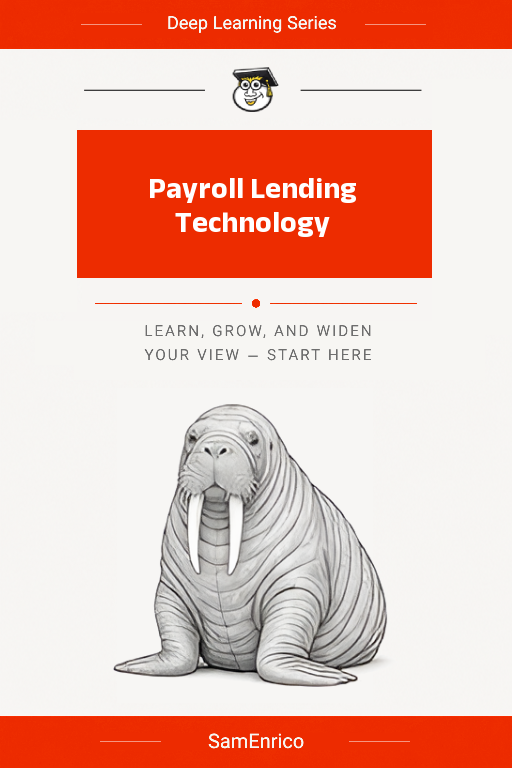
Non-FictionForecast & OutlookEWA
Payroll Lending Technology eBook
Learn how earned wage access platforms use time-tr
Learn how earned wage access platforms use time-tracking integration to advance worker pay before traditional payday.
Formats
Free sample
Chapter 1: The 14-Day Lie...–- Maria checked her bank account at 11:47 PM. The screen glowed blue in her dark kitchen. 4.22remained.Rentwasduetomorrow.Hernextpaycheckwasninedaysaway.Shehadworkedsixty−twohoursinthepasttwoweeksattheretailwarehouse—sheknewthisbecauseshehadloggedeveryshiftinasmallnotebookshekeptinherapron.Thosehoursrepresented4.22 remained. Rent was due tomorrow. Her next paycheck was nine days away.
She had worked sixty-two hours in the past two weeks at the retail warehouse—she knew this because she had logged every shift in a small notebook she kept in her apron. Those hours represented 4.22remained.Rentwasduetomorrow.Hernextpaycheckwasninedaysaway.Shehadworkedsixty−twohoursinthepasttwoweeksattheretailwarehouse—sheknewthisbecauseshehadloggedeveryshiftinasmallnotebookshekeptinherapron.Thosehoursrepresented1,085 before taxes, roughly $890 after. But none of that money was accessible. It sat, in a very real sense, nowhere—trapped in an employer’s accounting system, waiting for a calendar date rather than reflecting the reality of her labor.Maria is not a fictional character built for a case study. She is a composite of hundreds of thousands of American workers—the cashier, the warehouse picker, the home health aide, the restaurant server—who live inside a paradox that the payroll industry has normalized for over a century.
The paradox is simple: they have already earned their wages, but they cannot touch them. The system that holds those wages hostage is not a law of economics, not a requirement of banking, and not a protection against fraud. It is a relic. A habit. A piece of industrial-era machinery that survived the mainframe, the personal computer, the internet, and the smartphone, all while doing exactly what it was designed to do in 1885: batch paper timecards into paper paychecks every fourteen days.This book argues that the fourteen-day payroll cycle is the single greatest unexamined friction point in modern employment.
And Earned Wage Access (EWA)—specifically the integration layer between time-tracking systems and payroll engines—is the tool that finally dismantles it.The 70% Reality Let us begin with the number that should keep every CEO awake at night. According to the Federal Reserve’s 2023 Survey of Household Economics and Decisionmaking, 70 percent of U.S. households live paycheck to paycheck. That is not a poverty statistic. That number includes families earning six figures who have stretched their obligations to the exact length of the payroll cycle.
It includes single mothers, college graduates, and gig workers. It includes people who have done everything they were told—budgeted, saved, avoided credit card debt—and still find themselves with $4.22 on a Tuesday night because the plumbing broke, the car needed tires, or the child needed antibiotics.What happens next is predictable and tragic. The worker has two options. Option one: borrow from a payday lender at an annual percentage rate that routinely exceeds 400 percent. Option two: ask the employer for a manual payroll advance, which requires a conversation with a manager, a signed piece of paper, and a check-cutting process that takes three to five business days.
Both options are failures. The payday lender traps the worker in a cycle of debt. The manual advance punishes the worker with shame and delay while burdening the employer with administrative friction.But there is a third option that has emerged in the past decade, enabled by APIs, cloud payroll systems, and a regulatory framework that is slowly catching up. That option is Earned Wage Access. And the central argument of this book is that EWA is not a financial product—it is an integration problem.
The companies that succeed in this space are not the ones with the best marketing or the lowest fees. They are the ones that have solved the technical challenge of connecting time clocks to payroll systems in real time.The Industrial Relic To understand why the fourteen-day cycle persists, we must travel back to an era when payroll was a physical manufacturing process. In the late nineteenth century, a large factory employed hundreds or thousands of workers. Each worker kept a paper timecard that they inserted into a mechanical time clock—a device that stamped the arrival and departure time onto the card. At the end of the week or two-week period, a payroll clerk collected hundreds of these cards, manually calculated hours (adjusting for overtime, differentials, and breaks), looked up wage rates from a paper ledger, computed deductions using published tax tables, and wrote a physical check for each employee.
The entire process took days. The fourteen-day cycle was not a choice; it was a biological and logistical necessity. Humans could not process payroll faster than that without making catastrophic errors.Then came the mainframe in the 1960s. Payroll moved to batch processing—still a fourteen-day cycle, but now computed by machines rather than clerks. Then came the PC in the 1980s, with software like Quick Books automating the calculations further.
Then came the cloud in the 2000s, with systems like Workday and ADP enabling real-time access from anywhere. The technology improved by orders of magnitude. The payroll cycle did not change.Why? Because the cycle had become a social contract rather than a technical constraint. Employers believed—and many still believe—that paying employees every two weeks simplifies cash flow management, reduces administrative overhead, and gives employees a predictable schedule for bill payment.
There is some truth to this. But the belief has hardened into dogma. Ask a payroll manager why the company pays every two weeks rather than every week or every day, and the answer will almost certainly invoke tradition rather than analysis. "That's how we've always done it" is the most expensive sentence in business.The False Binary: Credit vs. Access Before we go further, we must establish a conceptual distinction that runs through every chapter of this book.
The distinction is between credit and access. Credit is the extension of money that the borrower does not yet own, based on a promise of future repayment. A payday loan is credit. A credit card cash advance is credit. A traditional bank loan is credit.
Credit requires underwriting, interest, and risk pricing. Credit can be denied. Credit can default.Access is different. Access is the withdrawal of money that the worker has already earned but not yet received. When Maria works eight hours at 15perhour,shehasearned15 per hour, she has earned 15perhour,shehasearned120.
That 120existsasanaccountingentryonheremployer′sbalancesheet.Itisanaccruedliability.Theemployerowes Maria120 exists as an accounting entry on her employer's balance sheet. It is an accrued liability. The employer owes Maria 120existsasanaccountingentryonheremployer′sbalancesheet.Itisanaccruedliability.Theemployerowes Maria120. The fact that the employer will pay that 120onafuturedate—daytenofthefourteen−daycycle—isanarbitrarychoice,notafinancialreality.Accesssimplymovesthat120 on a future date—day ten of the fourteen-day cycle—is an arbitrary choice, not a financial reality. Access simply moves that 120onafuturedate—daytenofthefourteen−daycycle—isanarbitrarychoice,notafinancialreality.Accesssimplymovesthat120 from the employer's liability account to Maria's bank account earlier than the arbitrary date.This distinction matters enormously for three reasons.
First, access carries no interest because there is no loan. The worker is not borrowing; they are reclaiming. Second, access requires no credit check because the funds are already earned. The only risk is operational—did the worker actually clock those hours, and will they complete the remaining shifts in the cycle? Third, access is fundamentally an integration problem rather than a lending problem.
The technology that enables access is not a loan origination system. It is a real-time ledger that bridges time clocks, payroll systems, and bank rails.The Integration Thesis Here…
This is the end of the free sample. Get the eBook to keep going. Buy now
About this book
Details
- Author
- Stackhouse Carrol
- Publisher
- SamEnrico
- Language
- English
- Genre
- Non-Fiction, Forecast & Outlook, EWA
- Released
- 2026-05-30
- Pages (approx.)
- 147
- Available as
- eBook, Audiobook

Read better in the ZLOADR app
Your eBooks on your phone or tablet. Sign in with your SamEnrico account and start reading.
More by Stackhouse Carrol
 Breath As Anchor MeditationStackhouse Carrol$11.99
 Morning Stretch Flexibility PlanStackhouse Carrol$11.99
 Twelve Step After Relapse GuideStackhouse Carrol$11.99
 Franchise Builder's Pricing PowerStackhouse Carrol$11.99
 The Vanishing of the Lost Colony: Roanoke's Last WhisperStackhouse Carrol$11.99
 The Berlin Spy Swap: Cold War's Most Audacious GambitStackhouse Carrol$11.99
 Understanding HypersomnolenceStackhouse Carrol$17.99
 DAO Operations ManualStackhouse Carrol$12.99
 Deal SpecialistStackhouse Carrol$11.99
 How to Start a Casting of Ferrous Metal Business (Beginners Guide)Stackhouse Carrol$11.99
You may also like
 Hong Kong Handover 1997Dunn Johnnie$11.99
 Zumba For Postnatal Recovery CourseNeal Christian$11.99
 Zumba for BeginnersLadner Nikia$11.99
 YouTube Comment Mining GuideHumes Pandora$12.99
 Worry Box MeditationCarlin Rudy$11.99
 Workplace Stress MeditationNguyen Lynn$11.99
 Workplace Stress and Sleep RepairHawley Ivory$11.99
 Workplace Perfectionism CureDelaney Jeffry$11.99
 Workplace Injustice Anger GuideWallen Isabelle$11.99
 Work Addiction and Burnout LinkGreenwood Ester$11.99
 Women in Yoga and WellnessBeattie Galina$11.99
 Women in Stand Up ComedyChun Evangeline$11.99