
Non-FictionInformativeEducational
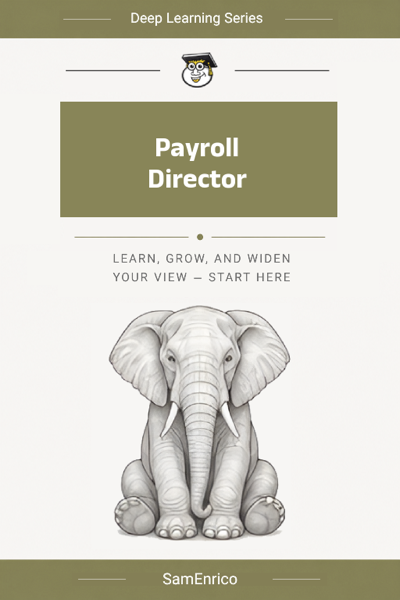
Payroll Director eBook
A Coursebook on Payroll Director
A Coursebook on Payroll Director
Formats
Free sample
Chapter 1: The $600 Million Typo--– The voicemail came in at 6:47 PM on a Tuesday. The Payroll Director, a 25-year veteran, listened twice before setting down her phone. A decimal point had been misplaced in a bonus file for 3,200 sales representatives. Instead of paying 1,500perperson,thesystempaid1,500 per person, the system paid 1,500perperson,thesystempaid15,000. The overpayment: 43million.Bythetimetheerrorwascaught,fivehourslater,the ACHfileshadalreadybeensenttothe Federal Reserve.Themoneywasgone.Thecompanyannouncedtheerrortoinvestorsthenextmorning.Stockpricedropped1143 million.
By the time the error was caught, five hours later, the ACH files had already been sent to the Federal Reserve. The money was gone. The company announced the error to investors the next morning. Stock price dropped 11%. Market capitalization lost: 43million.Bythetimetheerrorwascaught,fivehourslater,the ACHfileshadalreadybeensenttothe Federal Reserve.Themoneywasgone.Thecompanyannouncedtheerrortoinvestorsthenextmorning.Stockpricedropped11600 million.
The Payroll Director was terminated within 72 hours. The CEO testified before Congress. And a routine payroll cycle became a case study in what happens when organizations treat payroll as a back-office function rather than the strategic nerve center it has become.This is not a cautionary tale from the 1990s. It happened in 2022.The payroll function has undergone a radical transformation over the past decade, yet most executives—and even many payroll professionals—have not updated their mental models of what the role entails. The old model treated the Payroll Director as a calculator: someone who ensured numbers added up, taxes were withheld, and employees were paid on time.
That role still exists, but it is now the baseline, not the aspiration. The modern Payroll Director is a strategist, a data scientist, a compliance architect, and a key advisor to the C-suite. Those who fail to make this transition—or work for organizations that refuse to recognize it—will find themselves holding the bag when, not if, the next six-figure error occurs.This chapter establishes the foundational argument of this book: payroll data is strategic business intelligence, not administrative noise. The Payroll Director who understands this and acts on it becomes indispensable. The one who does not becomes a commodity, easily outsourced and easily replaced.
We will explore the evolution of the role, introduce the frameworks that separate strategic directors from tactical managers, and provide a roadmap for claiming your seat at the executive table.The Great Relegation: Why Payroll Became Invisible To understand where the Payroll Director role must go, we must first understand how it got stuck where it has been. In most organizations, payroll sits under the Controller or the Head of HR—a subordinate function within a support function. This structural relegation sends a clear message: payroll is important enough to require oversight but not important enough to lead.The historical reasons for this relegation are understandable. Payroll processing is repetitive, deadline-driven, and highly regulated. It requires meticulous attention to detail and tolerance for what feels like clerical work.
For decades, the primary qualifications for a Payroll Director were accuracy, reliability, and the ability to work under pressure. These are not strategic attributes; they are operational ones.But the world of work has changed around the payroll function in three fundamental ways.First, the composition of employee compensation has grown vastly more complex. Fifty years ago, an employee received a base salary and perhaps a year-end bonus. Today, that same employee might receive base salary, commission, overtime, shift differentials, stock options, restricted stock units, performance-based equity grants, signing bonuses, retention bonuses, referral bonuses, wellness reimbursements, tuition assistance, and a dozen other taxable and non-taxable benefits. Each of these elements has different tax treatment, different withholding rules, and different reporting requirements.
The Payroll Director who cannot model the interaction of these elements is not just operationally weak—they are a compliance risk.Second, the regulatory environment has fragmented. In 1980, a Payroll Director needed to master federal law and perhaps a single state's tax code. Today, a company with remote employees in 15 states must comply with 15 different withholding regimes, 15 different unemployment tax systems, 15 different paid leave laws, and dozens of local ordinances governing sick leave, predictive scheduling, and wage transparency. California alone has changed its overtime rules, exempt salary thresholds, and paid leave requirements eight times since 2015. A director who cannot track this fragmentation cannot protect the organization from penalties that now routinely reach seven figures.Third, and most importantly, workforce data has become a strategic asset.
Every payroll run produces a rich dataset: who earns what, when they earn it, how their compensation has changed over time, how their hours fluctuate seasonally, and how their departure patterns correlate with pay events. Organizations that ignore this data are flying blind. Organizations that analyze it gain predictive insight into turnover risk, overtime liability, compensation equity, and labor cost forecasting.The Payroll Director sits on top of this data. No one else in the organization has a cleaner, more complete view of actual labor costs. The question is not whether the data is valuable.
The question is whether the Director will claim the role of interpreter or remain a passive transmitter of numbers to the finance team.The Three-Legged Stool of Compensation: A Strategic Framework To move from calculator to strategist, the Payroll Director must understand the three competing forces that shape every compensation decision. This book introduces and will consistently refer to the Compensation Trinity: three legs that must be balanced for any pay strategy to succeed.Leg One: Internal Equity Internal equity means that employees doing similar work for the same organization are paid fairly relative to one another. It does not mean everyone is paid the same—experience, performance, and tenure still matter—but it does mean that pay differences are explained by legitimate, documentable factors rather than bias, favoritism, or administrative accident.Payroll Directors are uniquely positioned to assess internal equity because they have access to the full distribution of pay by role, department, and demographic category. A strategic director runs regular equity analyses, looking for patterns that suggest bias. For example, if women in a particular job family earn 92 cents for every dollar earned by men with similar tenure and performance ratings, that is a red flag.
If employees hired in the last two years earn significantly more than longer-tenured employees in the same role, that is a compression issue that will drive turnover.The key insight for Directors: internal equity is not an HR problem that payroll helps with. It is a payroll problem that HR helps with. The data lives in your systems. The analysis should be run by your team. The recommendations should come from you, with HR providing policy and legal review.Leg Two: External Competitiveness External competitiveness means that pay levels are aligned with the market for similar roles at comparable companies.
If you pay below market, you will struggle to attract talent. If you pay significantly above market, you will struggle to control costs.Most organizations rely on compensation surveys and consulting reports to assess external competitiveness. These are valuable inputs, but they are lagging indicators. By the time a survey is published, the market may have moved. Payroll data can provide a leading indicator: when you see voluntary turnover spiking in a particular role or department, and exit interviews consistently cite pay as a factor, you have real-time evidence that your external competitiveness has eroded.The strategic Director partners with HR to map pay…
This is the end of the free sample. Get the eBook to keep going. Buy now
About this book
Details
- Author
- Matheny Bettie
- Publisher
- SamEnrico
- Language
- English
- Genre
- Non-Fiction, Informative, Educational
- Released
- 2026-05-11
- Pages (approx.)
- 160
- Available as
- eBook, Audiobook

Read better in the ZLOADR app
Your eBooks on your phone or tablet. Sign in with your SamEnrico account and start reading.
More by Matheny Bettie
 The Mute Button TherapyMatheny Bettie$11.99
 WFH Plant BenefitsMatheny Bettie$11.99
 Financial Stress Bankruptcy RecoveryMatheny Bettie$11.99
 The Indonesia Vendor GuideMatheny Bettie$11.99
 The Phantom Trucker: Europe's Highway Killer of the 1980sMatheny Bettie$11.99
 Board Reporting for First Time DirectorsMatheny Bettie$12.99
 Learn to Play the Viola D'amoreMatheny Bettie$11.99
 How to Start a Bismuth Business (Beginners Guide)Matheny Bettie$11.99
You may also like
 Hong Kong Handover 1997Dunn Johnnie$11.99
 Zumba For Postnatal Recovery CourseNeal Christian$11.99
 Zumba for BeginnersLadner Nikia$11.99
 YouTube Comment Mining GuideHumes Pandora$12.99
 Worry Box MeditationCarlin Rudy$11.99
 Workplace Stress MeditationNguyen Lynn$11.99
 Workplace Stress and Sleep RepairHawley Ivory$11.99
 Workplace Perfectionism CureDelaney Jeffry$11.99
 Workplace Injustice Anger GuideWallen Isabelle$11.99
 Work Addiction and Burnout LinkGreenwood Ester$11.99
 Women in Yoga and WellnessBeattie Galina$11.99
 Women in Stand Up ComedyChun Evangeline$11.99