
Non-FictionBusiness BriefWorkplace Giving
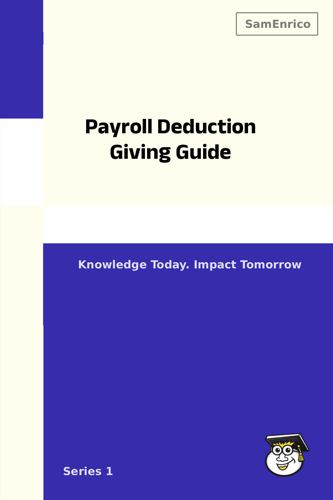
Payroll Deduction Giving Guide eBook
Set up automatic charitable deductions from payche
Set up automatic charitable deductions from paychecks for easy tax documentation.
Formats
Free sample
Chapter 1: The Invisible Leak--–- Every January, millions of Americans make a quiet promise to themselves. They promise to give more. To be more generous. To finally write that check to the food bank, the animal shelter, or the scholarship fund that changed their own life a decade ago. They feel the weight of that intention sitting somewhere between a New Year's resolution and a genuine moral urge.
And then something remarkable happens. Nothing. Absolutely nothing.By February, the intention has been buried under dental appointments, car repairs, and the relentless machinery of daily life. By June, the charity's fundraising letters go straight from the mailbox to the recycling bin, each unopened envelope a small monument to guilt. By December, as the tax year closes, the average well-intentioned American has donated less than half of what they told themselves they would.
This is not a failure of character. It is a failure of design.The problem is not that people are selfish. Decades of behavioral economics research have demonstrated conclusively that most humans want to be prosocial. They want to help. They want to leave the world better than they found it.
The problem is that generosity requires action, and action requires friction to be overcome. Writing a check means finding a pen, locating an envelope, buying a stamp, remembering to mail it, and then remembering to log the donation for tax purposes. Donating online means pulling out a credit card, navigating a charity's donation portal, typing in sixteen digits, and then doing the same thing thirty days later when the next paycheck arrives. Each step is a tiny speed bump. And speed bumps, repeated dozens of times a year, eventually bring the car to a complete stop.This book exists because there is a solution hiding in plain sight.
It sits inside every paycheck you receive, buried in the payroll system that already handles your health insurance, your 401(k), and your Social Security withholding. It requires no willpower, no monthly decision-making, and no frantic scramble in December to meet your giving goals. It is called payroll deduction giving, and it is the most underutilized financial tool in American philanthropy.But before we dive into mechanics, before we talk about tax forms and HR conversations and the precise language of IRS acknowledgment letters, we need to understand the enemy. The enemy is not the tax code, although the tax code is certainly complicated. The enemy is not your employer, although your employer may not make this easy.
The enemy is a behavioral phenomenon called the intention-action gap, and it steals more charitable dollars every year than any fraud, inefficiency, or scandal in the nonprofit sector.The $47 Billion Gap Let us put a number on the problem. According to aggregated data from philanthropic research organizations including the Lilly Family School of Philanthropy and the Stanford Center on Philanthropy and Civil Society, Americans intend to give approximately 50 percent more to charity each year than they actually do. In 2023, total charitable giving in the United States was about $500 billion. That means the gap between what people wanted to give and what they actually gave was roughly $47 billion.Forty-seven billion dollars. That is enough money to fully fund the annual operating budgets of every public library in America for three years.
It is enough to provide clean drinking water to every person on the planet who currently lacks it. It is enough to end homelessness in the United States twice over. And it disappears every single year into a黑洞 of good intentions and bad systems.Where does that money go? Not to greed. Not to apathy.
It goes to what psychologists call "decision fatigue." Every time you choose to donate, you must make a series of micro-decisions: How much? To whom? By what method? Should I wait until next month when I have more cash flow? Will I remember to get a receipt?
Is this even tax-deductible? Each micro-decision consumes a tiny fraction of your cognitive bandwidth. And because your cognitive bandwidth is finite, each additional charity you support multiplies the friction. The result is that most people donate to one or two causes irregularly, intending to do more, but never quite getting there.Consider a typical professional named Sarah. Sarah is a marketing director at a mid-sized tech company.
She earns $120,000 per year. She believes strongly in three causes: her local public radio station, a youth literacy nonprofit where she once volunteered, and an environmental advocacy group. In January, she tells herself she will give $1,000 total, split roughly evenly. By December, she has given $150 to the radio station during its pledge drive (the result of a guilt-inducing phone call), $50 to the literacy group (a one-off Facebook fundraiser she saw from a friend), and nothing to the environmental group. She feels vaguely ashamed.
She resolves to do better next year. The cycle repeats.Sarah is not lazy or selfish. Sarah is human. And the system failed her.The Psychology of Automatic Giving Now meet Michael. Michael is also a marketing director at a mid-sized tech company.
He earns the same salary and supports the same three causes. But Michael has done something Sarah has not. He has automated his giving. Ten dollars from every biweekly paycheck goes to each of his three chosen charities. That is $30 per paycheck, $780 per year, slightly less than his stated goal of $1,000 but significantly more than Sarah's $200.
Michael never thinks about giving. He never receives a fundraising phone call that interrupts his dinner. He never feels guilt in December. His donations simply happen, silently and reliably, every two weeks.The difference between Sarah and Michael is not character. It is what behavioral economists call the "pain of paying." When you make a manual donation, you experience an immediate, visceral sensation of loss.
Your brain's insula, the region associated with physical pain, actually activates when you part with your money. This is an ancient evolutionary adaptation designed to prevent you from giving away resources necessary for survival. It served your ancestors well on the savanna. It serves you poorly when you are trying to support your local food bank.Automatic deductions bypass the pain of paying entirely because the decision and the transaction are separated in time. You make one decision—usually sitting at a kitchen table or office desk, in a calm and thoughtful state—to authorize a recurring deduction.
Then, weeks or months later, when the money actually leaves your account, you are not making a choice. You are simply experiencing a consequence of a previous choice. The insula does not fire. The pain does not register. And because there is no pain, there is no reason to stop.This is the same psychological mechanism that makes automatic 401(k) contributions so effective.
Employees who have to opt into retirement saving manually do so at rates of 30 to 40 percent. Employees who are automatically enrolled and have to opt out do so at rates of 80 to 90 percent. The default is everything. The absence of friction is everything. Payroll deduction giving applies this same principle to charity.
You are not deciding to give every two weeks. You already decided. Now you are just letting the machine run.Why Inertia Is Your Greatest…
This is the end of the free sample. Get the eBook to keep going. Buy now
About this book
Details
- Author
- Faulkner Deandra
- Publisher
- SamEnrico
- Language
- English
- Genre
- Non-Fiction, Business Brief, Workplace Giving
- Released
- 2026-06-06
- Pages (approx.)
- 139
- Available as
- eBook, Audiobook

Read better in the ZLOADR app
Your eBooks on your phone or tablet. Sign in with your SamEnrico account and start reading.
More by Faulkner Deandra
 Anger De escalation for Social WorkersFaulkner Deandra$11.99
 Gambling in SeniorsFaulkner Deandra$11.99
 Baby Boomer vs Gen Z HobbiesFaulkner Deandra$11.99
 Alphabet Peg System WorkbookFaulkner Deandra$11.99
 Fear of Failure Breakthrough GuideFaulkner Deandra$11.99
 Quit Smoking for DiabetesFaulkner Deandra$11.99
 Biotin Hair Skin GuideFaulkner Deandra$11.99
 Gilgamesh and the Lost Tablet of UrukFaulkner Deandra$11.99
 The Vanishing Heiress: The Hunt for the Missing Duchess of WindsorFaulkner Deandra$11.99
 How to Produce Sorting and Stacking ToysFaulkner Deandra$11.99
 A Collector's Handbook to the Cord 812Faulkner Deandra$11.99
 Ransomware Mac and Linux GuideFaulkner Deandra$12.99
You may also like
 Hong Kong Handover 1997Dunn Johnnie$11.99
 Zumba For Postnatal Recovery CourseNeal Christian$11.99
 Zumba for BeginnersLadner Nikia$11.99
 YouTube Comment Mining GuideHumes Pandora$12.99
 Worry Box MeditationCarlin Rudy$11.99
 Workplace Stress MeditationNguyen Lynn$11.99
 Workplace Stress and Sleep RepairHawley Ivory$11.99
 Workplace Perfectionism CureDelaney Jeffry$11.99
 Workplace Injustice Anger GuideWallen Isabelle$11.99
 Work Addiction and Burnout LinkGreenwood Ester$11.99
 Women in Yoga and WellnessBeattie Galina$11.99
 Women in Stand Up ComedyChun Evangeline$11.99