
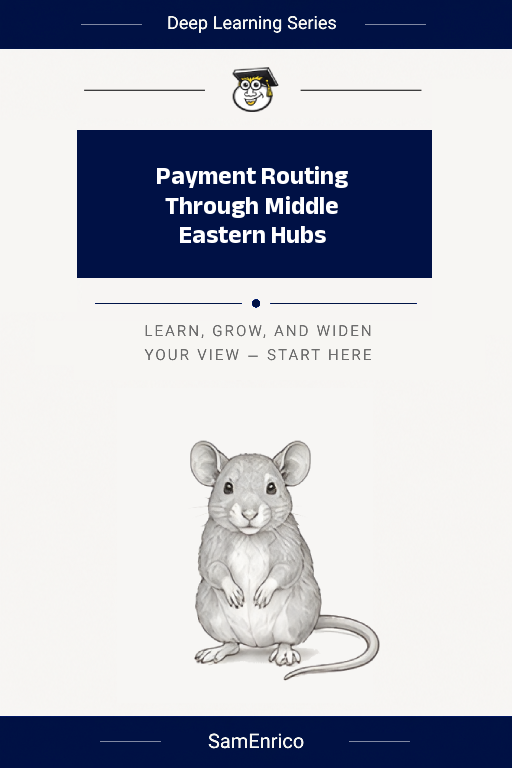
Non-FictionHub RoutingMiddle East Finance
Payment Routing Through Middle Eastern Hubs
Channel cross-border payments via Dubai and Bahrai
Channel cross-border payments via Dubai and Bahrain financial centers that offer better USD access and faster settlement for African exporters to global buyers.
Formats
About this book
Free sample
Chapter 1: The Great De-Risking Heist--–- The letter arrived on a Tuesday, tucked between a fertilizer invoice and a notice about port fees. Grace Muthoni almost missed it. Three pages of dense legalese from her bank in Nairobi, informing her that their correspondent banking relationship with a European intermediary had been terminated. Effective immediately. Any future payments from her German buyer would need to find a new route.
The bank offered no alternative. It simply stated, in paragraph fourteen, that this was "a routine de-risking exercise in compliance with international regulatory standards."Grace folded the letter and placed it next to her coffee scale. She had seventeen tons of AA-grade beans sitting in a warehouse in Mombasa, already sold to a roaster in Hamburg, payment due in fourteen days. The beans had been harvested by hand, sorted three times, and cupped at 88 points. They were worth $47,000.
And now, through no fault of her own, the financial system had decided she was too risky to serve.She was not alone.The Myth of Risk The term "de-risking" entered the financial lexicon around 2012, but its roots lie deeper. In the aftermath of the 2008 financial crisis, Western regulators—particularly in the United States and the European Union—unleashed a tidal wave of new rules. The US Patriot Act, already on the books since 2001, was enforced with new vigor. The EU's Anti-Money Laundering Directives multiplied in complexity. The Foreign Account Tax Compliance Act (FATCA) demanded that foreign banks report American account holders or face severe penalties.Each regulation made sense in isolation.
Money laundering is a crime. Terrorist financing is a crime. Tax evasion is a crime. But together, they created an impossible compliance burden for banks serving smaller, higher-risk markets. The cost of monitoring a correspondent relationship with a bank in Kenya, Nigeria, or Ghana began to exceed the revenue that relationship generated.
So Western banks did what any profit-seeking institution would do: they terminated the relationships.Between 2011 and 2021, the number of active correspondent banking relationships with African banks fell by over 22 percent, according to data from the Financial Stability Board.…
This is the end of the free sample. Get the eBook to keep going. Buy now
Contents
- Chapter 1
- Chapter 2
- Chapter 3
- Chapter 4
- Chapter 5
- Chapter 6
- Chapter 7
- Chapter 8
- Chapter 9
- Chapter 10
- Chapter 11
- Chapter 12
Details
- Author
- Woodcock Cecil
- Publisher
- SamEnrico
- Language
- English
- Genre
- Non-Fiction, Hub Routing, Middle East Finance
- Released
- 2026-05-30
- Pages (approx.)
- 147
- Available as
- eBook, Audiobook

Read better in the ZLOADR app
Your eBooks on your phone or tablet. Sign in with your SamEnrico account and start reading.
More by Woodcock Cecil
 Breast Health For Deaf WomenWoodcock Cecil$11.99
 Angry Driving Thought StoppingWoodcock Cecil$11.99
 Group Creativity for DesignersWoodcock Cecil$11.99
 Postpartum Gratitude PracticeWoodcock Cecil$11.99
 Influence Techniques for AccountantsWoodcock Cecil$11.99
 The Growth Mindset WorkbookWoodcock Cecil$11.99
 Rainbow After Storm VisualizationWoodcock Cecil$11.99
 Self Employed Income LossWoodcock Cecil$11.99
 Desert Mercy: The Unsung Heroes of the North African CampaignWoodcock Cecil$11.99
 The Phantom of La Scala: The Opera Scandal That Shocked the WorldWoodcock Cecil$11.99
 How to Produce Paintball and Airsoft EquipmentWoodcock Cecil$11.99
 A Collector's Handbook to the Triumph Spitfire 2000 Mk IWoodcock Cecil$11.99
You may also like
 Hong Kong Handover 1997Dunn Johnnie$11.99
 Zumba For Postnatal Recovery CourseNeal Christian$11.99
 Zumba for BeginnersLadner Nikia$11.99
 YouTube Comment Mining GuideHumes Pandora$12.99
 Worry Box MeditationCarlin Rudy$11.99
 Workplace Stress MeditationNguyen Lynn$11.99
 Workplace Stress and Sleep RepairHawley Ivory$11.99
 Workplace Perfectionism CureDelaney Jeffry$11.99
 Workplace Injustice Anger GuideWallen Isabelle$11.99
 Work Addiction and Burnout LinkGreenwood Ester$11.99
 Women in Yoga and WellnessBeattie Galina$11.99
 Women in Stand Up ComedyChun Evangeline$11.99